
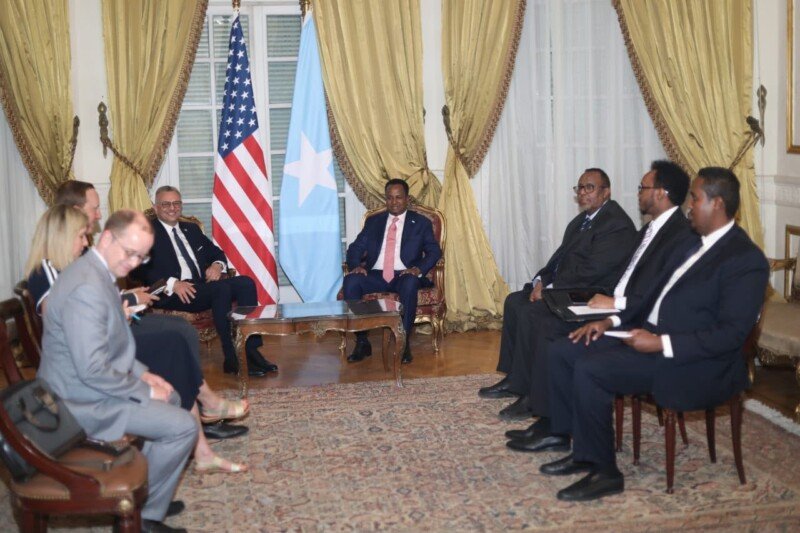
CAIRO – Somalia’s Foreign Minister Abdisalam Abdi Ali has held talks in Cairo with Massad Boulos, Senior Adviser to U.S. President Donald Trump on Arab and African Affairs, in a meeting that underscored the deepening but increasingly fraught security partnership between Mogadishu and Washington.
The discussions, which took place on Sunday, focused on strengthening bilateral relations, reaffirming support for Somalia’s sovereignty, unity and territorial integrity, and reviewing ways to deepen cooperation on counterterrorism and security. The two sides also exchanged views on regional developments, including security in the Horn of Africa and the Red Sea, as well as the role of the United Nations Support Office in Somalia (UNSOS) in supporting Somalia’s security priorities.
A Meeting Shadowed by U.S. Funding Cuts
The talks come at a critical juncture in U.S.-Somalia relations. Just weeks before the Cairo meeting, the Trump administration notified the African Union that it would no longer support UNSOS beyond the end of 2026. The decision, confirmed in a July 1 diplomatic note, effectively ends Washington’s financial contributions to the agency that allocates operating funds for the 12,000 troops in the AUSSOM mission.
The United States has provided nearly $2 billion in assessed contributions to UNSOS and its predecessor, according to a State Department spokesperson. Despite this investment, the Trump administration has grown increasingly frustrated with what it views as insufficient progress by Somali political leaders in assuming responsibility for their own security.
The timing of the Cairo meeting suggests that Somalia is scrambling to mitigate the impact of the impending funding cut. AUSSOM, which officially replaced the African Union Transition Mission in Somalia (ATMIS) in January 2025, is designed to operate with a reduced force focused on training, advising and institutional capacity building. Without UNSOS logistical support, the mission’s sustainability is in serious doubt.
A Balancing Act
The meeting also comes amid a broader realignment of U.S. foreign policy toward the Horn of Africa. A U.S. Congressional report released in June reaffirmed Somalia’s sovereignty and territorial integrity while simultaneously outlining deeper security and trade engagement with Somaliland. The Trump administration has also been actively engaging with Somaliland, with President Abdirahman Mohamed Abdullahi meeting Eric Trump and Israeli President Isaac Herzog at the World Economic Forum in Davos.
This dual-track approach has raised concerns in Mogadishu about Washington’s long-term commitment to Somalia’s unity. While the Cairo meeting reaffirmed U.S. support for Somalia’s sovereignty and territorial integrity, the administration’s simultaneous engagement with Somaliland and its decision to cut funding for UNSOS suggest a more transactional approach to the region.
The View from Mogadishu
For Somalia, the stakes could not be higher. The country is in the midst of a military campaign against Al-Shabaab, which continues to control large areas of southern and central Somalia. The group has repeatedly demonstrated its ability to exploit political divisions and weak state institutions. The loss of UNSOS support would not only undermine the AUSSOM mission but could also create a security vacuum that Al-Shabaab is well-positioned to exploit.
The Somali government has sought to present the Cairo meeting as a reaffirmation of the U.S.-Somalia partnership. According to the Foreign Ministry, the two sides discussed opportunities to expand economic cooperation and investment. But the timing of the meeting—coming just weeks after Washington’s decision to cut UNSOS funding—suggests that Mogadishu is engaged in damage control rather than partnership-building.
Way Forward
The Cairo meeting between Foreign Minister Abdisalam Abdi Ali and Senior Adviser Massad Boulos highlights the complex and increasingly transactional nature of the U.S.-Somalia relationship. While both sides reaffirmed their commitment to security cooperation and Somalia’s territorial integrity, the Trump administration’s decision to cut UNSOS funding casts a long shadow over the partnership.
For Somalia, the challenge is clear: it must find a way to fill the gap left by Washington’s withdrawal while continuing to demonstrate progress on security and governance. For the United States, the decision to cut funding reflects a broader shift toward a more transactional foreign policy, one that prioritises short-term results over long-term institution-building. Whether this approach will serve the interests of either country remains to be seen.
Recommended Reading On ftlsomalia.com
- U.S. Congressional Report Reaffirms Somalia’s Sovereignty While Outlining Deeper Security and Trade Engagement with Somaliland
- Somalia and UK Strengthen Strategic Defence Ties Through High-Level Engagement
- Somalia Commends UK’s Role in Developing its Security Sector
- Somali Authorities Detain Soldiers After Viral Video Shows U.S. Flag Desecration
- Trump Again Labels Somalia as Failed State
- Somali Defense Minister Rebukes Trump Over Offensive Remarks