
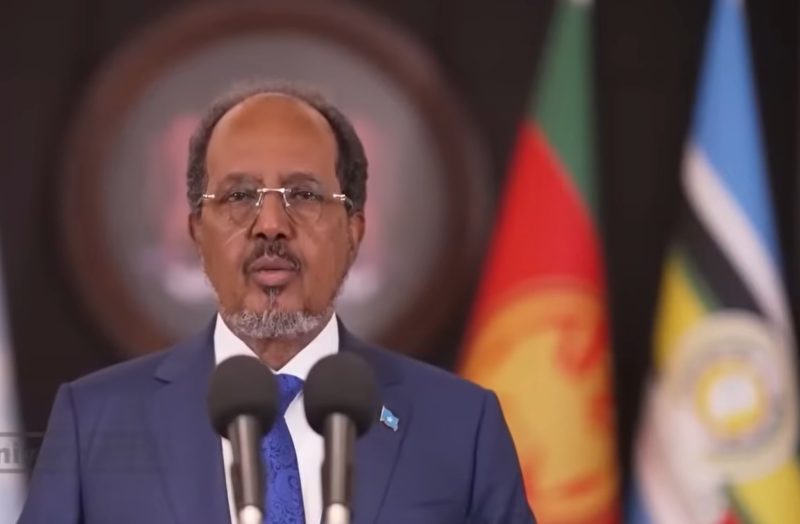
MOGADISHU – President Hassan Sheikh Mohamud has said the Federal Government is seeking to broaden its relationship with the United States beyond the traditional focus on security cooperation, calling for expanded partnership in trade, investment, technology, infrastructure, and the blue economy.
Speaking at a ceremony marking the 250th anniversary of U.S. independence, held at the U.S. Embassy in Mogadishu on Thursday, the President said that while security cooperation remains vital, the bilateral agenda should now encompass a wider range of economic and developmental priorities.
“Security cooperation is still important, as we continue the fight against Al-Shabaab and ISIS, and strengthen the capacity of national security institutions,” Mohamud said. “But the agenda we share with the United States is broader than security alone.”
The United States has recently signalled a shift from a “foreign aid model” to an “investment and growth model”, with Washington’s 2025 National Security Strategy emphasising maritime trade routes, energy exploration, and infrastructure projects over prolonged military involvement and aid dependency. For Somalia, this represents a potential pivot from emergency assistance toward a more durable economic partnership.
Security Cooperation Remains a Pillar
The President’s remarks come at a sensitive moment in U.S.-Somalia relations. While Washington remains one of Somalia’s largest security partners, the Trump administration has temporarily suspended multiple assistance initiatives following allegations of corruption within Somali institutions and has demanded that international aid demonstrate a clear benefit to U.S. interests.
U.S. Senator Jim Risch has warned that ongoing instability in Somalia presents direct security threats to the United States, demanding enhanced oversight of U.S. assistance to prevent waste, fraud, and exploitation by malicious actors. In response, Somali officials have emphasised that the United States remains a crucial ally.
The United States has significantly ramped up its aerial campaign in Somalia, with nearly 50 airstrikes conducted in the first quarter of 2026 alone, marking a notable escalation in counter-terrorism efforts within the Horn of Africa.
Economic Potential and Investment Opportunities
President Mohamud argued that Somalia offers significant opportunities for U.S. trade and investment, citing the country’s 3,300-kilometre coastline, abundant marine resources, agricultural land, livestock, and a market in need of major infrastructure development.
He said the government is pursuing legal and institutional reforms to strengthen the administrative framework and create a conducive environment for business and investment. These reforms, he added, are intended to position Somalia as a competitive destination capable of attracting investors and leveraging its international partnerships.
The Federal Government has officially proposed renewing a long-standing bilateral agreement that would allow the U.S. military to utilise its national ports and airports. State Minister for Foreign Affairs Ali Mohamed Omar Balcad stated that the proposal revives a historic cooperation framework originally established in 1980, and that Somalia’s position is clear: all agreements involving Somalia’s territory, ports, airspace, or strategic natural resources must be negotiated through the constitutional institutions of the Federal Republic.
High-level talks between Somalia’s Foreign Minister and the U.S. Chargé d’Affaires have focused on enhancing bilateral security collaboration, advancing political dialogue, and ensuring robust diplomatic alignment between Mogadishu and Washington.
U.S. Policy Shift and Congressional Scrutiny
President Mohamud thanked the United States for its long-standing support for Somalia, particularly in the areas of state-building, economic development, institutional reform, and the pursuit of lasting peace and stability. He also congratulated the U.S. government and people on the 250th anniversary of their independence.
President Mohamud has previously held conversations with U.S. Senior Advisor for Africa, Massad Boulos, to discuss strengthening cooperation and advancing shared goals for peace, stability, and governance in Somalia, with Boulos reaffirming the United States’ commitment to Somalia’s progress.
A recent U.S. Congressional report reaffirmed Washington’s official recognition of Somalia’s sovereignty and territorial integrity, while simultaneously outlining multiple avenues for enhanced security, diplomatic, and commercial cooperation with Somaliland, exposing the delicate balancing act at the heart of American policy in the Horn of Africa.
Way Forward
The President’s call for a broader partnership reflects Mogadishu’s desire to diversify its engagement with Washington and move beyond a relationship defined primarily by counter-terrorism. As the United States recalibrates its approach to the Horn of Africa, focusing on economic investment and strategic partnerships, Somalia’s ability to demonstrate progress in governance, transparency, and economic reform will be critical to realising this expanded vision. The success of this effort may determine whether the U.S.-Somalia relationship evolves into a more balanced and sustainable partnership in the years ahead.
Recommended Reading On ftlsomalia.com:
- US Prioritises Investment Over Traditional Aid in Somalia
- Somalia Offers US Access to Military Bases and Critical Minerals
- U.S. Escalates Airstrikes Against Militant Groups in Somalia
- Somalia Foreign Minister Meets with U.S. Envoy
- Somali President and U.S. Advisor Discuss Deeper Cooperation
- U.S. Congressional Report Reaffirms Somalia’s Sovereignty While Outlining Deeper Security and Trade Engagement with Somaliland