
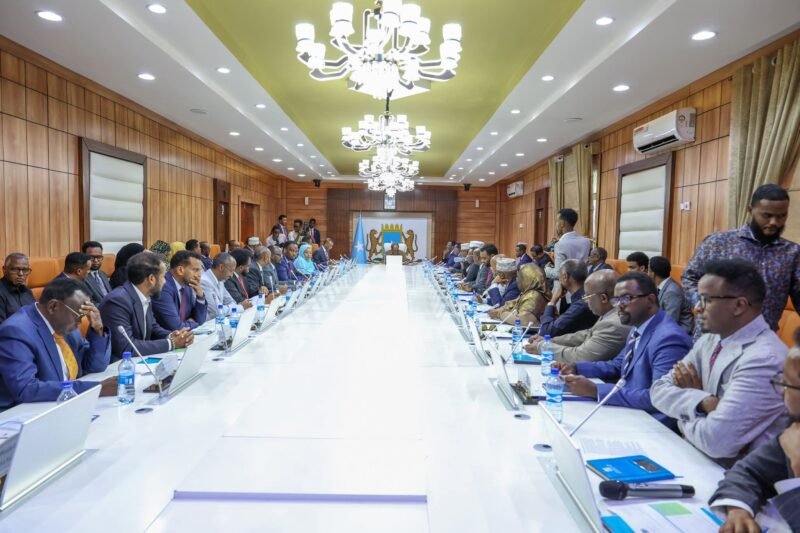
MOGADISHU — The Council of Ministers of the Federal Government of Somalia convened for its weekly meeting on Thursday, chaired by Prime Minister Hamza Abdi Barre, receiving comprehensive briefings on the country’s security situation, military operations, and financial performance.
The Cabinet received a security briefing highlighting positive developments in stabilizing the country, including recent gains made by the Somali National Armed Forces in their ongoing operations against Khawaarij militants. The briefing noted that government forces have made significant progress in areas of active conflict and dealt a serious blow to militant groups.
Prime Minister Hamza Abdi Barre emphasized the importance of ensuring that Somali citizens achieve economic self-sufficiency, benefit from domestic production and resources, increase domestic revenue collection, encourage investment, strengthen economic transparency and accountability, and maximize capital resources.
The meeting also reviewed the Fiscal Year 2025 annual financial report, which was presented by the Ministry of Finance. The report detailed Somalia’s economic performance, including a GDP growth rate of 3.1%. The Ministry also outlined progress in domestic revenue collection and financial restructuring.
Economic Progress and Financial Reforms
The Cabinet’s discussions on financial reforms come amid broader efforts to strengthen Somalia’s fiscal institutions. The Auditor General’s Office has flagged financial gaps in revenue systems and government oversight, with the most recent audit for Fiscal Year 2025 issuing an “unqualified opinion” while identifying significant weaknesses in revenue management, procurement, information systems, and compliance across public institutions.
The Auditor General has pressed Turkish firms managing Mogadishu’s port and airport for greater financial transparency, demanding that Favori LLC and Albayrak-Somalia submit independently audited financial statements as required by their concession agreements. The government has faced ongoing challenges in verifying revenue from these critical infrastructure assets, with the Auditor General unable to confirm approximately $32.2 million in reported concession fees for 2024.
The Office of the Auditor General also conducted compliance audits of 22 federal government institutions with combined budgets of approximately $822 million, representing 60.1% of the federal government’s overall budget. The review identified 66 instances of non-compliance or weaknesses across various ministries.
Security Operations and Military Gains
The Cabinet’s security briefing follows a pattern of intensified military operations against Al-Shabaab militants. The National Intelligence and Security Agency (NISA) has conducted intelligence-driven operations across central Somalia, with preemptive strikes destroying militant strongholds and thwarting several imminent attacks. The operations specifically targeted armed Kharijite elements gathering in the Hiiraan and Middle Shabelle regions, which have long been identified as vital logistical pathways for insurgents.
Security sources have confirmed that these coordinated operations have successfully disrupted militant networks, with NISA forces eliminating key commanders and dismantling operational bases. The government has maintained that tactical actions will continue until the remaining Khawaarij elements are fully neutralized and national security is restored.
Critical Note
The Cabinet’s discussion of security and financial reforms reflects ongoing efforts to strengthen governance and stabilize the country. However, the gap between reported progress and tangible outcomes remains significant. The GDP growth rate of 3.1%, while positive, remains modest and is unlikely to meaningfully improve living conditions for ordinary Somalis without more substantial economic transformation.
The Auditor General’s findings of 66 instances of non-compliance across 22 institutions, combined with the inability to verify $32.2 million in concession fees, point to persistent governance weaknesses that undermine public trust. Despite the government’s emphasis on transparency and accountability, the lack of independently audited financial statements from key infrastructure operators raises concerns about whether the government is receiving its rightful share of revenues from Somalia’s most important assets.
The government’s stated goal of achieving economic self-sufficiency is commendable, but it remains far from realization. Domestic revenue collection, while improving, still falls short of covering operational expenditures. Without sustained commitment to institutional reforms and genuine accountability, the gap between rhetoric and reality in Somalia’s financial governance is likely to persist.