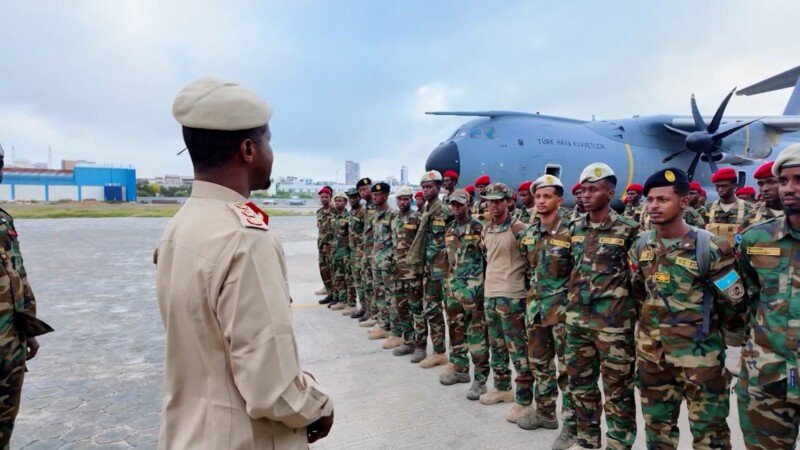


GAROWE – Leaked military and logistics documents reviewed by Garowe Online allege that Somali President Hassan Sheikh Mohamud, whose four-year term ended last month, is urging allied political groups from Puntland to provoke armed clashes in major cities as part of an operation aimed at creating political confusion.
According to the documents reviewed by local media, which detail troop registrations, official appointments, and strategic logistics, the plan seeks to divert global scrutiny from mounting internal pressure while portraying the president as a leader confronting broader regional instability.
Sources close to the presidency say its key political challenges stretch from Jubbaland to Puntland. The leaked documents show that the proxy groups have been split into four operational divisions.
Puntland President Said Abdullahi Deni has previously accused President Mohamud of creating armed pirate groups, dismantling the country’s federal system, and destabilising regional administrations across Somalia, describing the federal government’s actions as a “political and legal hijacking” of the country’s agreed constitutional framework.
Divisions Within Puntland’s Political Class
The plan has, however, split Puntland politicians aligned with the federal government into three factions. The first faction, made up of lawmakers with poor re-election prospects and former politicians, pushes to move the conflict into their own areas, rallying local supporters for coordinated attacks.
The second faction, led by several senior officials, outright rejects the president’s instructions, arguing the need to safeguard their long-term political prospects before the 2029 election cycle, reigniting old grievances from the 2019 and 2024 Puntland polls.
A third new wing from the Bari region, closely linked to business interests aligned with the president, expresses deep reluctance, claiming its initial mobilisation was compromised and abandoned without federal backing.
President Deni has instructed regional forces to maintain heightened readiness and prepare for potential military action by the federal government, warning against a repeat of the scenario that led to the ousting of South West State leader Abdiasis Laftagareen.
Puntland Accuses Federal Government of Destabilisation
As internal splits deepen, the allies who first agreed to carry out the destabilising plan now face intense anxiety. Traditional elders in Puntland have already warned these politicians against carrying out externally driven agendas that threaten regional stability.
Puntland Vice President Ilyas Osman Lugatoor has previously accused Villa Somalia of utilising substantial resources to destabilise the region, stating that “Hassan Sheikh Mohamud, who has roughly one hundred and ten days remaining in his term, is engaged in destructive activities.” The vice president declared that the state’s security focus would shift toward “defence” against political interference.
Constitutional Crisis and Federal-State Tensions
Puntland has stated that it does not recognise Hassan Sheikh as a legitimate president, maintaining that his term concluded on May 15, 2026, and that federal institutions have lost their constitutional legitimacy. The regional administration has called for an urgent national consultative conference to establish an inclusive electoral process.
Puntland has also formally rejected the federal government’s decision to cancel agreements with the UAE, accusing President Mohamud of using the diplomatic row to distract from domestic political failures and actively working to divide and incite conflict.
Way Forward
The leaked documents and the reported divisions within Puntland’s political class highlight the deepening rift between Garowe and Mogadishu. As the federal government insists that President Mohamud remains in office until May 2027 under constitutional amendments passed by parliament in March 2026, Puntland and the opposition Somali Future Council have warned that they will move to establish a parallel government if no political consensus on elections is reached – a step that could further fracture Somalia’s fragile federal system.
Recommended Reading On ftlsomalia.com:
- Puntland’s President Deni Accuses Hassan Sheikh Over Piracy and Federalism
- Puntland Accuses Federal Government of Destabilization Efforts
- Puntland Leader Orders Forces on Alert Over Federal Intervention Fears
- Puntland Accuses Hassan Sheikh of Remaining in Office Illegally
- Puntland Rejects Federal Decision to Cancel UAE Pacts, Vows to Maintain Bosaso Port Deal