
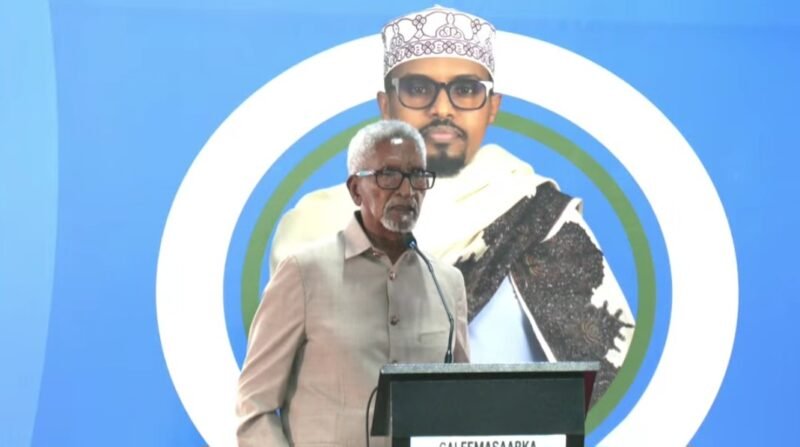
MOGADISHU — The Speaker of Somalia’s Upper House of parliament has accused the country’s government institutions of systemic lawlessness, ending a months-long political absence as the nation approaches a critical electoral deadline .
Senator Abdi Hashi Abdullahi, a veteran influential figure in Somali politics, stated that his return to public life followed a period of recovery from health-related issues. His return comes amid a growing standoff between federal leaders and opposition groups over constitutional changes and the election framework .
“The government must enforce the law, but we ourselves are the government, and yet we do not follow the law,” Abdullahi stated, directing broad criticism at state organs for failing to adhere to the country’s legal statutes .
A History of Challenging Executive Authority
The speaker’s return is likely to further complicate an already fractured political landscape. Abdullahi has a history of challenging executive authority; in 2021, he played a key role in blocking an attempt by the previous administration to extend its term during a similar electoral impasse .
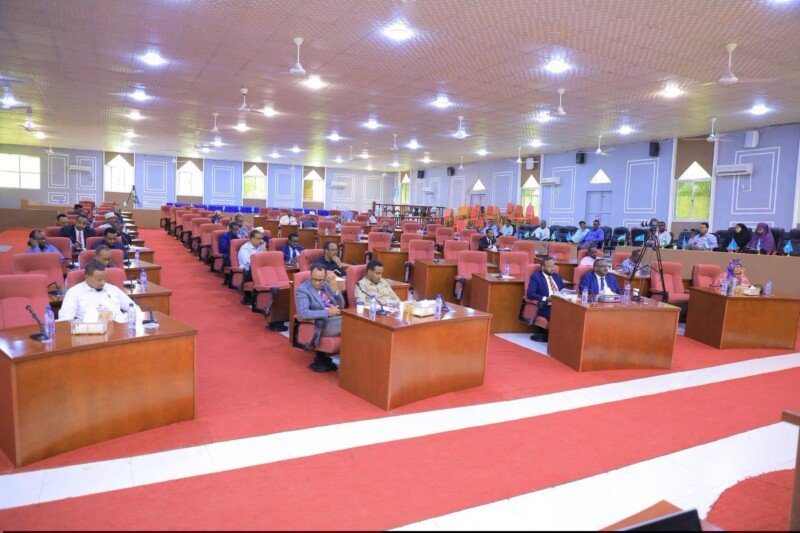
In January 2026, Abdullahi notably boycotted a crucial joint session of the Federal Parliament that was scheduled to debate amendments to Chapters 5 and 9 of Somalia’s Provisional Constitution — an issue that has sparked significant controversy . The session ultimately descended into chaos, with opposition lawmakers disrupting the meeting and physical confrontations breaking out in the parliamentary chamber .
Speaker’s International Engagements and Parliamentary Leadership
Senator Abdi Hashi Abdullahi has been actively engaged in strengthening Somalia’s parliamentary diplomacy on the international stage. In June 2025, the Senate Speaker arrived in Moscow following an official invitation from the Chair of Russia’s Federation Council, marking a significant step in strengthening diplomatic relations between Somalia and Russia as both nations sought to enhance cooperation in political, economic, and strategic sectors.
During his visit, Speaker Hashi delivered a keynote address as the guest of honor at the 591st plenary session of the Federation Council of the Federal Assembly of the Russian Federation, where he highlighted the importance of strengthening parliamentary diplomacy and expanding cooperation between Somalia and Russia, emphasizing shared interests in regional stability, economic development, and mutual respect for sovereignty.
In December 2025, Somalia’s Senate established a partnership agreement with the Global Council for Tolerance and Peace (GCTP), obtaining complete membership in the worldwide organization. Upper House Speaker Abdi Hashi Abdullahi welcomed a delegation headed by GCTP President Ahmed bin Mohamed Al-Jarwan in the capital city, with both parties examining the function of legislative bodies in promoting tolerance, communication, and peace.
In November 2025, members of the Upper House of Parliament passed the long-awaited Bill on Internally Displaced Persons (IDPs), spearheaded by the Ministry of Interior, Federal Affairs, and Reconciliation. The landmark legislation marked a pivotal step toward establishing a clear legal framework for the protection, rights, and dignity of millions uprooted by conflict and climate shocks.
Constitutional Crisis Deepens
Somalia is currently facing a volatile political vacuum as the presidential term approaches its conclusion on May 15 . Controversy has focused on a series of federal constitutional amendments that critics claim lack broad consensus and threaten the country’s fragile federal system .
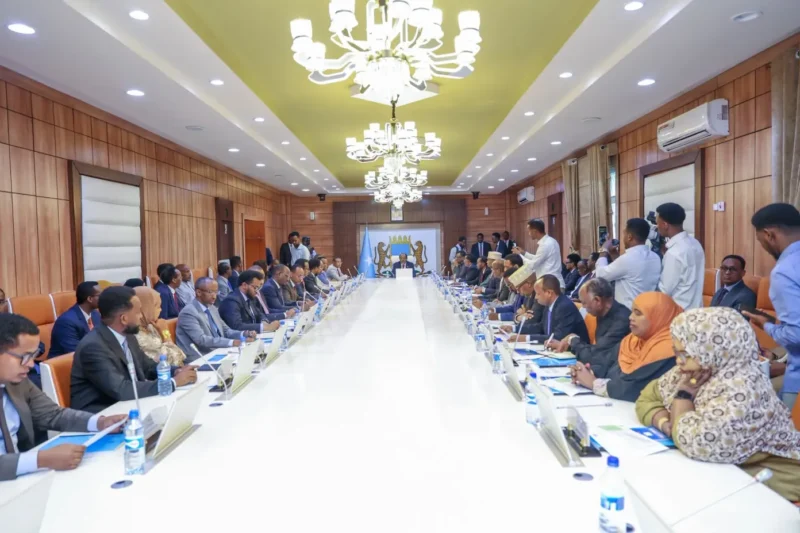
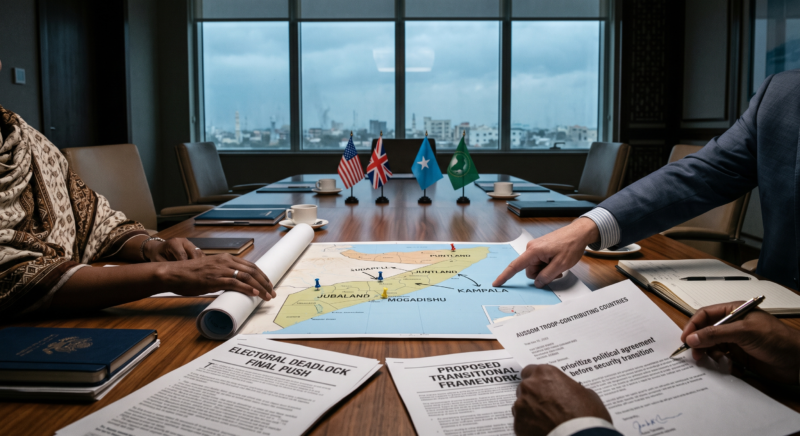
Members of Somalia’s bicameral parliament successfully finalized discussions on the ninth chapter of the provisional constitution during the 21st joint meeting of the seventh parliamentary session, with the legislative proceedings jointly overseen by the First Deputy Speaker of the Upper House, Ali Shacban Ibrahim. Just days prior, however, high-level electoral negotiations between the Federal Government and the opposition Somali Future Council had deadlocked, with the core of that dispute directly involving these ongoing constitutional revisions .
In early March 2026, Somalia’s Federal Parliament officially approved comprehensive amendments to the National Constitution, marking a historic and highly polarized milestone that formally ended the country’s 14-year provisional era. President Hassan Sheikh Mohamud praised the bicameral legislature for their majority vote, declaring the development a long-awaited national achievement.
However, the Somali Future Council — a prominent opposition bloc uniting Puntland, Jubaland, and other key political figures — strongly condemned the vote. The council alleged the measure failed to secure the constitutionally required two-thirds majority from the bicameral legislature and accused the federal government of utilizing intimidation and coercion. The bloc declared it will continue to recognize only the 2012 Provisional Constitution .
The Somali Future Council has warned that if both parliamentary and presidential terms lapse without elections or a political agreement, they would move ahead with organizing their own polls and establish a parallel federal administration. A consultative conference in Kismayo held in December 2025 issued a communiqué explicitly rejecting any extensions of constitutional mandates .
Regional Opposition and Political Fallout
The constitutional overhaul has been one of the most divisive political issues in recent weeks. Jubaland and Puntland have publicly rejected the constitutional process and outcomes, arguing that the amendments were adopted without broad consultation, consensus, or adherence to constitutional procedures . Critics argue that such unilateral action risks undermining national unity, federalism, and inclusive civic participation .
In February 2026, the Jubbaland administration released Federal Senator and prominent opposition figure Ilyas Bedel Gaboose following nearly 16 months of detention in the port city of Kismayo. Officials characterized the release as a strategic move to ease political tensions and advance regional reconciliation ahead of critical national processes. President Madobe stressed that peace and stability must supersede political competition, stating that his administration is prepared to make “significant concessions” to ensure enduring stability .
Ex-President Farmajo Warns of Leadership Vacuum
Former President Mohamed Abdullahi Farmaajo has declared that the constitutional mandate of the Federal Parliament officially expired on April 14, 2026, warning that Somalia has entered a period of “rising political uncertainty”. Farmaajo argued that legislative activities can only resume after new elections are held, challenging the recent one-year term extension announced by the leadership of the House of the People.
“A month before the end of his term, outgoing President Hassan Sheikh Mohamud must urgently present a credible plan for the upcoming elections. Failing to do so will destabilize the country in ways that will have lasting political, social, security, and economic implications,” Farmaajo said .
Outlook
The federal government has not yet issued a formal response to the speaker’s remarks .
In a separate development, senior Somali government officials led by Interior Minister Ali Yusuf Ali Hosh convened with international diplomats stationed in Mogadishu to provide updates on national progress and ongoing state-building initiatives, just weeks after the expiry of Somalia’s federal parliament term without a formal agreement on the electoral framework .
Abdullahi’s return to political life signals that the Upper House will play an active and potentially confrontational role in the weeks leading up to the May 15 deadline. With the presidential term approaching its conclusion and no agreed electoral framework in place, Somalia faces a narrowing window to avoid a constitutional and political vacuum that could have profound implications for the country’s fragile federal system and long-term stability .