
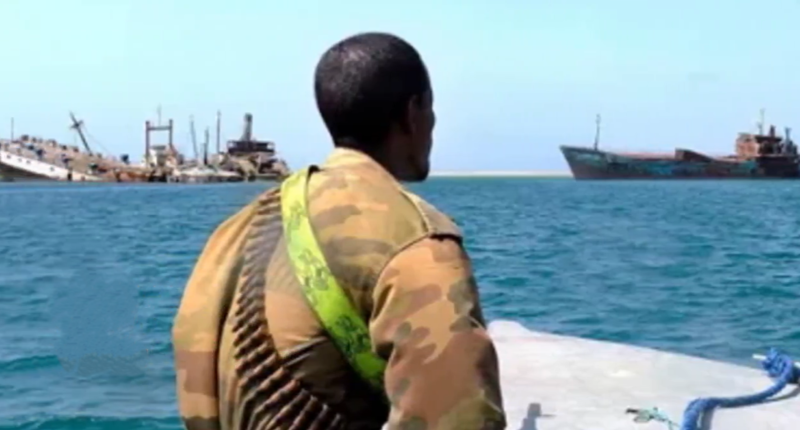
MOGADISHU — The International Maritime Organization (IMO) has issued an urgent warning about a significant resurgence of Somali piracy in the Gulf of Aden, where six merchant ships and more than 90 seafarers are now being held captive .
IMO Secretary-General Arsenio Dominguez issued the warning following the August 20 hijacking of the tanker Seamull, also known as Sibu 1, the second vessel seized by suspected Somali pirates in a matter of days. “With the most recent hijack, a sixth vessel is being held by pirates and armed robbers in waters that are becoming too dangerous for seafarers,” Dominguez said. “More than 90 innocent seafarers are now being held captive, their lives subject to constant uncertainty and threat,” he added, calling for their immediate and unconditional release.
The Joint Maritime Information Center (JMIC) confirmed that six merchant vessels remain in captivity in the region: Honour 25, Sward, Eureka, Asana, Lutuf and Seamull. Two of those seizures have occurred in the past week.
The general cargo ship Lutuf was hijacked on August 17 after eight armed attackers boarded the vessel about four nautical miles south of Mareeyo on Somalia’s Puntland coast. Three days later, six armed men boarded Seamull roughly 136 nautical miles east of Al Mukalla, Yemen, while the tanker was sailing west through the Gulf of Aden. The attackers took control and diverted the vessel toward Somalia.
The 32,200-dwt tanker had been operating under the name Sibu 1 and reportedly broadcast “PIRATE ONBOARD HELP” over AIS before changing course. It is now anchored off Somalia’s east coast, according to JMIC. Seamull was sanctioned by the U.S. Treasury Department in December 2025 as part of a broader crackdown on Iran’s sanctions-evading tanker fleet. Treasury said the vessel had transported Iranian petroleum products on multiple occasions and had also called at Houthi-controlled ports in Yemen.
The two August hijackings follow a string of successful seizures earlier this year. Honour 25 and Sward have been held since April, while Eureka was taken in May and Asana in July.
The resurgence adds yet another security problem for ships operating across the Middle East and western Indian Ocean, where crews are already contending with Houthi attacks in the Red Sea and Gulf of Aden and the continuing disruption surrounding the Strait of Hormuz.
Dominguez warned that piracy risks being overlooked as governments and naval forces focus on other conflicts affecting shipping in the region. “While international focus has been drawn to other areas of heightened tension, we cannot allow the resurgence of piracy in the Gulf of Aden and surrounding waters to go unaddressed,” he said.
He urged flag and coastal states to ensure ships are prepared for the threat and called for continued use of industry best management practices and IMO security guidance. Dominguez also called for renewed international naval cooperation, pointing to the coordinated effort that helped bring the previous Somali piracy crisis under control. “The international community has successfully confronted this threat before, and it must do so again,” he said.
JMIC currently rates the threat in the Gulf of Aden as “substantial,” reflecting both piracy and the continuing threat from Houthi attacks. The Somali coast and Somali Basin remain at a “moderate” threat level. “Pirate Action Groups continue to demonstrate the ability to board and divert merchant vessels in both coastal Somali waters and the Gulf of Aden under current monsoon conditions,” JMIC said.
A Humanitarian Crisis for Seafarers
Dominguez described the dire conditions faced by the captives, noting that they often have limited access to adequate food, fresh water, medical support and other essential services. “Behind each of them is a family enduring an unimaginable ordeal, with limited reliable information about their loved ones’ well-being,” he said.
At its peak from 2008-2011, Somali piracy was a scourge on the shipping industry which sparked co-ordinated international military and regulatory responses. Hundreds of attacks on vessels led to hundreds of successful hijackings, often leading to crews being held for ransom in appalling conditions ashore. Almost 1,200 seafarers were taken hostage in 2010 alone.
Dominguez reminded the industry of some of the tools developed during the era of heightened piracy, calling on flag and coastal States to ensure ships flying their flag are adequately prepared to manage security risks and that crews are not exposed to avoidable dangers. This includes the implementation of industry best management practices and relevant IMO guidance.
Critical Note
The IMO’s warning signals a troubling return to the piracy crisis that once made the waters off Somalia among the most dangerous in the world. The seizure of six vessels in four months, including two in just the past week, demonstrates that pirate networks have reconstituted themselves and are operating with renewed confidence. The fact that pirates continue to hold more than 90 seafarers, with limited access to food, water and medical care, is a humanitarian crisis that demands urgent international attention.
The international community’s response has been reactive rather than preventive. The redeployment of naval assets to the Red Sea has created a security vacuum that pirates are exploiting. The absence of a coordinated international response risks allowing piracy to re-establish itself as a profitable criminal enterprise, with potentially devastating consequences for maritime trade and regional stability.
The Somali government and international partners must address the root causes of piracy, including the lack of economic opportunities in coastal communities, illegal fishing, and the absence of effective governance. Without a comprehensive approach that combines security, economic development and governance, the cycle of piracy is likely to continue.