
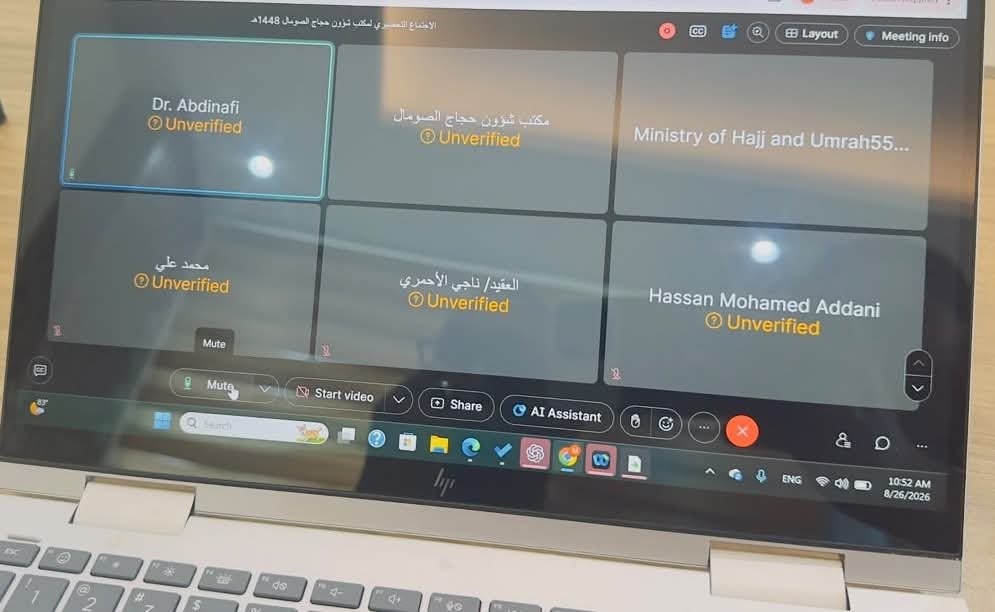
JEDDAH — The Director General of Somalia’s Ministry of Endowments and Islamic Affairs, Dr. Abdinnafaq Ahmed Abdalla, has participated in the preparatory meeting for the Hajj 1448H pilgrimage season, hosted by Saudi Arabia’s Ministry of Hajj and Umrah.
The meeting focused on planning and early preparations for the upcoming pilgrimage, including work plans, operational schedules for Hajj affairs offices, communication and coordination systems, health requirements for pilgrims, and the preparation of essential services for the Hajj season.
For Somalia, the meeting served as an opportunity to present the needs and priorities related to services for Somali pilgrims, particularly the expansion of the national Hajj quota and the strengthening of health preparedness for Somali citizens who travel each year to perform the pilgrimage.
Dr. Abdinnafaq expressed hope that the Somali Hajj quota would be increased to meet the needs of Somali citizens wishing to fulfill their religious obligation. “We hope that the quota for Somali pilgrims will be increased to cover the needs of the Somali people who wish to perform the Hajj,” he said.
Somalia secured an allocation of 11,500 slots for Somali pilgrims for the 2026 Hajj season, with the agreement signed in November 2025 by Minister of Endowments and Religious Affairs, Sheikh Mukhtar Robow Ali, and Saudi Arabia’s Minister of Hajj and Umrah, Dr. Tawfiq bin Fawzan Al-Rabiah. Somalia was also recognized among the top-performing countries in providing quality services to its pilgrims, achieving 4th place globally in the 2025 rankings.
The Federal Government launched this year’s Hajj operations with the first batch of 432 pilgrims departing from Mogadishu and Hargeisa, marking the official start of the country’s most complex annual international logistical undertaking. The government has eliminated past administrative barriers that had historically disrupted the pilgrimage journey, ensuring that all transportation, lodging, and documentation processes are proceeding efficiently.
The government has moved to address concerns raised by Somali pilgrims over food shortages and transport arrangements, following widespread complaints during the 2026 Hajj season. Officials confirmed that pilgrims were later able to access food through licensed restaurants operating in accordance with Saudi regulations, and the government has pledged to use the lessons from this year’s crisis to ensure a smoother experience in the future.
Minister Robow has also inspected several hotels housing Somali pilgrims in Madinah to assess service quality, receiving updates from officials and engaging directly with pilgrims to address their concerns. The Ministry has implemented a mandatory contractual framework for travel agencies, requiring service providers to enter into binding formal agreements with pilgrims prior to departure.
Enhanced medical support has been integrated directly into the operational structure, with a team of specialized medical professionals accompanying the pilgrims to monitor their health conditions and deliver prompt medical attention throughout their stay in Saudi Arabia.
The meeting is part of ongoing efforts to prepare for the Hajj 1448H season, strengthening cooperation and coordination between Saudi Arabia’s Ministry of Hajj and Umrah and the Hajj affairs offices of participating countries. Somalia’s participation in the meeting demonstrates the importance the Ministry of Endowments and Religious Affairs places on early preparation, to ensure that Somali pilgrims receive quality services, safety, and adequate care while fulfilling their religious obligation.
Critical Note
While Somalia’s participation in the Hajj preparatory meeting and its push for an expanded quota reflect the government’s commitment to facilitating the pilgrimage for its citizens, significant challenges remain. The logistical difficulties faced during the 2026 Hajj season—including food shortages and transport disruptions—highlight the gap between administrative planning and on-the-ground service delivery.
The government’s reliance on private tour operators and the closure of unlicensed Somali restaurants in Saudi Arabia underscore the need for stronger oversight and coordination with Saudi authorities. The expanded quota of 11,500 pilgrims, while welcome, will require commensurate improvements in service capacity to ensure that pilgrims receive adequate care and support.
The Hajj is a once-in-a-lifetime journey for many Somali families, who often save for years to participate. The government must ensure that the services provided match the expectations of these pilgrims and that the lessons from past challenges are translated into meaningful improvements. The Ministry of Endowments’ mandatory contractual framework for travel agencies and the integration of medical services are positive steps, but their implementation will be critical to the success of future Hajj seasons.