
MOGADISHU — A late-night, closed-door meeting at the presidential palace on Wednesday has thrust Somalia’s South West State election into fresh controversy, after President Hassan Sheikh Mohamud designated Parliament Speaker Adan Mohamed Nur, widely known as Adan Madobe, as the ruling party’s sole candidate for the upcoming regional presidency.
The meeting brought together President Mohamud, Prime Minister Hamza Abdi Barre, and Speaker Madobe, along with a select group of South West politicians, including Hussein Hassan Elay, Sadad Mohamed Nur Aliyow, and Ilyas Ali Hassan. Many prominent figures from the region — some serving in the federal cabinet and others within the ruling party — were notably absent.
According to local media, the president made it unequivocally clear: there would be no internal contest. Adan Madobe alone would carry the party’s banner in the forthcoming South West presidential election.
Leadership Succession Race Intensifies
The federal intervention in South West State has sparked a fierce competition for leadership within President Mohamud’s closest associates. Candidates vying for the regional presidency include federal parliamentary speaker Adan Mohamed Nur, Ports Minister Abdulkadir Mohamed Nur, and Livestock Minister Hassan Elay. Observers suggest the outcome will likely depend on the president’s personal backing as he works to strengthen federal authority over this semi-autonomous territory.
Speaker Adan Mohamed Nur (Madobe) has issued a strong call for unity and cooperation among residents of South West State, emphasizing that broad public support is crucial for strengthening stability and governance in the region during this transition. Speaking upon his arrival at Shati Gaduud Airport in Baidoa, the speaker urged local communities to work closely with authorities to advance peace and regional development.
Ministers Defy Presidential Recall
The decision to anoint Madobe as the sole candidate has been met with resistance from some quarters. President Mohamud formally instructed several federal cabinet ministers currently participating in the contentious South West State regional presidential contest to immediately return to Mogadishu and resume their official responsibilities. However, these ministers have outright rejected the president’s instruction.
In a direct political standoff with Villa Somalia, they have clearly stated their unwavering intention to remain stationed in Baidoa until formal regional elections occur or a highly transparent electoral framework is permanently established. They argue this guarantee is necessary to enable their full and fair participation in the regional competition, a demand that echoes broader national debates where the federal government is simultaneously pushing for sweeping, transparent electoral reforms across the country.
Concerns Over Democratic Credentials
The decision has quickly stirred unease, not only among sidelined allies but also among observers who see it as a test of the government’s democratic credentials. For critics, the question is straightforward: if competition is curtailed within the ruling party itself, what guarantees exist for a genuinely open election beyond it?
The move risks widening fractures within a party already weakened by the recent departure of key members. Several influential figures from South West State, who had been positioning themselves for the presidency, now find themselves shut out entirely, an outcome that could deepen political tensions in the weeks ahead.
“If a party cannot demonstrate commitment to democracy internally, where else can it protect democracy?” said Rashid Abdi, a prominent Horn of Africa analyst.
Speaker’s Role in Constitutional Amendments
Adan Madobe’s selection is also politically loaded. As speaker, he played a pivotal role in shepherding President Mohamud’s controversial constitutional amendments through parliament — measures critics say were passed without the required majority. In March 2026, the Federal Government of Somalia approved constitutional amendments that delay the country’s scheduled 2026 federal elections and extend the term of the current president by one year. The amendments introduce a new electoral framework based on direct parliamentary elections, in which citizens would elect members of parliament who would subsequently select the president.
Madobe has also been central to advancing the government’s proposed shift to a one-person, one-vote electoral system, an initiative the opposition argues is being used to delay elections as institutional mandates lapse. Parliament’s term has already expired, and the president’s mandate is due to end next month.
Federal Takeover of Baidoa
The backdrop to all this is the federal government’s recent military takeover of Baidoa, the administrative seat of South West State. Tensions escalated dramatically in late March as federal government forces commenced strategic military movements from Buurhakaba toward regional defenses outside Baidoa, signaling a possible armed confrontation over the intensifying electoral dispute.
The military operation followed the deployment of approximately 2,000 federal soldiers to the town of Buurhakaba. Ground sources suggested the federal government planned to fully assess its military capabilities and positioning. The military action coincided closely with the South West State administration’s active preparations to conclude its independent local electoral process, a step explicitly rejected by the federal government.
The federal government officially declared that South West State President Abdiaziz Hassan Mohamed, widely known as Laftagareen, no longer possesses legitimate executive authority. The Ministry of Interior announced it had been formally assigned to manage the selection process of new regional officials to ensure continuity in local governance and prevent an administrative vacuum.
Opposition Backs South West State
The federal intervention has drawn sharp criticism from regional states. The Somali Future Council — a powerful political alliance comprising the regional governments of Jubbaland and Puntland, alongside the Salvation Forum — issued a formal public statement endorsing Laftagareen’s challenge to the central government’s authority. The council declared complete support for South West State’s decision to conduct independent, “free and fair” regional elections, demonstrating a united front against Mogadishu’s proposed electoral framework.
The core dispute centers on several contentious issues, including federal constitutional amendments passed without regional consensus and the central government’s push for a “one-person, one-vote” system — a model that regional states deem currently impractical and a unilateral mechanism for consolidating federal power.
President’s On-the-Ground Engagement in Baidoa
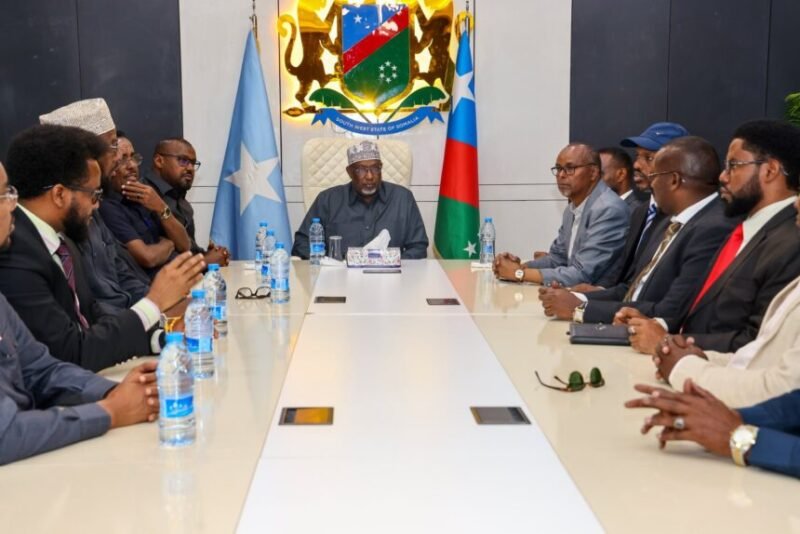
President Mohamud has been actively engaged in managing the transition in Baidoa. The president, alongside a high-level federal delegation, officially arrived in Baidoa to oversee the political transition. During his stay, he held a series of critical, closed-door meetings with the interim state leadership, influential traditional elders, senior officers of the national armed forces and regional Darwish units, as well as representatives from various sectors of civil society.
President Mohamud also convened a significant strategic meeting with senior traditional elders in Baidoa, where the comprehensive dialogue focused on enhancing regional peace, community reconciliation, and robust governance. During his address, the president heavily stressed the absolute importance of traditional leaders maintaining active involvement in Somalia’s historic transition to a “one-person, one-vote” electoral system.
Former Leader Mobilizes from Kenya
Meanwhile, ousted leader Laftagareen has made a notable political resurgence in Nairobi. The former president hosted a luncheon gathering for political loyalists, bringing together federal lawmakers, influential political figures, and close associates who supported him during the power struggle. Notably present was Mohamed Mursal, the former Speaker of the House of the People.
Laftagareen signaled that his departure from office was not an exit from politics, pledging to his allies that their political partnership would remain intact and announcing that they would move forward as a unified bloc in upcoming election campaigns.
Security Measures and Electoral Timelines
To legitimize the power transfer, the National Electoral Commission has scheduled parliamentary and district council elections for April 28. Federal authorities have enacted a nighttime curfew in Baidoa, prohibiting civilians from carrying weapons during evening hours, with exceptions for authorized security personnel.
Prime Minister Hamza Abdi Barre has declared that there will be no elections in Baidoa or across South West other than a one-person, one-vote process. “We will not allow, in any way, disorder, revenge, clan-based discrimination or any trouble in Baidoa,” Prime Minister Hamza stated.
A Test of Democratic Commitments
The government has pledged that the upcoming vote in Baidoa will be conducted under universal suffrage, with candidates competing freely and voters able to make an open choice. But the decision to field only a single ruling party candidate has cast a long shadow over those assurances.
As the election draws closer, the central question remains unresolved: whether South West State is heading toward a genuinely competitive vote — or an outcome shaped well in advance behind closed doors.
The push for direct elections faces strong opposition from the presidents of Puntland and Jubaland, who are united in the Somali Future Council, reflecting deeper fissures within Somalia’s federal system as the nation approaches highly contentious national elections due this year.