
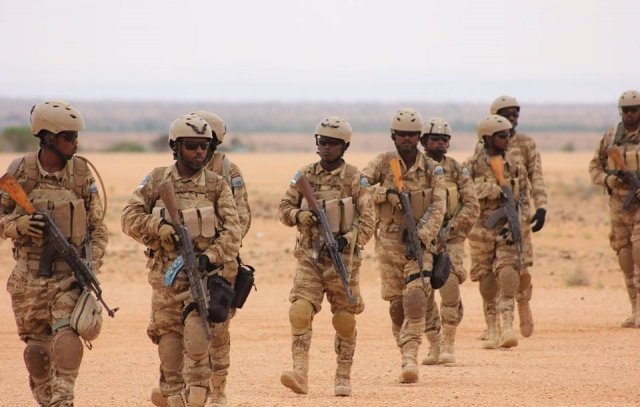
GAROWE – The Puntland administration has formally disowned the Puntland Security Force (PSF), declaring that no force by that name legally exists within its security apparatus, in a move that formalizes a long-running rift and raises the stakes in a confrontation that has already claimed lives.
The statement, issued by the presidency, comes days after deadly clashes between PSF fighters and Puntland’s Dervish forces near the Laag area outside Bosaso, where at least eight PSF fighters were captured and multiple military vehicles were seized. “The Puntland government confirms that there is no force called PSF that legally forms part of the Puntland defence forces,” the statement read. The administration also rejected the presence of any federally registered military unit inside its territory.
A Force Caught Between Two Masters
The PSF’s origins lie in counter-terrorism. Established in 2004 as a specialised unit with international backing, it was once the pride of Puntland’s security establishment. But its command structure has long been a source of friction. The force has historically operated with considerable independence from Puntland’s regular security command, a structure that has repeatedly caused tensions between PSF commanders and the regional administration.
The current rift dates back to November 2021, when President Said Abdullahi Deni attempted to dismiss then-PSF commander Mohamud Osman Diyaano. The move triggered deadly clashes in Bosaso, killing close to 20 people. Though Deni later reinstated Diyaano in March 2022 following consultations with Puntland elders, the underlying tensions never healed.
In October 2024, the federal government announced that the PSF was being fully integrated into the Somali National Army, with salaries, equipment, and command flowing directly from Mogadishu. The move effectively placed the PSF under federal control, a decision Puntland has never accepted. The PSF has since been at the centre of several security incidents in Puntland, including a June 2024 attack on Bosaso Central Prison in which two police officers were injured. The PSF denied authorising the attack, claiming its officers acted in their personal capacity.
Confrontation
The July 20 clash in the Laag area brought the long-simmering dispute to a boiling point. According to local reports, PSF forces traveling from Bosaso were ambushed by Puntland Darwish forces in the mountainous Laag area. The confrontation escalated into an exchange of fire before regional security forces, reinforced by additional troops, surrounded the PSF fighters. Facing superior numbers, the PSF elements reportedly withdrew overnight on foot through the mountainous terrain, abandoning the technical vehicles they had been using during the fighting.
The PSF claimed it was carrying out a routine security operation. A PSF spokesperson told BBC Somali that the force does not pose a threat to Puntland’s security and has played a key role in counterterrorism operations for many years. Puntland described the incident as a planned security operation targeting armed groups it accused of threatening stability. Whatever the label, the result was the same: gunfire, captured fighters, and a further erosion of trust.
A Broader Political Confrontation
The PSF dispute is not an isolated security issue. It is the military manifestation of a broader political confrontation between Garowe and Mogadishu. Puntland has accused President Hassan Sheikh Mohamud of directing military movements designed to provoke conflict and weaken the regional government. The federal government, for its part, has not publicly responded to the accusations.
The confrontation is fuelled by overlapping disputes: constitutional amendments Puntland rejects, the federal government’s expired mandate in Puntland’s view, and competing claims over who commands security forces operating in the region. Regional authorities have prohibited federal government forces operating in Puntland from moving between the region’s major towns and cities. Puntland has also barred federal government officials from entering the region and prohibited federal military recruitment within the state.
The Diyaano Factor
At the centre of the dispute is the Diyaano family. The PSF has been managed by the Osman Diyaano family since its inception. The current Somali Police Force Commander, General Asad Osman Abdullahi Diyaano, is a former PSF commander whose family maintains strong ties to the force. Reports have linked the PSF to Diyaano, though the precise chain of command has remained a subject of political contention.
Puntland’s statement effectively declares the Diyaano-linked force illegitimate. But the PSF’s federal backing means it is unlikely to simply disappear. The force continues to operate, and its presence in Puntland territory remains a source of tension. In a clash in Garowe, authorities intercepted a vehicle driven by individuals impersonating law enforcement personnel and believed to be linked to the PSF, leading to a deadly exchange of gunfire that left two soldiers dead.
A Crisis of Governance
The PSF dispute is a symptom of a deeper crisis of governance in Somalia’s federal system. The constitution is ambiguous on the division of security authority between the federal government and member states. Puntland insists that regional states are responsible for police forces, while the federal government is responsible for defence. But the PSF blurs that line: it is a counter-terrorism force with federal backing operating in a regional state that does not recognise its authority.
Puntland’s declaration that no PSF legally exists is a bold gambit. But it does not resolve the underlying dispute. It merely formalises a division that has already led to bloodshed. The federal government’s silence on the matter is telling; it suggests a strategic choice to avoid escalation while continuing to support the PSF indirectly.
Way Forward
The PSF dispute is a microcosm of Somalia’s broader federal crisis. It is a conflict over authority, resources, and the future shape of the Somali state. Puntland’s statement is a declaration of independence from federal security structures, but it is also a recognition of its own limited capacity to enforce that declaration.
The international community, which has invested heavily in both Puntland’s stability and Somalia’s federal project, faces a dilemma. Backing Garowe risks undermining the federal government. Backing Mogadishu risks legitimising a force that Puntland considers illegitimate. The PSF dispute, like so many others in Somalia, has no easy solution. But the alternative, continued confrontation with its inevitable cost in lives, is not a sustainable option.