

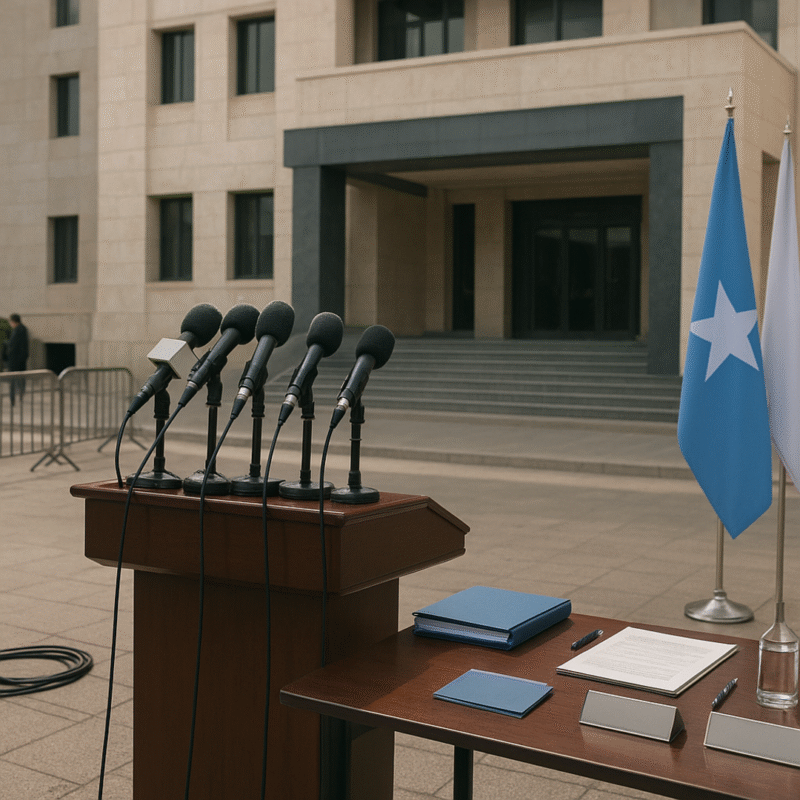
Mogadishu, Somalia – Somali Prime Minister Hamza Abdi Barre has addressed offensive statements by U.S. President Donald Trump, which have generated significant displeasure among Somalis both domestically and internationally.
The Prime Minister’s remarks came during a media briefing where journalists inquired about the government’s stance on Trump’s latest controversial statements.
PM Barre characterized Trump’s comments as part of a recurring pattern, not an isolated incident targeting Somalia.
“The American President’s utterances lack specificity and contribute no meaningful substance,” he commented, minimizing their importance.
He explicitly suggested a policy of strategic non-engagement: “Donald Trump has made similar remarks about numerous nations. The optimal approach is to refrain from addressing them and proceed.”
The Prime Minister’s public dismissal follows substantial online condemnation within Somalia, where Trump’s comments which broadly disparaged the Somali nation and its people have been widely criticized on various social media platforms.
Prime Minister Barre’s response exemplifies diplomatic diversion intended to de-escalate tensions.
By refusing to engage substantively, he denies Trump’s remarks the prominence of an official, high-level diplomatic confrontation. This “ignore and advance” strategy represents a calculated approach for a government that heavily depends on U.S. security and financial assistance, ensuring operational ties with current U.S. leadership remain unaffected by rhetorical exchanges with the US President.
By asserting that Trump “has spoken about many countries,” Hamza effectively normalizes and diminishes the offense. This framing serves dual purposes:
For the global community, it indicates that Somalia perceives the comments as unpredictable personal expressions, not indicative of U.S. official policy or a shift in bilateral relations.
For the domestic constituency, it attempts to assuage national pride by contextualizing the insult as universal rather than uniquely Somali, thereby reducing its perceived impact.
While advocating for public indifference, the PM’s statement simultaneously acknowledges and provides a controlled outlet for domestic outrage.
By addressing the issue publicly, he demonstrates governmental awareness and responsiveness to public sentiment. However, by advising against a confrontational reply, he seeks to prevent the matter from escalating into a domestic political crisis that might compel the government into a more adversarial international position.
The restrained response highlights the substantial imbalance in the U.S.-Somalia relationship. A direct, forceful rebuttal could carry uncertain repercussions for aid, security collaboration, and diplomatic standing.
Barre’s approach prioritizes the stability of these crucial partnerships over the satisfaction of a strong public denunciation, a pragmatic assessment for a vulnerable state.
This strategy carries inherent risks. It might be perceived domestically as weakness or an insufficient defense of national dignity. If public indignation is not sufficiently addressed, it could intensify anti-American sentiment or be leveraged by opposition factions to question the government’s sovereignty and resolve.
Prime Minister Barre’s reaction is less concerned with the substance of Trump’s remarks and more focused on crisis management and strategic positioning.
It represents a deliberate, measured choice to safeguard Somalia’s vital interests by avoiding an unwinnable verbal conflict, reflecting the intricate diplomacy required of a nation navigating dependence on an unpredictable political partner.
The success of this approach depends on whether the Somali populace accepts the logic of strategic silence over the demand for vocal confrontation.