
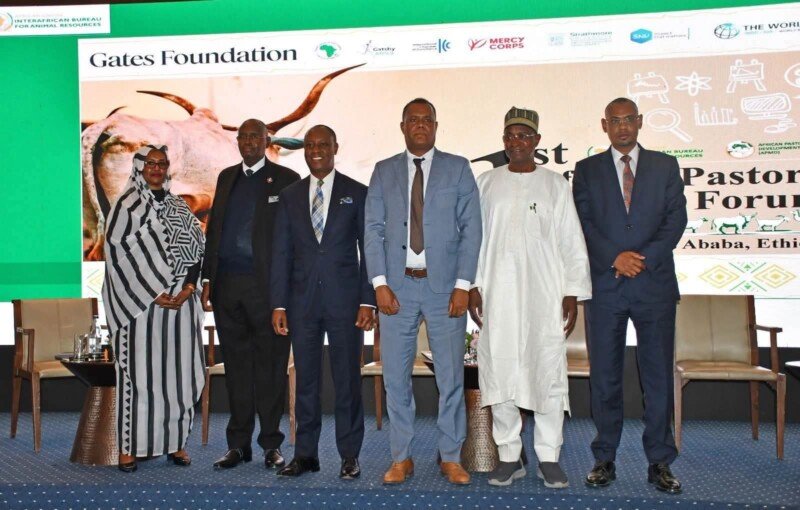
ADDIS ABABA – Somalia’s Minister of Livestock, Forestry and Rangelands, Hassan Hussein Mohamed, has attended the Ministerial Session of the African Pastoral Markets Development (APMD) Forum in Addis Ababa, where African governments and regional stakeholders moved to overhaul the continent’s pastoral livestock economy through a new policy and investment agenda aimed at creating an integrated African livestock market under the African Continental Free Trade Area (AfCFTA).
The forum, organised by the African Union Inter-African Bureau for Animal Resources (AU-IBAR) through its African Pastoral Markets Development Platform, brought together livestock ministers from Ethiopia, Kenya, Nigeria, Somalia and Uganda, as well as representatives of regional economic communities, development partners, financial institutions and pastoral organisations. African Union Commissioner for Agriculture, Moses Vilakati, told delegates that Africa must begin to treat pastoral livestock as a strategic economic asset rather than a marginal rural activity.
Minister Hassan Hussein Mohamed presented a report detailing Somalia’s progress in reforming livestock policies, strengthening animal health services, expanding market access and encouraging the role of the private sector. He noted that livestock remain the backbone of Somalia’s economy, supporting the livelihoods of millions of people, and that Somalia remains one of the world’s top exporters of live animals. The minister also outlined key initiatives, including the Livestock Market Information System (LIMS), the Somali Livestock Identification and Traceability System (SOMLITS), and the preparation of a comprehensive Somali Livestock Investment Plan.
A Continental Push for Livestock Market Integration
The ministerial session was part of the inaugural African Pastoral Markets Forum, a five-day event running from 13 to 17 July 2026, designed to catalyse investment, strengthen market systems and unlock trade in Africa’s pastoral livestock sector. The forum aims to produce a continental investment pipeline, strengthen political commitment to pastoral market development, and establish a platform for sharing experiences and showcasing bankable business models.
AU-IBAR Director Dr. Huyam Salih called for a fundamental shift in the way Africa views pastoral livestock production. She noted that livestock contributes close to a quarter of agricultural GDP in sub-Saharan Africa and between 30 and 80 percent of agricultural value added in several countries, while pastoral systems support more than 268 million pastoralists and agro-pastoralists across the continent. Despite Africa possessing one of the world’s largest livestock populations, she noted that the continent captures only a small share of the sector’s economic value.
The AU-IBAR, with support from the Gates Foundation, established the African Pastoral Markets Development Platform to strengthen policy reforms, promote viable business models and attract investment into livestock value chains. Commissioner Vilakati outlined five priorities: recognising livestock value chains as strategic sectors, integrating pastoralists into structured markets, developing livestock trade corridors, mobilising public and private finance, and investing in shared regional infrastructure.
Somalia’s Livestock Sector: Ambition and Reality
Minister Hassan Hussein Mohamed has been actively engaged in advancing Somalia’s livestock sector on the international stage. In October 2024, he led a delegation to Muscat, Oman, where he secured an agreement to establish a joint trade and investment forum and signed a memorandum of understanding on livestock cooperation. In February 2026, Somalia launched a major reform drive to transform its feed and fodder sector, a move aimed at strengthening livestock productivity, improving food security, and unlocking export potential.
The livestock sector remains the backbone of Somalia’s economy, contributing approximately 45 percent of GDP and 60 percent of foreign exchange earnings, while supporting an estimated 60 percent of the population. The sector generates an estimated $400–$500 million in annual export revenue, with over five million live animals exported to Gulf markets each year.
Drought Crisis and Export Decline
However, the gap between ministerial rhetoric and on-the-ground reality remains significant. The sector continues to be undermined by recurrent droughts, conflict, weak feed systems and chronic feed deficits of 10 to 60 percent even in non-drought years. The October to December 2025 deyr rains failed, leading to widespread water scarcity, crop failure, livestock losses and displacements. Animal body conditions are at very low levels, and livestock deaths due to starvation and diseases have increased during the January to March 2026 Jilaal dry season. Over 85 percent of lowland areas show very low pasture conditions, increasing stress on livestock.
Export data further underscores the sector’s vulnerability. Exports of sheep and goats fell from approximately 5.9 million head in 2024 to about 3.8 million in 2026, a drop of 35.6 percent, while cattle exports declined by 36.4 percent and camels by 19.8 percent over the same period. These declines reflect the compounded effects of drought, climate stress and market disruptions, raising questions about the government’s ability to translate policy ambitions into tangible improvements for pastoralist communities.
The recurring drought cycles have devastated pastoralist livelihoods across Somalia. The 2024 deyr rains brought above-average rainfall across much of the country, offering a temporary reprieve, but the failure of the 2025 deyr season has reversed those gains. Pastoralists in central and southern Somalia have been forced to sell off breeding stock at depressed prices, further eroding their productive assets and long-term resilience. The Somalia Water and Land Information Management (SWALIM) agency has warned that without significant intervention, the situation will worsen in the coming months.
The Gap Between Policy and Practice
The ministerial forum in Addis Ababa highlighted the continent’s ambition to transform pastoral livestock into a major driver of economic growth, employment, trade and investment. However, the challenge for Somalia, as for many African countries, lies in implementation. The government has developed promising frameworks, including the Livestock Market Information System, the Somali Livestock Identification and Traceability System, and a comprehensive investment plan. Yet these initiatives remain largely in the planning stages, with limited evidence of tangible impact on the ground.
Pastoral communities continue to face major challenges, including limited market infrastructure, inadequate financial services, animal health risks, climate variability and weak transport networks. Trade barriers, including multiple taxes and checkpoints imposed by various authorities, continue to fragment the livestock market and increase transaction costs. The government’s commitment to modernising the sector, while welcome, has yet to translate into meaningful improvements in the livelihoods of the millions of Somalis who depend on livestock for their survival.
Way Forward
The African Pastoral Markets Forum represents a significant step toward recognising pastoral livestock as a strategic economic asset rather than a humanitarian concern. For Somalia, participation in this continental initiative offers an opportunity to attract investment, harmonise standards and expand market access. However, the success of these efforts will depend on the government’s ability to move beyond policy announcements and deliver concrete improvements in animal health services, market infrastructure, and support for pastoralist communities.
The minister’s call for strengthened cooperation among African governments, regional organisations, development agencies and the private sector is well-founded. Yet without sustained investment, effective implementation and genuine accountability, the livestock sector’s potential to drive economic growth and reduce poverty will remain unrealised. The gap between the ambitions expressed in Addis Ababa and the realities faced by Somali pastoralists remains wide, and bridging that gap will require more than ministerial attendance at international forums. The recurring drought crisis demands urgent action, not just policy announcements, to protect the livelihoods of millions of Somalis who depend on livestock for their survival.
Recommended Reading On ftlsomalia.com
- Livestock Minister Oversees Director General Transition
- Somalia Approves Meat Inspection and Protection Law to Boost Food Safety and Exports
- New Fodder Development Centre Launched in Dhusamareb
- Somalia Joins EAC Agriculture Talks to Tackle Regional Food and Livestock Challenges
- Southwest Residents Concerned over Sharp Increase in Livestock Prices
- Galmudug President Lays Foundation for New Livestock Ministry Building