
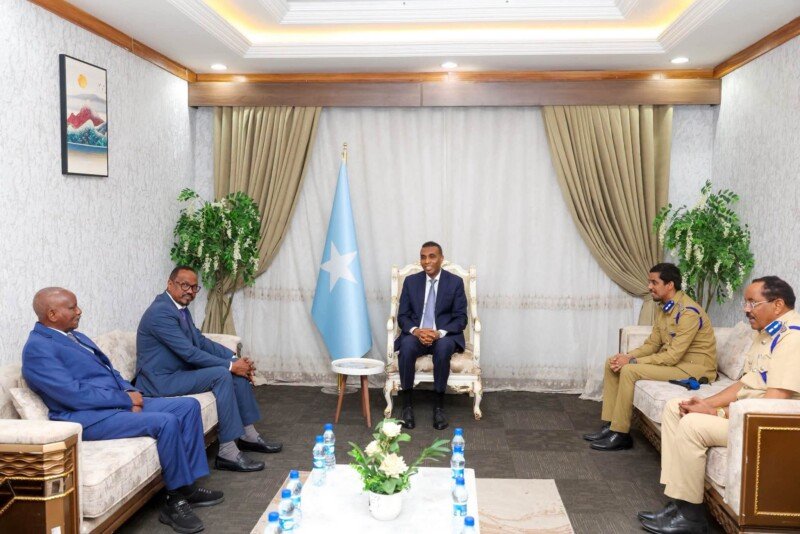
MOGADISHU – Prime Minister Hamza Abdi Barre has held talks with the Ambassador of the Republic of Djibouti to Somalia, Colonel Osman Dubad Sugulle, and the Commander of the Djibouti Police Force, Colonel Abdirahman Ali Kahin, at his office in the capital, reaffirming the longstanding fraternal ties and strategic partnership between the two Horn of Africa nations.
The meeting, which also included the Djiboutian police commander on a visit to Somalia, focused on strengthening bilateral cooperation across political, security and economic sectors. Prime Minister Barre expressed gratitude for the visit and emphasised that the relationship between Somalia and Djibouti is rooted in brotherhood and mutual support across multiple domains. Ambassador Sugulle, for his part, commended the Prime Minister’s commitment to strengthening bilateral ties and acknowledged the efforts of the Federal Government in building cooperation based on the shared interests of both countries.
A Deepening Strategic Alliance
The meeting follows a series of recent high-level engagements that have deepened the strategic alliance between Mogadishu and Djibouti. President Hassan Sheikh Mohamud travelled to Djibouti in March 2026 for a strategic working visit, holding talks with President Ismail Omar Guelleh on security, trade and economic partnership. The two countries have also signed a Memorandum of Understanding on political consultations, establishing a framework for regular dialogue between the two governments on pressing political, economic and security matters.
In the security domain, Somalia and Djibouti have reached an agreement to enhance defence and security cooperation, a development officials say will bolster Somalia’s stabilisation initiatives and improve regional coordination against common threats. The consensus was established during discussions between Somali Defence Minister Ahmed Moalim Fiqi and his Djiboutian counterpart, Hassan Omar Mohamed, in Mogadishu. Both parties anticipate that this closer partnership will facilitate joint planning, intelligence sharing and operational coordination.
Djibouti’s Enduring Role in Somalia’s Stability
Djibouti has remained one of Somalia’s closest allies, playing a significant role in peacekeeping, mediation and security sector development. Ambassador Sugulle, who presented his credentials to President Mohamud in May 2026, previously served as commander of the Djiboutian contingent under the African Union peacekeeping mission’s Sector 4, now operating under the African Union Support and Stabilization Mission in Somalia (AUSSOM). The Djiboutian forces stationed in the Hiiraan region of central Somalia, widely known as “Hiil-Walaal” (Somali for “brothers in arms”), have been instrumental in stabilising the region, working alongside the Somali National Army to secure key areas.
President Hassan Sheikh Mohamud has previously bestowed Somalia’s National Honor Medal upon Djibouti’s President Ismail Omar Guelleh, recognising his enduring solidarity and contributions to Somalia’s stability and progress. In his speech, President Mohamud reflected on the significance of the Arta Peace Process, hosted by Djibouti in 2000, calling it a defining moment in Somalia’s modern political history.
Strengthening Security and Police Cooperation
The presence of the Djibouti Police Commander at the meeting underscores the growing cooperation between the two countries in law enforcement and internal security. Colonel Kahin arrived in Mogadishu at the official invitation of his Somali counterpart, Major General Asad Osman Abdullahi, and was received at Aden Adde International Airport by senior Somali police officers, federal officials and the Djiboutian Ambassador to Somalia. Speaking to reporters upon arrival, Colonel Kahin described Somalia as his “second country” and said he planned to visit various regions during his stay to assess the security situation firsthand. He also highlighted the shared history of the two nations, recalling the pivotal role Somalia played in Djibouti’s own liberation struggle, stating that “if Somalia did not exist, Djibouti would not have gained independence.”
Somalia’s police forces have been working to strengthen their capacity to address security challenges, including terrorism, organised crime and illegal arms trafficking. Djibouti’s experience in policing and security sector development is expected to contribute to these efforts. Ambassador Sugulle’s military background is expected to further strengthen security collaboration between the two nations. Somalia and Djibouti have also reinforced defence ties in high-level talks, with discussions focusing on deepening bilateral defence cooperation, enhancing regional security, and coordinating efforts to combat terrorist groups threatening the stability of the Horn of Africa.
The Democracy Deficit in Somalia and Djibouti
While the meeting between Prime Minister Barre and the Djiboutian delegation highlights the deepening strategic partnership between the two countries, both nations continue to face significant democratic deficits that raise questions about the nature of their political systems and the accountability of their leadership.
Somalia has not held direct national elections since the collapse of its authoritarian regime in 1991. The political system remains fragmented, with indirect elections and clan-based power-sharing arrangements that have delayed the transition to a fully democratic framework. Despite the passage of constitutional amendments in 2024 that favour direct “one-person, one-vote” elections, implementation has been slow and contested. President Mohamud has declared that Somalia has moved beyond the era of personality-driven politics, but critics argue that meaningful democratic reforms remain elusive, with political power concentrated among a small elite and public participation in governance limited.
Djibouti, a key ally and host to multiple international military bases, has been ruled by President Ismail Omar Guelleh since 1999. His rule has been characterised by restricted political freedoms, limited press freedom and the suppression of political opposition. The country’s political system has been described as authoritarian, with elections often marred by irregularities and a lack of genuine competition. While Djibouti has maintained relative stability and economic growth, its democratic credentials remain weak, with the ruling party controlling nearly all seats in parliament.
The warm diplomatic ties and security cooperation between Somalia and Djibouti contrast sharply with the democratic shortcomings in both countries. While the two governments celebrate their partnership, ordinary citizens in both nations continue to face limited political participation, restricted freedoms and governance systems that often prioritise elite interests over public accountability. The strengthening of bilateral ties, while strategically significant, does not address the underlying democratic challenges that affect the lives of millions of Somalis and Djiboutians.
Way Forward
The meeting between Prime Minister Barre and the Djiboutian delegation reflects the enduring strategic alliance between Somalia and Djibouti, as both nations continue to strengthen ties across multiple fronts, including joint military planning, intelligence sharing and operational coordination aimed at fortifying Somalia’s security apparatus and promoting stability across the Horn of Africa.
However, as Somalia continues its transition toward full security responsibility, questions remain about whether the deepening partnership between two nations with limited democratic governance will serve the interests of their citizens or primarily benefit political elites. The challenge for both governments will be to ensure that security cooperation is accompanied by meaningful political reforms, transparency and accountability. Without these elements, the strategic alliance risks reinforcing authoritarian tendencies rather than fostering the democratic governance that citizens in both countries deserve.
Recommended Reading On ftlsomalia.com
- PM Hamza Welcomes Djibouti’s New Ambassador to Somalia
- Djiboutian Ambassador Presents Credentials to Somali President
- Somalia and Djibouti Sign MoU to Deepen Political Dialogue
- Somalia and Djibouti Bolster Security Cooperation
- President Mohamud Honors Djibouti’s Leader for Lifelong Support to Somalia
- Hassan Sheikh Mohamud Travels to Djibouti to Boost Bilateral Relations