
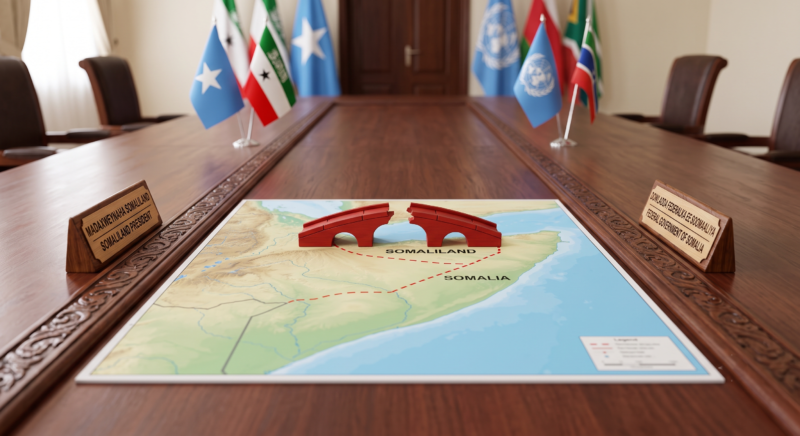
NAIROBI — Somaliland President Abdirahman Mohamed Abdullahi (Cirro) has stated that dialogue between Somaliland and the Federal Government of Somalia could resume, but only if previous agreements between the two sides are first implemented.
Speaking at a meeting in Nairobi attended by ambassadors, heads of international agencies, and development partners, President Cirro said Somaliland has consistently demonstrated its readiness for dialogue, but argued that past agreements have not been fully honoured. “We respectfully request our international friends not to focus only on encouraging dialogue, but also to urge Somalia to implement the previous agreements that were reached,” Cirro said.
He specifically cited the management of civilian airspace as one of the agreements that were reached between the two sides but have not yet been implemented according to his assessment.
President Cirro also accused the Federal Government of Somalia of interfering in Somaliland’s affairs, arguing that Mogadishu has been focusing its efforts on Somaliland rather than addressing the political, security, and humanitarian challenges within Somalia itself.
Somaliland declared independence from Somalia in 1991 and has since sought international recognition. The Federal Government of Somalia has consistently maintained that it will preserve the unity and territorial integrity of Somalia and opposes Somaliland’s independence.
Prime Minister Hamza Abdi Barre has previously called on Somaliland politicians to return to the negotiating table to find a peaceful resolution to the grievances and disputes between the two sides. He stated that dialogue is the most appropriate path to achieving a lasting solution.
Somaliland has previously described Prime Minister Barre’s visit to Las Anod as a “clear provocation” and a violation of its claimed territorial sovereignty.
Background: Stalled Dialogue and Competing Claims
The relationship between Somalia and Somaliland has been marked by decades of tension since Somaliland’s self-declaration of independence in 1991. While the Federal Government of Somalia maintains that Somaliland is an integral part of its territory, Somaliland has continued to pursue international recognition and has deepened its engagement with Israel, a move that has drawn widespread condemnation from the Federal Government, the Arab League, and many Islamic nations.
Previous rounds of dialogue between the two sides, including talks held in Djibouti and elsewhere, have failed to produce a breakthrough. The dispute over the management of civilian airspace, which Cirro referenced, has been a recurring point of contention, with Somaliland asserting its authority over its airspace while the Federal Government claims jurisdiction.
Israel formally accepted Somaliland’s first ambassador in February 2026, a move that the Federal Government of Somalia described as a violation of Somalia’s sovereignty and territorial integrity.
Critical Note
President Cirro’s precondition for resuming dialogue, that previous agreements must first be implemented, reflects the deep mistrust that has characterised Somalia-Somaliland relations. While the call for implementation of past agreements is a legitimate negotiating position, it also risks creating a circular logic that perpetuates the status quo, as each side may have a different interpretation of what was agreed and whether it has been fulfilled. The lack of progress on the airspace management issue, despite being one of the areas where technical progress had been made, illustrates the challenge of translating agreements into action. Furthermore, the Federal Government’s focus on asserting its authority over Somaliland, combined with Somaliland’s deepening international engagement, particularly with Israel, has created a climate of mutual suspicion that makes meaningful dialogue difficult. The international community, which has a significant stake in stability in the Horn of Africa, must press both sides to demonstrate genuine commitment to dialogue and to explore creative solutions that address the underlying grievances of both parties.
Recommended Reading On ftlsomalia.com
- PM Barre Urges Somaliland to Rejoin Talks and Reconsider Israel Ties
- Somaliland Terms PM Barre’s Visit a “Clear Provocation”
- Israel Welcomes Somaliland’s First Ambassador
- 16 Arab and Muslim Nations Condemn Somaliland’s Jerusalem Embassy Plan
- Somalia Blocks UAE Military Flights
- Somaliland Revives Fisheries Infrastructure