
MOGADISHU — The Arlaadi Council, a group of Somali intellectuals and professionals from the Digil and Mirifle clan, has strongly rejected any attempt to allocate the position of Speaker of the Federal Parliament to their clan, arguing that such a move would undermine the community’s broader political aspirations and constitutional rights.
In a statement issued ahead of the Speaker election scheduled for August 10, 2026, the council said that the political destiny of the Digil and Mirifle clan cannot be confined to a single position, and that the community has the right to compete equally for all top leadership roles, including the Presidency, the Prime Ministership, and other senior positions in the federal government.
“The political destiny of Digil and Mirifle cannot be limited to one position,” the statement read. “The community’s demand has always been to have an equal opportunity to access all top executive positions of the Somali nation, including the Presidency, the Prime Ministership, and all other senior positions of the Federal Government of Somalia, in line with the principles of equality, constitutional rights, and full participation in governance.”
Council Warns Against ‘Betrayal’ of Clan’s Struggle
The council warned that any individual who accepts the Speaker position while viewing it as the final political share for the Digil and Mirifle clan would be betraying the community’s long struggle for equal political representation. “Anyone who accepts this position in the name of the clan, while reducing it to a substitute for the broader national aspirations of the community, would be breaking the trust placed in them by the people, betraying the long struggle of the community for equal representation, and setting back the pursuit of genuine political equality within the Federal Republic of Somalia,” the statement said.
The statement was signed by prominent members of the Arlaadi Council, including Prof. Abdi Mohamed Kusow, Prof. Mohamed Haji Mukhtar, and other academics and professionals.
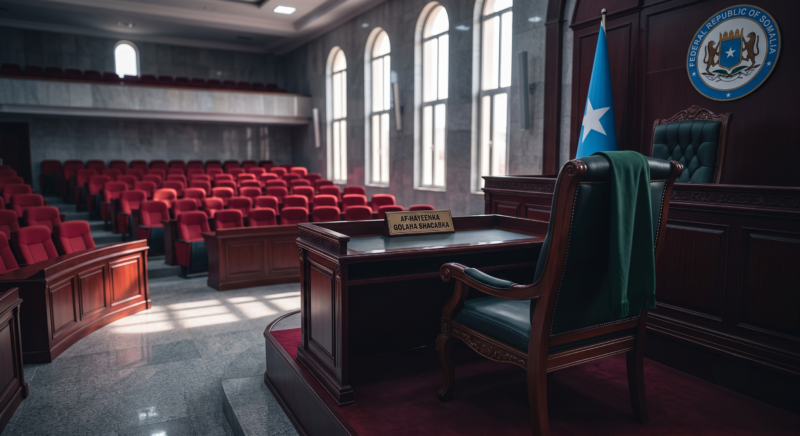
The Council’s position comes as the parliamentary election committee has opened candidate registration for the Speaker position, with a registration fee of $30,000 for male candidates and $15,000 for female candidates. The election is set to take place on August 10, 2026, with candidate registration opening on August 5 and closing on August 6.
President Hassan Sheikh Mohamud has previously praised former Speaker Sheikh Aden Mohamed Nur (Madobe) for strengthening parliament and supporting Somalia’s state-building efforts, as the veteran politician prepared to assume his new post as president of South West State.
The 4.5 Power-Sharing Formula and Clan Dynamics
Under Somalia’s longstanding 4.5 clan-based power-sharing formula, key leadership positions are distributed among different clans, with the Speaker position traditionally allocated to the Digil and Mirifle (Rahanweyn) clan family. Previous Speakers, including Sheikh Aden Mohamed Nur (Madobe) and Mohamed Osman Jawari, have all been from this clan. This means that, in practice, only Rahanweyn MPs are eligible to contest the Speaker position under the current power-sharing arrangement.
The Arlaadi Council’s statement challenges this convention, arguing that the Speaker position should not be viewed as a final settlement for the Digil and Mirifle clan’s political representation, but rather as one of many positions that members of the community should be able to contest.
The council’s position could complicate the upcoming Speaker election, as it suggests that any Digil and Mirifle candidate who accepts the role may face criticism from within their own community for accepting what some view as a lesser position. This could influence the dynamics of the election, which is expected to be fiercely contested.
Villa Somalia has reportedly backed Minister of Ports and Marine Transport Abdulkadir Mohamed Jaamac for the role, with Turkish influence reportedly playing a significant role in the lobbying effort. Meanwhile, State Minister for Interior Saadad Mohamed Nur (Caliyow) has resigned from his cabinet post to pursue the position.
The acting Speaker of the House of the People, Sacdiya Yaasin Haaji Samatar, has appointed a nine-member committee to oversee the election of the next Speaker of the Federal Parliament. The committee has convened its inaugural meeting and elected MP Abdirizak Omar Mohamed as its chairman.
The political landscape has been marked by tensions between the federal government and opposition factions, with the international community repeatedly urging Somali leaders to resume dialogue and reach a consensus on the way forward.
Critical Note
The Arlaadi Council’s statement raises important questions about the nature of political representation in Somalia’s federal system. While the council’s call for equal access to all leadership positions reflects a legitimate aspiration for full political participation, the reality of Somalia’s 4.5 power-sharing formula means that clan identity continues to shape political outcomes in ways that limit individual merit and equal opportunity. The council’s warning that accepting the Speaker position while viewing it as a final settlement for the clan would constitute a “betrayal” places potential candidates in a difficult position, as they must navigate competing expectations from their community and the broader political establishment.
Recommended Reading On ftlsomalia.com
- Candidates Must Pay $30,000 as Parliamentary Speaker Election Set for August 10
- Political Contest for Speaker: Villa Somalia Backs Abdulkadir Jaamac
- Interior State Minister Resigns Amidst Speaker Race
- Somali Parliament Forms Election Committee to Select New Speaker
- Electoral Committee Meets as Parliament Prepares for Speaker Vote
- Opposition Confirms Deal with FGS to Resume Dialogue