
NAIROBI – Somali media such as Somali Guarding, WardheerNews, Hortibn Media and Garowe Online, have wronfully reported that the Somalia’s ambassador to Kenya, Jabril Ibrahim Abdulle, has been summoned to Mogadishu for consultations following widespread controversy over his attendance at an agricultural conference in Nairobi where Israel’s ambassador to Kenya was also present.
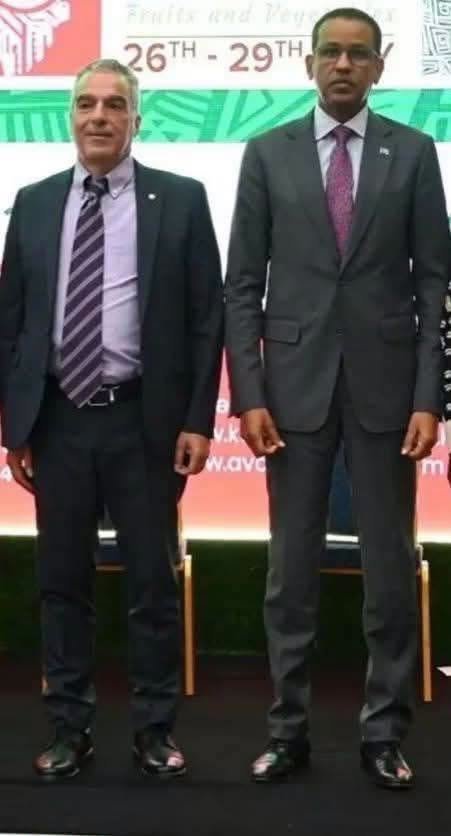
The controversy erupted after images circulated on Somali social media showing Ambassador Jabril at the 6th Africa Avocado Congress and Expo, held at the Sarit Expo Centre from May 26 to 29. The conference brought together government officials, diplomats, investors, agricultural experts, exporters, and private sector stakeholders from across Africa and beyond.
According to the official programme, Israel’s Ambassador to Kenya, Gideon Behar, participated in the opening ceremony, while Somalia’s envoy was listed among speakers during a separate session focused on trade and investment opportunities.
Controversy at a Sensitive Diplomatic Moment
The photograph emerged at one of the most delicate moments in recent Somalia-Israel relations. Just days before its appearance, President Hassan Sheikh Mohamud had described Israel as an enemy of the Palestinian people and accused it of seeking military influence in Somalia and the wider region.
His remarks came directly after Israel’s formal recognition of Somaliland as an independent state in December 2025, a move widely condemned in Mogadishu as challenging Somalia’s territorial sovereignty. This recognition has intensified public and political scrutiny of any contact between Somali officials and Israeli representatives.
Israel formally recognized Somaliland in late 2025, with both parties announcing plans to establish embassies. Somaliland declared it would open its diplomatic mission in Jerusalem, a choice that provoked criticism from Mogadishu and eighteen other countries with Muslim majorities.
Against this backdrop, the image of Ambassador Jabril beside Israel’s Nairobi envoy, regardless of the event’s nature, proved sufficient to ignite public anger and prompt a government response.
Government Response and Recall
Somalia’s Foreign Ministry launched an internal review of the ambassador’s participation, examining whether proper authorization procedures were followed, according to local media. Reports circulated online claiming that Ambassador Jabril had been recalled to Mogadishu for consultations.
However, Somalia’s Foreign Minister, Abdisalam Abdi Ali Dhaay, publicly denied those reports, stating that the ambassador attended the conference in his official capacity and that no wrongdoing had occurred. The minister described the gathering as an agricultural and trade conference rather than a political event.
In a separate statement, the Foreign Ministry confirmed that Minister Abdisalam attended the Africa Forward Summit in Nairobi on May 11, where he participated in a ministerial meeting on UN Security Council reform. Ambassador Jabril accompanied the minister at that event, alongside other senior diplomats.
Economic Diplomacy vs. Political Symbolism
According to sources with knowledge of the event, Ambassador Jabril attended the Nairobi conference in his official capacity as Somalia’s representative in Kenya, promoting agricultural trade and investment opportunities on behalf of his country. His participation aimed at promoting Somalia’s economic opportunities and attracting investment in sectors including agriculture, fisheries, logistics, infrastructure, telecommunications, and renewable energy.
No evidence has emerged that the event was organized, funded, or hosted by Israel, nor that Ambassador Jabril had any planned engagement with the Israeli ambassador. The Africa Avocado Congress, now in its sixth year, is a continental gathering convened by the Avocado Society of Kenya in partnership with regional and international bodies and routinely attracts diverse diplomatic and commercial representation.
Critics argue that the ambassador’s presence at an event where the Israeli envoy played a prominent role appears inconsistent with Somalia’s publicly stated diplomatic posture. Others have questioned whether the participation reflected a shift in policy or was merely part of routine diplomatic engagement at a multilateral trade and agriculture forum.
Ambassador’s Personal History with Israel
The controversy has taken on additional complexity due to Ambassador Jabril’s personal history. According to diplomatic sources in Mogadishu, when Jabril was serving as the Director of the Center for Research and Dialogue (CRD) in Mogadishu, he was shot and injured by one of his own security guards. The incident required urgent medical evacuation, and his treatment was reportedly facilitated by the government of Israel.
This historical connection between the ambassador and Israel has added another layer of sensitivity to the current controversy. Critics have pointed to this past incident as evidence of long-standing ties that they argue are inconsistent with Somalia’s official foreign policy posture. Others, however, note that medical evacuation and emergency treatment should be viewed as humanitarian matters rather than political statements.
Neither Ambassador Jabril nor the Somali Foreign Ministry has publicly commented on these historical reports.
Somalia-Israel Tensions at a Peak
Somalia-Israel tensions have reached a level where the mere presence of a Somali diplomat in the same room as an Israeli official carries political consequences that no briefing document could fully anticipate. The Somalia-Kenya diplomatic episode reflects growing pressure on Somali officials to visibly distance themselves from Israel following the Somaliland recognition dispute.
The Somali federal government has concentrated much of its diplomatic pressure on the United Arab Emirates, which Mogadishu accuses of financing global advocacy campaigns for Somaliland. Last week, Prime Minister Hamza Abdi Barre claimed that Abu Dhabi was investing millions of dollars to promote Somaliland’s recognition process, an assertion that Emirati representatives have not publicly responded to.
Former U.S. ambassador to Somalia Larry Andre has accused President Mohamud of deliberately breaking down the nation’s federal system, arguing that this has unexpectedly supported Somaliland’s quest for independence. For Mogadishu, Israel’s decision to recognize Somaliland strikes at the foundation of Somali statehood, a matter of constitutional and political gravity that has placed Somalia’s foreign policy on heightened alert.
Ambassador’s Role and Future
According to statements attributed to the ambassador, his participation at the conference was centered on economic diplomacy rather than engagement with Israel. He reportedly maintained that Somalia’s involvement was aimed at attracting investment and showcasing the country’s economic potential.
The Federal Government of Somalia has not issued an official public statement specifically addressing the controversy. The silence has fueled further speculation and debate, with some commentators demanding clarification from the Ministry of Foreign Affairs regarding the circumstances surrounding the ambassador’s attendance.
Whether Ambassador Jabril returns to his post in Nairobi will depend on the outcome of the Foreign Ministry’s internal review. As debate continues, analysts say the controversy reflects the growing scrutiny facing Somali diplomats abroad, especially when participating in international forums where political symbolism can often carry as much weight as the official agenda itself.
The Somali Foreign Ministry and the Office of the President had not issued further formal public statements at the time of publication.