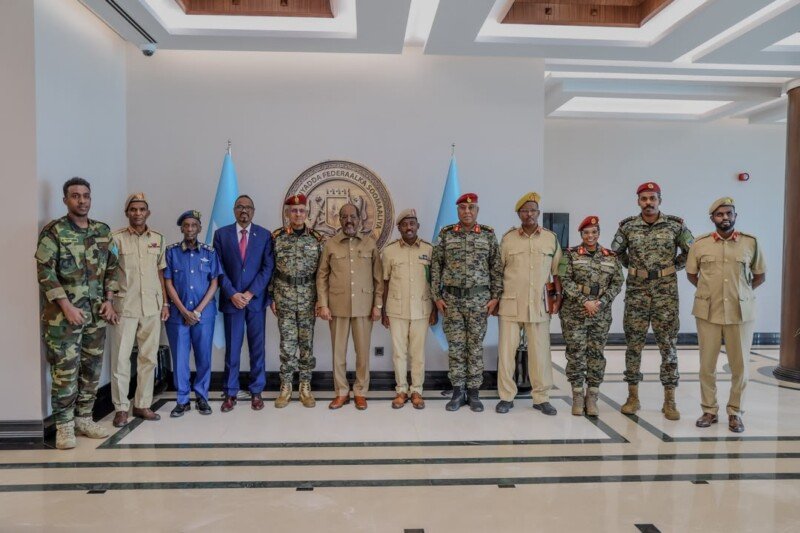

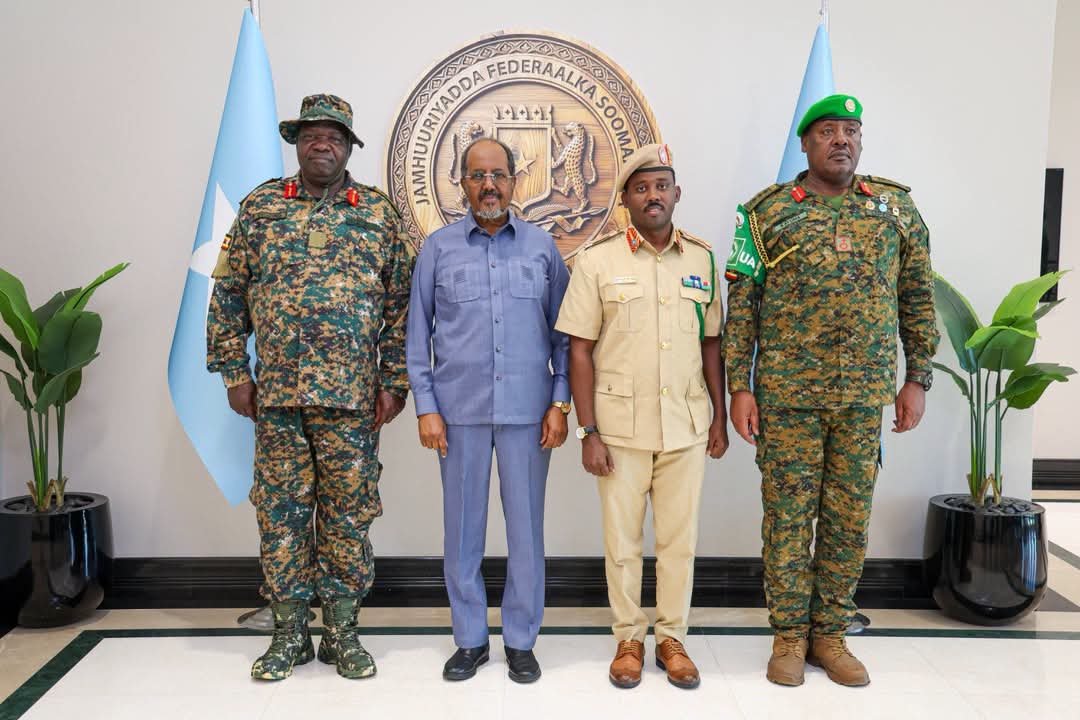
MOGADISHU — President Hassan Sheikh Mohamud has received the Deputy Commander of the Uganda People’s Defence Forces (UPDF), Lt. Gen. Sam Okiding, at Villa Somalia for talks focused on strengthening bilateral security cooperation, accelerating joint counter-terrorism operations, and advancing the strategic partnership between the two countries.
The meeting was part of the President’s ongoing engagements with senior military officials attending the African Union Support and Stabilization Mission in Somalia (AUSSOM) Military Chiefs Conference in Mogadishu. General Okiding, a seasoned military officer who previously served as the African Union Mission in Somalia (AMISOM) Sector One Commander from 2015 to 2017 and later as ATMIS Force Commander, is in the Somali capital to participate in high-level discussions on the future of the AU mission and the security transition.
President Mohamud expressed gratitude to the Ugandan government and people for their steadfast support to Somalia, particularly in building and strengthening security institutions and contributing to efforts aimed at achieving lasting peace. He emphasised the importance of further strengthening the strategic relationship between Somalia and Uganda, noting that bilateral cooperation plays a vital role in regional stability and the success of counter-terrorism efforts.
The Somali National Army’s Chief has previously commended the Uganda People’s Defence Forces for their pivotal role in operations against Al-Shabaab, extending gratitude to Uganda for its enduring role in stabilising Somalia and its steadfast contribution to peacekeeping under AUSSOM.
AUSSOM Military Chiefs Conference: A Critical Juncture
General Okiding’s visit coincides with the AUSSOM Military Chiefs Conference in Mogadishu, which brings together defence leaders from troop-contributing countries to review operational progress, coordinate joint action plans, and address the mission’s future amid significant funding uncertainty. The conference follows the Extraordinary Summit of Heads of State and Government of Troop-Contributing Countries to AUSSOM, held in Kampala, Uganda, on July 31, 2026, which was chaired by Ugandan President Yoweri Museveni.
Military experts have finalised a joint action plan to accelerate operations against Al-Shabaab, strengthen intelligence sharing, and improve coordination of military capabilities and resources among forces participating in the mission. The plan, which was presented to defence chiefs for review and approval, is expected to serve as a framework for the next phase of operations aimed at strengthening security and stability in Somalia and the region.
Uganda is one of the largest troop-contributing countries to AUSSOM, with 4,500 troops deployed under the mission’s current configuration. The country has been a cornerstone of African Union peace support operations in Somalia since the first deployments in 2007, and its forces are deployed across multiple sectors, conducting joint operations with Somali troops and providing training and logistical support.
Uganda’s Role in Somalia’s Security Transition
The Kampala summit, which brought together leaders from Somalia, Uganda, Burundi, Djibouti, Ethiopia, Kenya, and Egypt, alongside representatives from the African Union, IGAD, and the United Nations, was convened amid growing uncertainty over the future financing of AUSSOM. The United States informed the African Union on July 1, 2026, that it would not support the renewal of the mission’s mandate when it comes before the United Nations Security Council in December, raising concerns about the mission’s ability to sustain operations beyond 2026.
At the Kampala summit, troop-contributing countries urged the UN Security Council to maintain logistical and operational support for the mission for an additional 18 to 24 months, warning that an early withdrawal could undermine security gains and delay the transfer of responsibilities to Somali forces. Ugandan President Yoweri Museveni called on African countries to take greater responsibility for securing peace and stability in Somalia, while leaders reaffirmed their determination to extend the mission’s existence despite threats to its logistical support.
General Okiding’s visit is part of a broader pattern of high-level Ugandan military engagement in Somalia, aimed at strengthening military cooperation and assessing Uganda’s role in the African Union peacekeeping mission.
Critical Note
While President Mohamud’s meeting with General Okiding and the broader AUSSOM Military Chiefs Conference reflect the strong security partnership between Somalia and Uganda, the future of the AU mission remains highly uncertain. The US decision to end funding for UNSOS by December 2026 has placed the mission’s sustainability in jeopardy, and the troop-contributing countries’ request for an 18- to 24-month extension of UN logistical support reflects a recognition that Somali forces are not yet prepared to assume full security responsibilities. Uganda, despite its significant troop contributions and historical commitment, faces its own domestic pressures and resource constraints, raising questions about its ability to sustain the current level of commitment. Furthermore, the emphasis on military cooperation, while necessary, has not been matched by comparable progress in stabilisation, governance, and reconciliation in areas liberated from Al-Shabaab. Without addressing the underlying drivers of conflict, including marginalisation, corruption, and weak rule of law, military gains risk being temporary. The Somali government would be well advised to ensure that security planning is accompanied by genuine progress in building accountable, effective institutions that can sustain security gains beyond the AU mission’s departure, while also diversifying its international partnerships to reduce over-reliance on any single contributor.
Recommended Reading On ftlsomalia.com
- SNA Chief Hails AUSSOM-UPDF Victory in Lower Shabelle
- Ugandan Deputy Defence Chief Arrives in Mogadishu to Boost Military Cooperation
- Military Experts Finalize Joint Action Plan as AUSSOM Faces Funding Uncertainty
- President Hassan Sheikh Receives Djibouti’s Military Chief Amid AUSSOM Security Talks
- SNA Commander Meets AUSSOM Leadership to Discuss Security Transition
- Somali Army Chief Reviews Security Transition