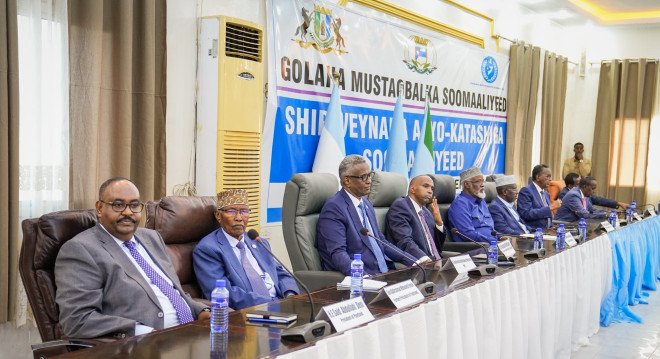

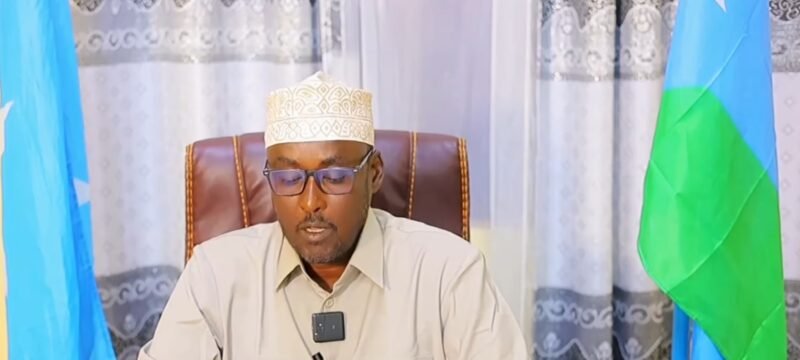
MOGADISHU: The Governor of the Gedo region, Abdullahi Shimbir, has warned that any election held in the area must adhere to legal frameworks and include broad consultation, stating that regional authorities have been excluded from electoral planning. The warning came after discussions with Federal Government officials in Mogadishu, where talks centered on the implementation of a “one‑person, one‑vote” system. However, the enduring political tension between Somalia’s Federal Government and Jubbaland President Ahmed Madobe continues to affect the region. “We will not accept an election that our people are unaware of and where we were not consulted,” Shimbir declared.
The governor’s comments come at a particularly sensitive time. The Federal Government, which previously assumed administrative control of Gedo from Jubbaland, is advancing plans for direct universal suffrage. Shimbir clarified that, despite previous tensions, his administration remains part of Jubbaland State and has resolved internal differences with the regional leadership in Kismayo. While he stressed there is no active conflict between his administration and the Federal Government, he warned that unilateral electoral moves taken without political consensus could lead to new security and political instability. “Efforts are ongoing to resolve the dispute between the Federal Government and Jubbaland,” Shimbir added, noting that Jubbaland’s leadership remains willing to engage in dialogue and reach a political settlement.
Gedo has long been a political flashpoint in Somalia, serving as a principal site of contention between the federal leadership and regional states concerning national election management. The region has repeatedly been at the center of disputes over electoral authority, constitutional reforms, and the transition to direct elections. The Jubbaland administration has previously accused the federal government of “illegal interference” in Gedo’s internal affairs and warned that federal maneuvers could trigger renewed instability.
The National Independent Electoral and Boundaries Commission (NIEBC) had announced plans to begin voter registration in multiple regions, including Gedo, as part of preparations for Somalia’s planned one‑person, one‑vote elections. Mohamed Hussein Al‑Qaadi, a previous Gedo governor, issued a stern warning against unauthorized voter registration, declaring that any election activities conducted without coordination with Jubbaland authorities would be deemed illegitimate and would face opposition. However, the government’s push for universal suffrage aims to replace Somalia’s traditional 4.5 clan‑based power‑sharing system.
Federal authorities have deployed a unit of elite “Gorgor” commandos to the Luuq district in the Gedo region, substantially increasing the government’s military presence in this strategic area where federal and Jubbaland authorities have long vied for control. The deployment of Turkish-trained special forces came as tensions in the border region escalated. Federal forces have also captured several towns in Gedo, including Balad Hawo and the regional administrative center of Garbaharey, as part of efforts to weaken Jubbaland’s influence.
At the national level, the dispute over the electoral process has become a central issue in Somalia’s political crisis. The opposition Somali Future Council has warned of a political crisis as election deadlines approach. The government advocates for a transition to a “one‑person, one‑vote” system, while the opposition favors an indirect voting model. The opposition has demanded an independent mediator as a precondition for substantive negotiations. High‑stakes talks between the two sides were held at the fortified Halane compound, but no immediate agreement was reached.
As Somalia approaches critical electoral milestones, the standoff in Gedo highlights the broader challenges of implementing a unified electoral framework across the country’s federal states. With both the federal government and Jubbaland unwilling to concede ground, the region remains poised for further political and security upheaval.
Recommended Reading on ftlsomalia.com:
- Gedo Governor Warns Electoral Commission Against Unauthorized Voter Registration
- Jubbaland Warns of Escalation Over Federal “Interference” in Gedo
- Somali Government Sends Turkish-Trained Commandos to Gedo Region
- Opposition Seeks Indirect Voting System as Future Council Sets Conditions for May 10 Dialogue
- Opposition Council Warns of Political Crisis as Election Deadlines Loom
- Somalia Government Considers Dolow Takeover Following Baidoa Success