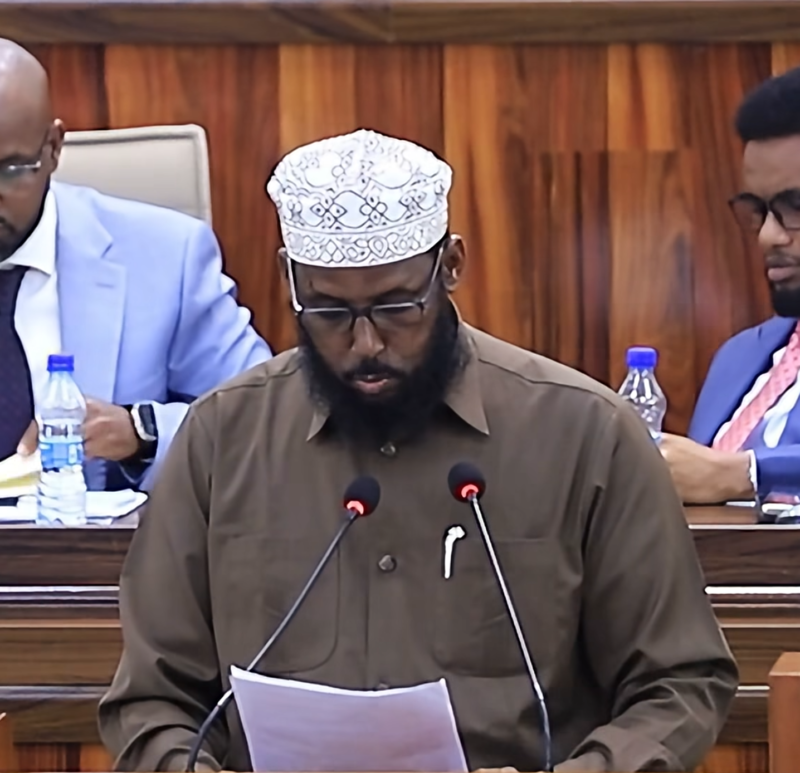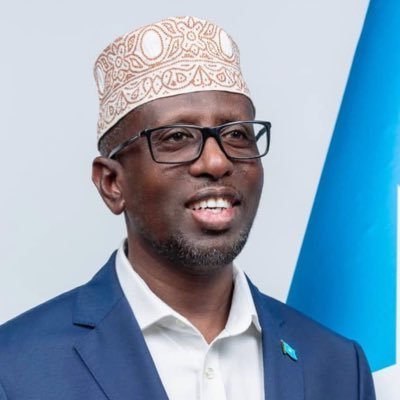

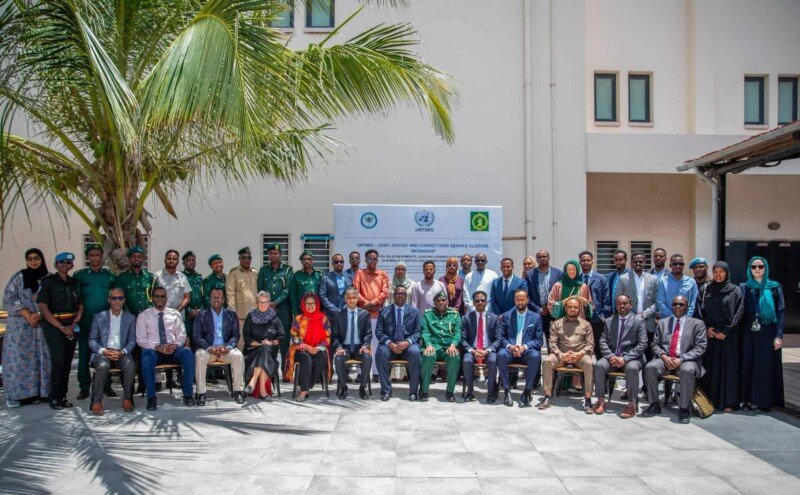
MOGADISHU — The Minister of Justice and Constitutional Affairs of the Federal Government of Somalia, Hassan Moallim Mohamud, has participated in a meeting marking the conclusion of UNTMIS support for Somalia’s justice and corrections services .
The workshop brought together officials from the Federal Government and Federal Member States, representatives from the United Nations and UNTMIS, justice and corrections agencies, and international partners supporting Somalia . Minister Mohamud expressed gratitude to the United Nations, UNTMIS, and other partners for their support in developing Somalia’s justice and corrections institutions, building institutional capacity, and strengthening the rule of law .
The Minister stated that the conclusion of UNTMIS activities represents an important milestone that further strengthens the Federal Government’s national responsibility for the justice sector . He reaffirmed the government’s commitment to continuing the development of Somalia’s justice system and national institutions. He also emphasized that the knowledge, experience, and institutional capacity developed during UNTMIS’s engagement would serve as a foundation for further advancing the country’s justice system .
Commissioner of the National Independent Human Rights Commission Farhan Jimale called for stronger national ownership, independent oversight and institutional cooperation as Somalia enters a new phase in justice and corrections. He emphasized that justice and corrections are fundamentally human rights matters, stressing that people deprived of their liberty retain their dignity and fundamental rights. The workshop marked the conclusion of 13 years of UN rule-of-law support through UNSOM and UNTMIS .
Broader UN Transition and Withdrawal
The conclusion of UNTMIS justice support is part of a broader transition of UN operations in Somalia . The United Nations Assistance Mission in Somalia (UNSOM) closed its operations on 31 October 2024 and was succeeded by the United Nations Transitional Assistance Mission in Somalia (UNTMIS) on 1 November 2024, in line with UN Security Council resolution 2753 . The transition reflects progress in the country and aligns with the Federal Government’s request for a two-year phased transfer of UNSOM’s functions to the United Nations Country Team by October 2026 .
In November 2025, UNSOM began implementing its plan to end operations in the country, with the handover of the mission office in Dhusamareb, the capital of Galmudug State, marking the start of the withdrawal process . The UN transferred a fortified compound in Dhusamareb to Galmudug’s regional administration under Ahmed Abdi Kariye Qoorqoor. UN representative James Swan stated that the UN had built and equipped the compound for operations in Galmudug but that due to financial constraints and the planned closure of UNTMIS in October 2026, the facility would be handed over to the Galmudug government .
The UN Security Council unanimously adopted Resolution 2809 (2025), voting to extend the authorization for the African Union Support and Stabilization Mission in Somalia (AUSSOM) until December 31, 2026. The Council also decided that UNTMIS will conclude its transition and cease all operations by October 31, 2026 .
The transition is structured in two main phases. Phase One (November 2024 – October 2025) prioritized support and capacity building in state-building, human rights, rule of law, security sector support, coordination of international aid, and counter-violent extremism . Phase Two (November 2025 – October 2026) involves the progressive transfer of all remaining functions to the Federal Government, the UN Country Team and other partners, leading to the mission’s conclusion .
James Swan was officially appointed as the UN Secretary-General’s Special Representative for Somalia and Head of UNTMIS in March 2025 . Swan has engaged with both federal and state leaders, including Puntland President Said Abdullahi Deni, to discuss security, humanitarian and development priorities, and federal relations .
However, the UN transition has been complicated by a significant funding crisis. The United States has announced it will terminate all financial and logistical support for the United Nations Support Office in Somalia (UNSOS) by December 31, 2026 . UNSOS has issued a public tender seeking qualified auctioneers to sell a wide range of UN-owned equipment and vehicles, including generators, medical and laboratory equipment, prefabricated accommodation materials, and heavy construction machinery. The auction comes amid growing uncertainty over the future of the UN mission in Somalia, following the US decision to end critical funding for UNSOS by December 31, 2026.
Critical Note
The conclusion of UNTMIS support for Somalia’s justice and corrections services represents a significant milestone in the country’s transition toward greater national ownership. The international community’s investment in building Somalia’s justice institutions over the past 13 years has been substantial, and the government’s commitment to continuing these reforms is welcome.
However, the broader UN transition is occurring against a backdrop of significant uncertainty. The U.S. decision to cut funding for UNSOS threatens to undermine the logistical backbone that sustains AUSSOM and other international operations in Somalia. The planned auction of UN assets without clear public oversight raises serious transparency and corruption concerns.
Without sustained commitment and accountability from both the Somali government and its international partners, the risk is that the progress made over the past decade will be eroded. The international community must ensure that the transition is managed transparently and that security gains are preserved.
Recommended Reading On ftlsomalia.com
- Foreign Affairs Minister Meets UNTMIS Delegation
- UN to Close Somalia Political Office, Extend AU Mission Until 2026
- New UNTMIS Office Opened in Mogadishu
- UN Transfers Fortified Compound to Galmudug State
- Somali Foreign Minister Meets UN Team, Stresses Somali-Led Transition
- UN Security Council Extends AU Mission in Somalia
- Swan Officially Appointed SRSG for Somalia
- UN and Somalia Advance Security Transition Plans
- UNSOM to Transition to UNTMIS Over the Next Two Years
- Fiqi Concludes Meeting on UNTMIS Transition Roadmap
- Deni Holds Talks with UN Envoy on Security, Development, and Federal Relations
- UNSOS Seeks Auctioneers for $30 Million Disposal of UN Equipment