
MOGADISHU — President Hassan Sheikh Mohamud is confronting a rapid and highly consequential unraveling of his political coalition, as a string of influential allies abandon his camp in the final stretch of his term – a moment many analysts say could redefine the country’s immediate political trajectory.
What began as isolated departures has, in recent weeks, evolved into a steady exodus of figures who were once central to Mohamud’s 2022 re-election victory. The symbolism is difficult to ignore: a political machine that once projected breadth and inclusivity now appears to be thinning at its core.
During that campaign, Mohamud brushed aside claims that his political “train” had reached capacity, arguing instead that it was expansive enough to carry all who wished to join. Today, that metaphor has taken on a different meaning. Rather than struggling to board, key allies are stepping off – an indication, critics argue, that the coalition may have failed to sustain even its earliest supporters.
Party Secretary-General Resigns, Cites Presidential Intransigence
The first major rupture came with Abdiasis Laftagareen, the ousted South West State leader and deputy head of the ruling Justice and Solidarity Party (JSP), whose departure signaled early discontent within senior ranks. Laftagareen was removed from power last month in a federal military operation after a disputed election that the federal government rejected outright, declaring it invalid and unconstitutional. On March 30, federal troops took control of Baidoa, and following intense, closed-door negotiations, Laftagareen agreed to step down and subsequently departed for Nairobi, Kenya.
He was soon followed by Abdirahman Odowaa, the party’s secretary-general. Odowaa officially declared his resignation on March 24, publicly revealing a notable and deepening rift within the country’s central political leadership. In a strongly worded departure statement, Odowaa explicitly criticized President Mohamud for “obduracy and intransigence,” highlighting a fundamental, irreconcilable disagreement regarding the federal administration’s current political and legislative path.
Political analysts in Mogadishu perceive this high-profile resignation as a substantial setback to the President’s closest inner circle, arriving during a volatile period of rapidly increasing regional and domestic tension.
Additional Defections: Sanbalolshe, Nur, and Madale
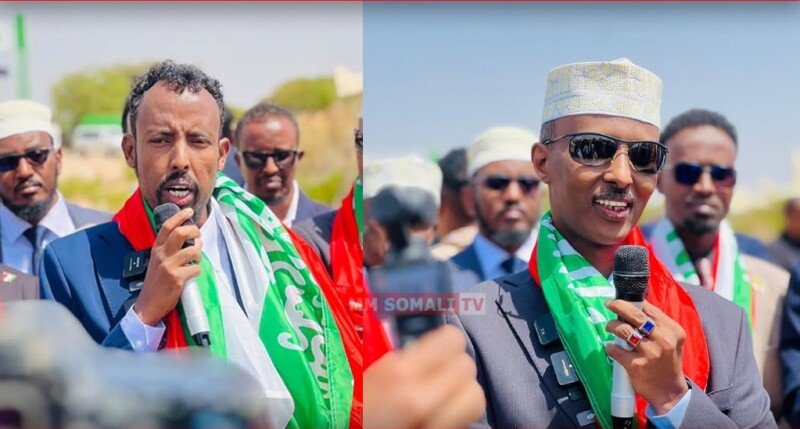
The exits quickly gained momentum: former intelligence chief Abdullahi Mohamed Sanbalolshe, longtime ally Abdullahi Mohamed Nur, and former Mogadishu mayor Yusuf Jimale Madale each severed ties with the president’s inner circle.
Tensions have escalated further as Puntland authorities have explicitly accused President Mohamud of arming clan militias to destabilize and undermine the regional administration. Faysal Ali Jifo-Jabsade, the Puntland governor of the Mudug region, stated that the federal government had purposefully failed to support Puntland’s ongoing military campaign against ISIS militants and alleged that injured regional fighters were denied critical medical treatment in the capital.
Individually, these figures carry weight. Collectively, they represent a significant political shift.
Unfulfilled Ambitions and a Fractured Coalition
Many of those now defecting had backed Mohamud’s return to power with expectations of advancing their own political agendas. Observers say those ambitions were left largely unfulfilled, as the president resisted opening the political space they had anticipated in exchange for their support. Their departure reflects not only personal calculations but also a broader reassessment of where power may be heading.
For Mohamud, a fragmented opposition has long been a strategic advantage, potentially allowing him to extend his grip on power without the pressure of a fully inclusive and broadly agreed electoral process. In recent years, he has worked to divide rival factions and successfully attracted some opposition figures into his camp.
Now, that equation appears to be shifting. The latest wave of defections cuts against the president’s strategy in a critical way. Those leaving are widely regarded as more politically influential than the figures previously drawn into his orbit. Many come from powerful Hawiye sub-clans with deep-rooted influence in Mogadishu and neighboring regions, amplifying the potential impact of their exit on the balance of power.
President Downplays Crisis, Opposition Threatens Parallel Government
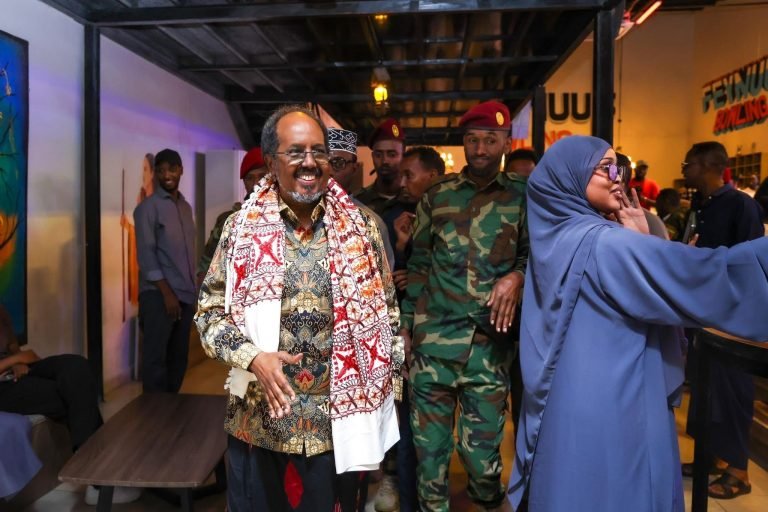
Speaking at a recent event, President Mohamud downplayed the political crisis, framing it as a routine disagreement seen in many countries. He expressed confidence that it would be resolved calmly and without escalation.
Puntland President Said Abdullahi Deni has issued a stark warning that Somalia’s federal government will no longer be recognized if a broad political agreement is not reached before President Mohamud’s term ends on May 15. “From the 15th of next month, should no broadly acceptable solution to all Somalis be reached, the federal government will no longer be considered in existence,” Deni said.
Precedent for Defections and Political Realignment
In Somalia’s political tradition, it is not unusual for alliances to shift as elections approach. Politicians often distance themselves from incumbents when they sense vulnerability, seeking to reposition ahead of what they perceive as a turning tide. What sets this moment apart is its timing: these defections are unfolding with roughly two weeks still remaining in the president’s term – far earlier than such realignments typically intensify.
The expectation in Mogadishu is that more departures may follow.
At the same time, opposition groups are moving quickly to capitalize on the moment, absorbing experienced and recognizable figures into their ranks. Their objective is becoming clearer: to mount a credible challenge that could either force the president from office or compel a consensus on an electoral process before his mandate expires.
Outlook
For Mohamud, the challenge is no longer simply managing dissent but containing a narrative that his coalition is weakening at a critical juncture. For the opposition, the opportunity lies in transforming momentum into a unified front strong enough to reshape the political landscape.
Whether this moment marks a temporary period of instability or the beginning of a deeper political realignment remains uncertain. What is clear is that Somalia’s political center of gravity is shifting – and quickly.
The escalating confrontation between Mogadishu and opposition figures recalls the political crisis of 2021, when prolonged disputes over delayed elections escalated into armed clashes on the streets of the capital. The coming days are likely to be decisive, as the international community, including the United Nations, African Union, and European Union, continues to monitor the situation closely and urges all stakeholders to engage in constructive dialogue.