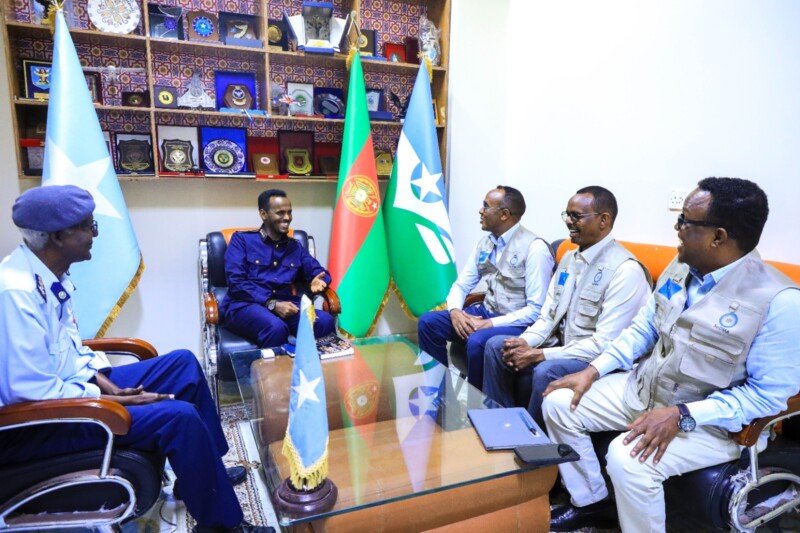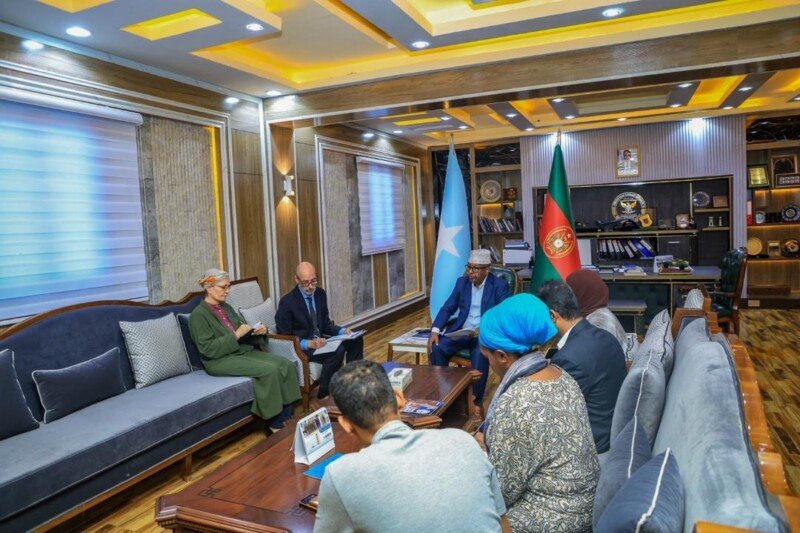

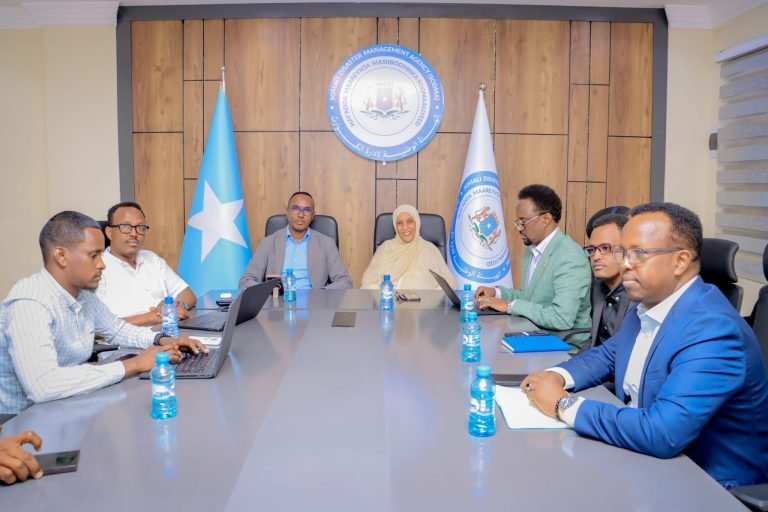
MOGADISHU — The Commissioner of the Somali Disaster Management Agency (SoDMA), Mahamuud Moallim Abdulle, has received the Chairperson of the National Independent Human Rights Commission (NIHRC), Dr. Maryan Qasim, at the agency’s headquarters in Mogadishu to discuss strengthening cooperation, information sharing, and the humanitarian situation facing vulnerable communities affected by disasters.
The meeting focused on enhancing collaboration between the two institutions, exchanging data on humanitarian needs, and improving response mechanisms for communities affected by crises. SoDMA officials briefed the Human Rights Commission on the agency’s efforts in disaster preparedness, response, and humanitarian assistance delivery.
Dr. Maryan Qasim was elected Chairperson of Somalia’s Independent Human Rights Commission in February 2026, bringing over forty years of expertise in public administration, health, education, and humanitarian affairs to the role . The commission consists of nine members chosen through a merit-based selection process conducted in May 2025. Both sides agreed to strengthen cooperation and information sharing to improve humanitarian response. Commissioner Abdulle described the meeting as important for enhancing coordination between government institutions and supporting Somali communities facing humanitarian challenges.
SoDMA has been actively assessing humanitarian conditions in affected areas, including a recent assessment mission to Buur Hakaba in the Bay region, where the team evaluated the needs of communities affected by drought and other humanitarian challenges. The mission included representatives from the United Nations, led by Deputy Special Representative George Conway.
Strengthening Humanitarian Coordination
The meeting between SoDMA and the National Human Rights Commission reflects ongoing efforts to strengthen coordination between government institutions working on humanitarian issues. The National Independent Human Rights Commission was formally established in December 2025 when President Hassan Sheikh Mohamud signed legislation creating the commission, following ratification by both chambers of the federal parliament . The commission is mandated to promote and protect human rights, monitor compliance with constitutional standards, and investigate complaints of violations.
The creation of the NIHRC fulfills a key requirement of the Provisional Constitution and represents a significant milestone in Somalia’s state-building process . The establishment of a homegrown watchdog offers a renewed promise of dignity and protection after decades of conflict and displacement.
The Council of Ministers officially endorsed nine individuals to serve as members of the National Human Rights Commission, bringing a wide array of professional experience spanning law, social work, civil society, and advocacy. The commission is now expected to begin operationalizing its mandate and collaborating closely with other justice sector bodies and civil society actors.
The NIHRC has held high-level strategic meetings with Switzerland’s Ambassador to Somalia to advance the institutional framework for human rights protection in the country, with discussions focusing on the current operational landscape of human rights within the republic and identifying developmental opportunities.
The NIHRC and the European Union have agreed to deepen their cooperation on human rights, accountability, and governance, with discussions centered on broadening support for the Commission’s activities, improving its institutional capacity, and fostering collaboration on rule of law, transparency, and protection of vulnerable communities.
SoDMA’s Expanding Humanitarian Role
SoDMA has been at the forefront of disaster management and humanitarian response in Somalia, coordinating with federal and regional authorities, UN agencies, and international partners to deliver life-saving assistance to affected communities. SoDMA has distributed emergency food aid to vulnerable families in the Caabudwaaq district as part of ongoing efforts to mitigate the impact of drought affecting communities across central Somalia.
SoDMA has delivered lifesaving aid to over 148,000 families across the country, providing essential relief assistance and coordinating the distribution of sacrificial meat during the Eid al-Adha holiday to more than 148,040 families.
SoDMA has been building disaster management capacity across Somalia, including training officials in disaster preparedness, prevention, and response in anticipation of the Super El Niño rains expected to bring flooding to parts of the country.
Critical Note
While the meeting between SoDMA and the National Human Rights Commission reflects a commitment to strengthening humanitarian coordination, the effectiveness of this partnership will ultimately depend on implementation and accountability. The humanitarian situation in Somalia remains dire, with 6.5 million people facing high levels of acute food insecurity and 1.9 million children suffering from acute malnutrition. The government’s ability to coordinate effectively with human rights institutions and ensure that humanitarian assistance reaches the most vulnerable communities will be a critical test of its disaster management capacity.
The National Human Rights Commission’s role in monitoring the protection of vulnerable populations during humanitarian crises is essential, but the Commission’s capacity to effectively carry out its mandate is limited by resource constraints and institutional weaknesses. Rights advocates caution that the commission’s credibility will hinge on its independence, resources, and ability to resist political pressure. The government must prioritise investment in both disaster management and human rights institutions to ensure that the rights of all citizens are protected during emergencies.