
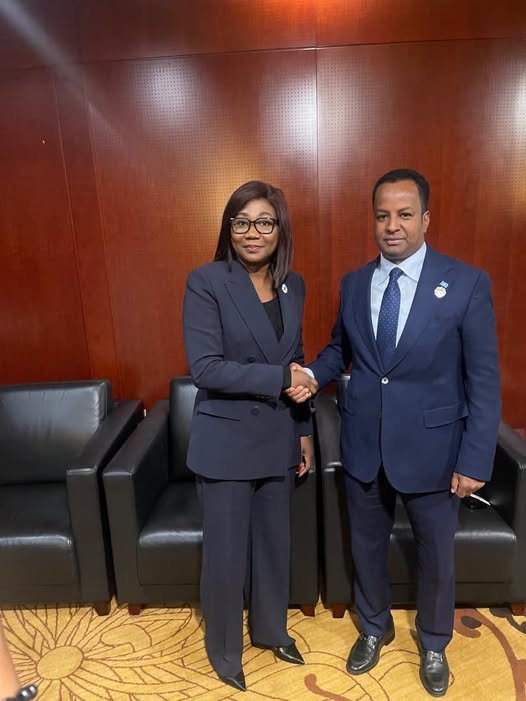
ADDIS ABABA – Somalia’s Minister of Foreign Affairs and International Cooperation, Abdisalam Abdi Ali, has held bilateral talks with his Central African Republic counterpart, Sylvie Baipo Temon, on the sidelines of the 49th Ordinary Session of the African Union Executive Council, as both nations reaffirmed their commitment to deepening cooperation on continental priorities, regional peace, and development.
The meeting, which took place at the AU Headquarters in Addis Ababa, focused on strengthening bilateral cooperation on AU priorities, regional peace, and development cooperation. Minister Temon reiterated the Central African Republic’s consistent support for Somalia’s sovereignty, unity, territorial integrity, and political independence, emphasizing the importance of upholding these principles as the foundation for regional stability and the international rules-based order. Both ministers underscored their commitment to continuing close cooperation within the AU and other international forums.
A Meeting of Convenience
The talks come as Somalia seeks to consolidate its diplomatic gains following its election to the African Union Peace and Security Council for the 2026–2028 period. The election to the PSC represents a significant diplomatic achievement for Mogadishu, demonstrating its expanding role in shaping Africa’s security framework. The Central African Republic’s reaffirmation of support for Somalia’s territorial integrity is a welcome diplomatic gesture, but it is also a reminder of the transactional nature of African diplomacy. CAR, like many other AU member states, has its own domestic challenges, and its support for Somalia is unlikely to translate into tangible action beyond diplomatic statements.
A Pattern of Rhetoric Without Follow-Through
The meeting between Abdisalam Abdi Ali and Sylvie Baipo Temon is part of a broader pattern of Somali diplomatic engagement at AU summits. The Foreign Minister has held a series of critical diplomatic meetings on the sidelines of the AU summit, focusing on the transition to the new security mission, regional stability, and strengthening bilateral ties with key partners. Somalia previously attended the 48th Ordinary Session of the AU Executive Council, reviewing a comprehensive agenda critical to the continent’s strategic direction.
Yet for all the diplomatic activity, the gap between rhetoric and reality remains wide. Somalia’s foreign policy has succeeded in securing high-level meetings and signing agreements, but translating these into tangible improvements in the lives of ordinary Somalis has proven elusive. The Central African Republic’s support for Somalia’s sovereignty is a welcome gesture, but it does not address the governance failures and institutional weaknesses that continue to undermine Somalia’s stability.
Strengthening Regional Partnerships
The meeting also reflects Somalia’s broader diplomatic push to strengthen ties with African nations. Somalia and the AU have pledged stronger cooperation in key talks, with the AU reaffirming its commitment to standing by Somalia as it builds a united and peaceful nation. The AU has doubled its peace fund allocation to the Somalia mission, reflecting the continent’s commitment to supporting Somali-led stabilization efforts.
However, the meeting with CAR also underscores the limitations of Somali diplomacy. While Mogadishu has successfully cultivated a network of diplomatic relationships, it has struggled to convert these into concrete support for its security transition and economic recovery. The CAR meeting is a diplomatic success, but it is unlikely to result in significant material support for Somalia’s reconstruction.
Way Forward
The bilateral meeting between Somalia and the Central African Republic is a reminder of the importance of diplomatic engagement in advancing national interests. However, it is also a reminder of the limits of diplomacy in the absence of effective governance and institutional capacity. The Somali government has become adept at attending international forums and presenting ambitious plans, but translating these into tangible improvements in the lives of ordinary Somalis has proven elusive. Until Somalia’s leaders prioritize the needs of their people over diplomatic posturing, meetings like these will remain symbolic gestures rather than meaningful steps toward recovery.
Recommended Reading On ftlsomalia.com
- Somalia Wins Seat on African Union Peace and Security Council for 2026–2028
- Foreign Minister Abdisalam Ali Holds High-Level Talks at AU Summit
- Somali Foreign Minister at AU Executive Council Session
- Somalia and AU Pledge Stronger Cooperation in Key Talks
- AU Doubles Peace Fund Allocation to Somalia Mission
- Somalia Joins African Union Peace and Security Council for First Time