
NEW YORK – The African members of the UN Security Council, the Democratic Republic of the Congo, Liberia, and Somalia, have issued a strong joint statement reaffirming their commitment to Yemen’s sovereignty and warning against external interference, as tensions in the country escalate following unauthorised Iranian flights and Houthi attacks on Saudi Arabia.
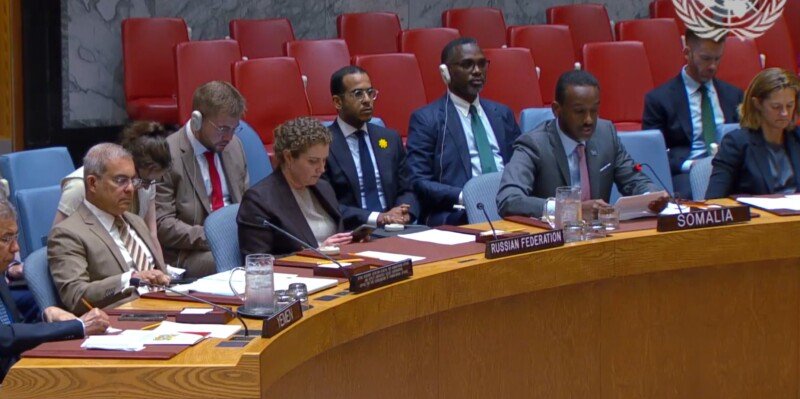
The statement was delivered during an emergency Security Council session on 13 July 2026, convened at the request of the Yemeni government following a series of developments that have threatened to unravel the relative calm Yemen has experienced since the 2022 truce agreement.
Unauthorised Flights and Escalating Tensions
Briefing the Council, Assistant Secretary-General Khaled Khiari reported that on 3 July 2026, an Iranian aircraft travelled from Tehran to Sana’a International Airport before returning to Tehran, reportedly transporting a Houthi delegation to attend the funeral of Iran’s late Supreme Leader. The Yemeni government viewed this flight as a violation of its airspace and sovereignty.
On the day of the Security Council session, another Iranian plane carrying a Houthi delegation returning from Tehran reportedly landed at Hudaydah Airport. This followed reports of airstrikes at Sana’a International Airport, which the Houthis attributed to Saudi Arabia. According to the Yemeni government, the strikes targeted the airport runway to prevent the Iranian flight from landing. The Yemeni government had earlier warned Iran against unauthorised flights and vowed to take all necessary measures.
Following the reported airstrikes, the Houthis announced the “end of the de-escalation phase” with Saudi Arabia and reportedly launched ballistic missiles against the Kingdom, which were intercepted.
A3 Statement: Sovereignty and Non-Interference
In their joint statement, the A3 countries, Somalia, the Democratic Republic of the Congo, and Liberia—reaffirmed their “unwavering commitment to the sovereignty, independence, unity, and territorial integrity of Yemen.” They stressed that “all external action that infringes on Yemen’s sovereignty or risks expanding the conflict must not be tolerated.”
The African members emphasised that “insulating Yemen from the broader conflict unfolding in the Middle East is essential to regional and international peace and security.” This reflects growing concern that Yemen’s protracted war is being drawn deeper into regional rivalries, particularly following recent attacks on Iran by Israel and the United States.
Concern Over Renewed Hostilities
The A3 expressed deep concern over the renewed tensions in Yemen and recent attacks near the port of Hodeidah, where Houthi forces launched an attack south of the city, killing 14 soldiers of the internationally recognised Yemeni government forces. The group noted that “the hostilities only prolong the conflict and undermine ongoing efforts toward a negotiated settlement.”
The A3 called on all parties to de-escalate and engage constructively under the United Nations-led political process, reaffirming firm support for the efforts of UN Special Envoy Hans Grundberg. “A lasting resolution can only be achieved through an inclusive Yemeni-led and Yemeni-owned political process,” the statement declared.
Humanitarian Crisis at Breaking Point
The African members also highlighted the dire humanitarian situation in Yemen, noting that “the humanitarian crisis in Yemen is reaching an alarming breaking point.” As the country enters the peak lean season, more than 22 million people, over half the population, require humanitarian assistance and protection services. This includes 5.2 million internally displaced persons, 329,000 migrants, and 63,000 refugees and asylum seekers.
Humanitarian food assistance needs are expected to peak at 15 to 16 million people during the July to September lean season. The UN has warned of worsening food insecurity affecting 18.3 million people, while over 2.2 million children under five suffer from acute malnutrition.
The A3 called on the international community to “maintain and increase predictable funding” for Yemen’s humanitarian response, noting that funding constraints continue to place significant pressure on humanitarian operations.
Detention of UN Personnel
The A3 expressed deep concern over the continued detention of UN personnel, humanitarian workers, NGO staff, civil society representatives, and personnel associated with diplomatic missions by the Houthis. As of February 2026, 73 UN staff members and dozens of other humanitarian workers remain detained by the Houthis, all of whom are Yemeni nationals. One UN staff member has died in detention.
The A3 reiterated their call for the “immediate, safe, and unconditional release of all those detained.” At the same time, they welcomed the recent UN-brokered agreement to release over 1,600 detainees, the largest such release since the start of the conflict, and encouraged efforts to build on this positive momentum toward its full implementation.
UN Envoy’s Engagement
UN Special Envoy Hans Grundberg has been actively engaging with the parties to urge de-escalation. On 14 July, he held talks in Muscat with senior Omani officials and the Houthis’ chief negotiator, Mohammed Abdul Salam, focusing on the need for “immediate de-escalation” and preserving the relative calm Yemen has experienced since the 2022 truce agreement.
Grundberg stressed the necessity for Yemeni parties to engage in UN-sponsored negotiations across the political, military and security, and economic tracks of the mediation process. “Unilateral measures will not bring Yemen closer to peace,” Khiari warned the Council. “On the contrary, they risk entrenching divisions, accelerating fragmentation and heightening the danger of renewed escalation and military confrontation.”
Way Forward
In closing, the A3 affirmed their support for “the legitimate aspirations of the Yemeni people” and underscored that “the path towards lasting peace lies through dialogue, compromise, and sustained political engagement.” The Council members stressed the need to fully respect international law, including the UN Charter, international humanitarian law, and international human rights law.
As Yemen faces one of its most precarious moments since the 2022 truce, the international community’s ability to prevent a wider escalation and address the deepening humanitarian crisis remains critically important.
Recommended Reading On ftlsomalia.com
- UN Security Council Condemns Houthi Attacks on Saudi Arabia
- Iranian Flights to Yemen Spark Security Council Emergency Session
- Bahrain Warns Against Support for Houthis at UN Security Council
- UN Envoy Warns Yemen Conflict Risks Wider Escalation
- Security Council Resolution 2817 Condemns Iranian Support for Houthis
- A3 Countries Call for Yemen Ceasefire and Humanitarian Access