
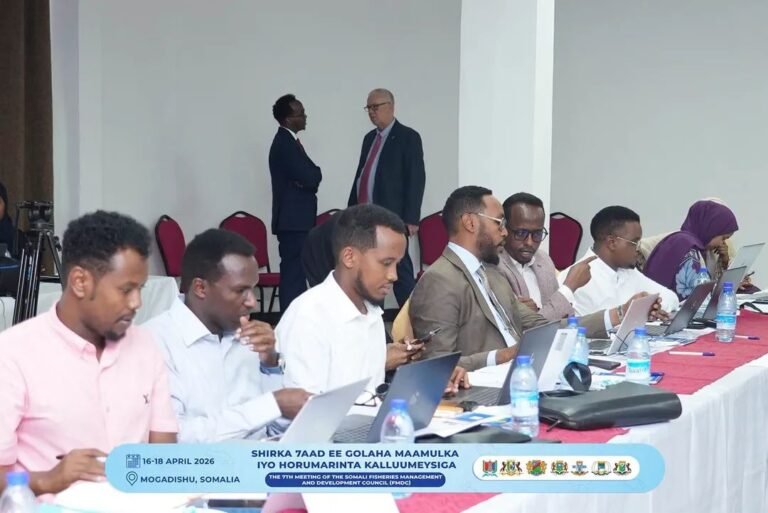
MOGADISHU — The Federal Government of Somalia, through the Ministry of Fisheries and Blue Economy, has launched the seventh quarterly meeting of the Fisheries Management and Development Council (FMDC) in Mogadishu. Taking place from April 16 to 18, 2026, this high-level assembly unites federal authorities, state ministries, and key sector stakeholders to discuss the sustainable management of the country’s vast marine resources .
Led by Federal Minister of Fisheries and Blue Economy, Ahmed Hassan Adem, the council serves as the main coordinating entity for marine and fisheries policy nationwide. The sessions concentrate on harmonizing legislative frameworks, addressing inter-sector conflicts, and ensuring Somalia’s ocean resources are managed equitably and sustainably .
The event brings together representatives from all government levels, including Iidle Siyaar Sh Khalif, Fisheries Minister for Hirshabelle State; Garad Yusuf Mohamud from Galmudug; Abdirahman Mohamed Ali of South West State; and Abdiaziz Osman Mohamed, Deputy Mayor of Benadir Regional Administration .
Somalia’s Blue Economy Holds Billion-Dollar Promise
Somalia possesses Africa’s longest coastline, stretching over 3,300 kilometers, and holds some of the richest fishing grounds in the region. Director General of the Ministry of Fisheries and Blue Economy, Abdi Dirshe, has emphasized that the country’s vast maritime resources could generate billions of dollars annually if managed effectively. He described the blue economy as a cornerstone for sustainable growth and national prosperity .
“Somalia’s blue economy can transform livelihoods and strengthen our economy, but only if we protect it. Illegal fishing is not just a theft of resources—it’s a theft of opportunity from our people,” Dirshe said .
Combating Illegal Fishing and Strengthening Oversight
Working under its official mandate, the FMDC is responsible for implementing ambitious sustainable development policies. The current session’s main goals include promoting rapid Blue Economy growth while maintaining strict ecological conservation. Discussions specifically aim to encourage sustainable fishing practices, protect vulnerable marine ecosystems, and improve the livelihoods of coastal communities reliant on ocean resources .
The Somalia Fisheries Competent Authority has been officially launched by the Ministry of Fisheries and Blue Economy, marking a significant milestone for the country. The authority aims to ensure responsible usage of marine resources, fostering economic growth, and improving food security for local communities dependent on fishing .
Officials are also establishing a well-regulated, transparent economic framework to attract both domestic and foreign investment. The Ministry of Fisheries and Blue Economy hosted a high-level forum aimed at unlocking the country’s rich but underutilized marine resources, where Minister Adem underscored Somalia’s commitment to becoming a regional hub for sustainable fisheries and maritime investment .
“Our coastline is one of the longest in Africa, yet remains largely untapped. We are inviting the world—and especially Somali entrepreneurs—to seize this opportunity,” Minister Adem said .
China Lifts Tariffs on Somali Seafood Imports
A key development in the fisheries sector has been China’s decision to lift domestic tariffs on seafood imports from Somalia. The new policy allows Somali-owned and joint-venture companies to export seafood products to the Chinese market tariff-free, presenting what Minister Adem described as “a transformational opportunity” for Somali entrepreneurs to lead the growth of a prosperous and sustainable blue economy .
Turkey-Somalia Fisheries Partnership: Somtürk
Somalia has established a major collaborative fisheries enterprise with Turkey. The Federal Government has officially introduced Somtürk, a joint venture formed between the Somali Fisheries Company and Turkey’s OYAK Group, with the strategic objective of advancing the nation’s blue economy and promoting the sustainable management of marine resources .
Second Deputy Prime Minister Jibril Abdirashid Haji characterized the project as a pivotal advancement for economic growth and the responsible, structured exploitation of Somalia’s extensive oceanic assets. According to federal authorities, Somtürk intends to improve fisheries production and oversight, safeguard marine ecosystems, and strictly address illegal, unreported, and unregulated (IUU) fishing activities .
Minister Ahmed Hassan Adan concluded a major accord with Turkish conglomerate OYAK in Ankara, launching the Cooperation and Marine Production Development initiative. The accord concentrates on increasing fish production to align with international market requirements, creating local processing facilities, and enhancing the technical expertise of Somali fishermen. It also encompasses comprehensive measures against illegal fishing and seeks to create thousands of jobs, particularly for youth and populations in coastal regions .
Turkey’s Commitment to Somalia’s Marine Sector
Minister Adem met with Turkish Ambassador to Somalia, Alper Aktaş, in Mogadishu to advance bilateral cooperation in the sustainable development of Somalia’s marine resources. The two officials discussed expanding collaboration in sustainable fisheries, aquaculture, and investment in Somalia’s vast marine sector .
Adem emphasized that Türkiye’s experience and technical expertise in fisheries and aquaculture could greatly benefit Somalia’s national development goals. Ambassador Aktaş reaffirmed Türkiye’s continued support and interest in deepening cooperation with Somalia, particularly in sectors that promote economic growth and environmental sustainability .
UNDP Partnership and Blue Economy Agenda
Somalia’s State Minister for Finance, Planning and Economic Development, Yusuf Mohamed Waliid, held a key meeting with Christopher Laker, Deputy Resident Representative of the UNDP in Somalia, to explore avenues for expanding cooperation in the blue economy sector. The high-level discussion focused on strategies to unlock Somalia’s vast and largely untapped marine resources .
“Our coastline offers immense opportunities for fisheries, maritime transport, and marine biodiversity conservation. To harness these assets effectively, Somalia needs stronger institutional support, technical expertise, and investment partnerships — areas where UNDP’s role is vital,” Waliid said .
Both sides agreed to establish a joint technical working group to assess key blue economy priorities and identify short-term and long-term support mechanisms .
Coordinated Approach Across Federal and State Levels
A key feature of the FMDC structure is its commitment to collective implementation. Agenda items, from aligning domestic policies with international conservation standards to creating localized fishery management plans, are jointly adopted and implemented across all federal and regional administrations. This coordinated approach ensures conference outcomes translate into synchronized on-the-ground actions .
The Ministry of Fisheries and Blue Economy has previously convened quarterly National Blue Economy Forums bringing together stakeholders to assess progress, review ongoing initiatives, and strategize for future growth. Participants have consistently agreed on the need to enhance public awareness and accelerate efforts to harness Somalia’s vast blue economy potential .
By emphasizing unified federal-state collaboration, the Council seeks to avoid policy division, enhance national unity, and advance progress toward securing Somalia’s long-term marine and economic stability .
Second Deputy Prime Minister Jibriil Abdirashiid Abdi addressed the 21st UNIDO General Conference, stating that the nation is at a “historic and decisive moment” while seeking international investment and expanding its blue-economy prospects. He indicated that Somalia is intensifying initiatives to enhance food security, increase fisheries production, and attract new investments into emerging blue-economy sectors .
The Federal Government continues to reaffirm its commitment to the advancement of the fishing sector. Director General Abdi Dirshe has assured fishermen and other stakeholders in the sector that the government is ready to avail all resources they need to thrive, emphasizing that with the right reforms and investment in monitoring technologies, Somalia could turn its waters into one of its greatest sources of economic resilience and pride .