
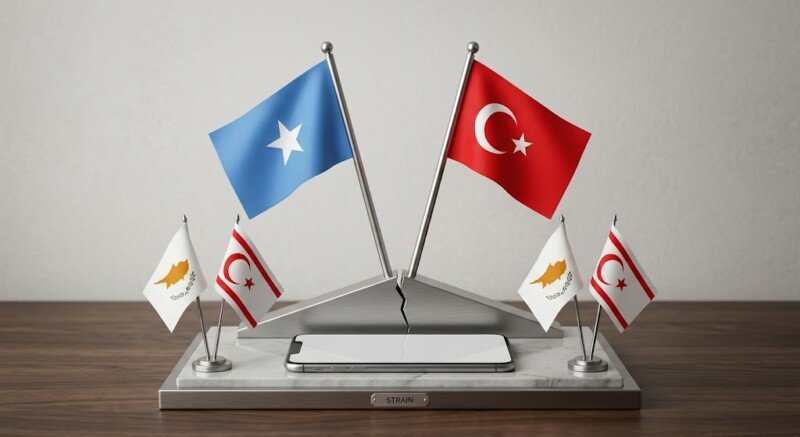
MOGADISHU — The Federal Government of Somalia has issued a statement clarifying that its position on the Cyprus issue remains unchanged, following public controversy over a social media post by the newly elected Speaker of the House of the People that referred to the Turkish Republic of Northern Cyprus by its disputed title.
The Ministry of Foreign Affairs and International Cooperation reaffirmed Somalia’s full respect for the sovereignty, independence, unity and territorial integrity of the Republic of Cyprus, in accordance with international law and United Nations Security Council Resolutions 541 (1983) and 550 (1984). The statement emphasized that the referenced personal communication does not reflect any change in Somalia’s foreign policy and does not constitute recognition of any separate entity in the northern part of Cyprus.
The controversy began when Speaker Abdulkadir Mohamed Nur posted a message on X thanking Dr. Ziya Öztürkler, whom he referred to as the “Speaker of the Assembly of the Turkish Republic of Northern Cyprus,” for congratulating him on his election. The post, which included a graphic featuring both men’s photographs and Somalia’s national emblem, drew immediate scrutiny given the international community’s non-recognition of Northern Cyprus, which is recognized only by Türkiye.
The Foreign Ministry’s clarification stated that no decision has been taken by the Federal Government to alter its established position, and that Somalia remains committed to a peaceful, negotiated and lasting settlement of the Cyprus issue under United Nations auspices.
Turkey’s Expanding Influence in Somalia
The incident comes against the backdrop of Turkey’s rapidly expanding influence in Somalia, following a high-level strategic meeting between President Hassan Sheikh Mohamud and Turkish President Recep Tayyip Erdoğan in Istanbul in April 2026. The two leaders reaffirmed their expanding strategic partnership across energy, trade, and security sectors, with Erdoğan stating that Ankara would continue taking steps to strengthen relations with Somalia across multiple sectors .
Turkey has also stepped into a mediation role in Somalia’s political crisis, with a Turkish delegation conducting separate meetings with federal government officials and opposition leaders following clashes in the capital. Diplomatic sources indicated that Turkey’s National Intelligence Organization (MIT) personnel participated in the talks, signaling that Ankara is bypassing formal diplomatic channels in favor of direct, discreet engagement with political and military actors .
A senior Turkish delegation led by Director General for the Africa Department Ali Onaner reaffirmed Ankara’s steadfast commitment to Somalia’s unity, sovereignty, and territorial integrity, continuing a long-standing partnership that spans security, development, and economic cooperation .
Cyprus and Somaliland Connection
The debate has also revived discussion over whether Cyprus should reconsider its position on Somaliland. Cyprus was among the European countries that publicly backed Somalia’s sovereignty and territorial integrity following Israel’s recognition of Somaliland in December 2025. International supporters of Somaliland contend that Cyprus has little strategic incentive to continue backing Somalia unconditionally if Mogadishu is willing to engage politically with Northern Cyprus while opposing international engagement with Somaliland.
Somaliland occupies a strategic position along the Gulf of Aden near the Bab el-Mandeb Strait, one of the world’s busiest maritime corridors. Advocates of closer Cyprus-Somaliland relations argue that cooperation could serve mutual interests in maritime security, trade and regional stability.
Turkey’s role in Somalia’s security sector has grown significantly, with Turkish Ambassador Alper Aktaş reaffirming Ankara’s commitment to rebuilding the Somali National Army. The relationship extends beyond financial aid into direct institutional capacity building through the TURKSOM Military Academy in Mogadishu, which has trained thousands of Somali soldiers and officers .
Critical Note
The Somali government’s clarification on Cyprus highlights the diplomatic tightrope Mogadishu walks in managing its relationships with Türkiye, its most important strategic partner, while maintaining credibility on territorial integrity issues. The Speaker’s reference to Northern Cyprus, whether intentional or not, has exposed a fundamental contradiction in Somalia’s foreign policy that critics have been quick to exploit.
While the Foreign Ministry’s statement may have contained the immediate diplomatic fallout, it does not fully resolve the underlying issue. A senior Somali official used the official title of an entity whose status is rejected by the United Nations and most of the international community. The government’s dismissal of this as a “personal communication” raises questions about the consistency of Somalia’s diplomatic protocol and the level of coordination between the executive and legislative branches on foreign policy matters.
Somalia’s growing dependence on Turkish support, military, economic and diplomatic, has increasingly shaped its international positions, sometimes at the expense of consistency with its own stated principles. The government must ensure that its strategic partnerships do not compromise its credibility on fundamental issues of sovereignty and territorial integrity, which are central to its own state-building project.
Recommended Reading On ftlsomalia.com
- Turkey Mediates Somalia Political Tensions
- Hassan Sheikh Mohamud and Erdoğan Hold Strategic Meeting in Istanbul to Strengthen Somalia-Turkey Alliance
- Somalia, Türkiye Mark 60 Years of Diplomatic Ties
- Turkey to Finish Somalia Offshore Drilling in 6-9 Months
- Somalia’s Defense Minister Holds Talks with Turkish Counterpart at SAHA 2026
- Foreign Minister Meets Turkish Delegation in Mogadishu