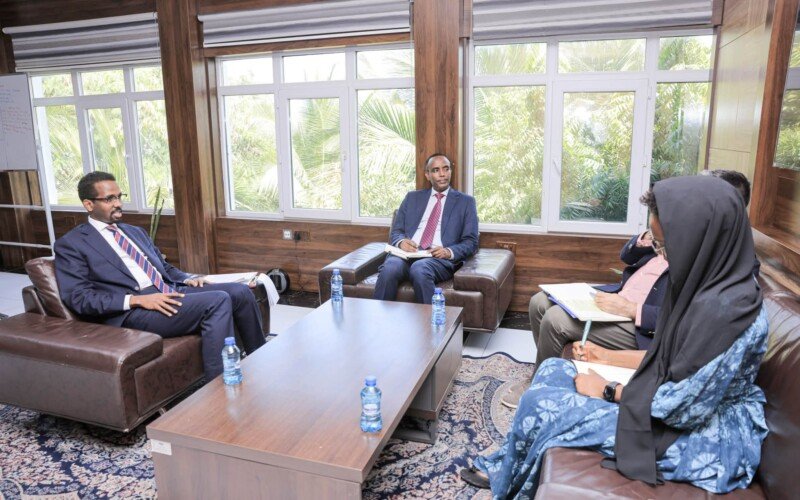


MOGADISHU: The Minister of Planning, Investment and Economic Development, Mohamud BeeneBeene, today received a high-level World Food Programme (WFP) delegation led by Assistant Executive Director for Program Operations, Matthew Hollingworth. The meeting focused on harmonizing WFP’s Country Strategic Plan with the government’s National Transformation Plan (NTP) 2025-2029, reinforcing national systems, and increasing resource mobilization during a period of declining global assistance.
Discussions emphasized the alignment of WFP’s upcoming country strategy with Somalia’s NTP, a five-year roadmap for economic growth, governance reforms, and infrastructure development launched by Prime Minister Hamza Abdi Barre. Intentional integration is seen as a way to ensure that international humanitarian and development efforts complement domestic priorities, avoid administrative overlap, and maximize the impact of every dollar. The WFP remains one of the federal government’s largest partners in delivering both humanitarian aid and development support.
A key driver of the conversation was the sharp decline in Official Development Assistance (ODA) for Somalia. According to a WFP statement, the UN agency is urgently appealing for $95 million to sustain critical food and nutrition operations through August 2026. Without immediate funding, programs could face complete shutdown, posing a severe threat to millions of Somalis already confronting drought conditions, including an estimated 4.4 million people experiencing critical food insecurity. The World Food Programme has warned that its lifesaving programs could be forced to shut down entirely without an immediate injection of funds.
Beyond the immediate funding crisis, the meeting also explored strategies for mobilizing alternative financing and building long-term resilience. The partnership aligns with WFP’s support in areas such as nutrition, school feeding, food assistance for assets, and climate adaptation. The meeting concluded with an agreement to establish a joint technical taskforce to ensure coherence between operational planning and development priorities, thereby enhancing programmatic effectiveness while improving Somalia’s ability to navigate a challenging donor landscape. Somalia and WFP have been working to align their strategies to tackle hunger and the effects of declining aid.
This high-level engagement mirrors similar strategic dialogues that Minister BeeneBeene has pursued with other UN agencies. Recently, he held negotiations with UNICEF Representative Sandra Lattouf to align UNICEF’s Country Programme (2026-2030) with the NTP, focusing on streamlining planning, monitoring, and joint resource mobilization targeting the current nutrition and food emergency. The government and UNICEF have coordinated development strategies to address the food and nutrition emergency. The consistent approach underscores the government’s push for a coordinated, government-led framework to manage nearly all development partnerships.
The WFP’s financial strain has already forced drastic reductions in aid. The number of emergency food aid recipients fell from 2.2 million in early 2025 to just over 600,000 currently. Crucial nutrition initiatives for expectant mothers and young children have also been severely scaled back. Without immediate donor pledges, Somalia risks catastrophic hunger, which carries grave humanitarian and security repercussions for the entire Horn of Africa. The Planning Ministry has previously reviewed WFP’s 2025 programs to assess their effectiveness and alignment with national priorities.
The National Transformation Plan 2025-2029, officially launched by Prime Minister Hamza Abdi Barre in February 2025, serves as Somalia’s medium-term development framework. It prioritizes economic recovery, governance reforms, infrastructure development, and human capital investment. The NTP was launched with the aim of driving sustainable development and reducing dependency on external aid. Minister BeeneBeene’s office has consistently emphasized the importance of aligning all international partner programs with this national roadmap.
The meeting concluded with both sides reaffirming their commitment to strengthening the partnership. Minister BeeneBeene confirmed that his ministry would continue implementing strict Results-Based Monitoring protocols across all projects to ensure tangible outcomes. The engagement signals that while international aid is shrinking, the government is methodically integrating what remains of external support into its national development architecture. WFP’s Matthew Hollingworth praised the federal government’s leadership in coordinating humanitarian and development efforts and pledged continued support for Somalia’s transition toward self-reliance.