
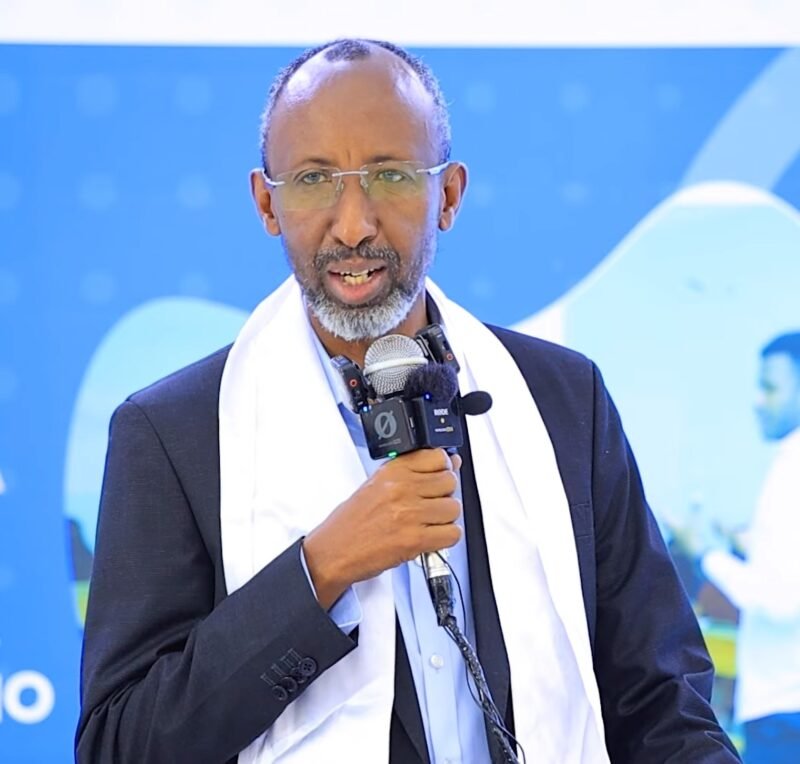
MOGADISHU: Somalia’s Education Minister, Farah Abdulkadir, announced on Monday that the federal government could potentially remain in office for up to two additional years following the scheduled expiration of President Hassan Sheikh Mohamud’s term on May 15. The statement has deepened an already volatile showdown with opposition leaders over the country’s electoral process and the interpretation of Somalia’s newly adopted constitution.
Speaking at a public gathering in the capital, Minister Abdulkadir, a close ally of the president, indicated that the administration could extend its stay in power by one to two years beyond the presidential term’s conclusion. Opposition leaders have already declared they will cease to recognize Mohamud as head of state once his current mandate concludes. The minister urged opposition members to engage in dialogue and refrain from what he characterized as actions motivated by individual political ambitions, stressing that attention should remain on settling electoral differences in a manner that preserves national stability.
Abdulkadir highlighted that the main disagreement between the administration and the opposition concerns the electoral framework: the opposition prefers an indirect election model, while the government advocates for a universal suffrage system. Though Somalia has relied on indirect electoral processes for many years, the minister said the current controversy is about transitioning to a new voting system rather than any question of governance continuity. Previous high-level negotiations between the Federal Government and the opposition Somali Future Council collapsed without resolution, revealing deep, ongoing disagreements over the nation’s electoral trajectory.
Opposition Sets May 15 Deadline
President Mohamud’s term is set to expire on May 15, with opposition lawmakers and the Somali Future Council insisting that the president will forfeit his legitimacy if that date arrives without a political consensus on elections. Opposition leaders have declared that President Mohamud will lose his legal authority after May 15, 2026, unless national elections are conducted or a constitutional alternative is agreed upon. After that date, they have said, he would be regarded as a former leader rather than a current one. The opposition has warned that if both parliamentary and presidential terms lapse without an agreement, it could proceed to establish a parallel federal administration.
At the same time, Prime Minister Hamza Abdi Barre has argued that the government possesses an extra year in power under a newly ratified constitutional framework approved by parliament. Somalia’s Federal Parliament adopted the revised constitution following a highly polarized review process, extending the presidential term from four to five years. However, the opposition and the regional administrations of Jubaland and Puntland have disputed this claim, asserting that the constitutional process was implemented without proper consultation and due procedure. Puntland authorities have expressed concern that Somalia is experiencing a constitutional vacuum and have called for urgent consultations to avert potential instability. The provisional constitution, which the opposition continues to cite, sets four-year terms for both parliament and the presidency.
May 10 Consultative Meeting and Electoral Process
Abdulkadir’s remarks came shortly after President Mohamud extended an invitation to opposition leaders for a national consultative meeting scheduled for May 10. President Mohamud formally invited the Somali Future Council to take part in a national consultative meeting scheduled for May 10, as part of ongoing federal efforts to promote inclusive political dialogue. The meeting is expected to address critical issues related to governance, national unity, and the country’s political trajectory, with the Federal Government maintaining that inclusive engagement remains essential for advancing stability and democratic processes.
Opposition representatives are anticipated to determine whether they will accept the government’s offer for dialogue and establish their stance on the electoral model before any negotiations begin. The Somali Future Council has voiced deep concern regarding substantial delays in the nation’s electoral process, accusing senior government officials of neglecting their constitutional obligations. The fundamental disagreement centers on the proposed electoral models: the federal administration supports a nationwide “one-person, one-vote” system, while the opposition and regional leaders have rejected that plan, calling instead for an indirect electoral approach. The diplomatic community has expressed profound concern over the impasse, with the United States, the United Kingdom, and the United Nations urging all sides to return to the table in good faith.
With the May 15 deadline approaching and no electoral framework in place, the political climate in Mogadishu has grown increasingly tense. The ongoing conflict over Somalia’s constitutional structure and the legitimacy of the electoral transition underscores persistent divisions that, if left unresolved, could trigger a protracted political crisis. Clan leaders have stepped into the deepening political standoff, taking on a central mediating role between the president and opposition leaders. The outcome of the May 10 consultative meeting remains uncertain, but both sides appear to be consolidating their positions as the deadline draws near.