
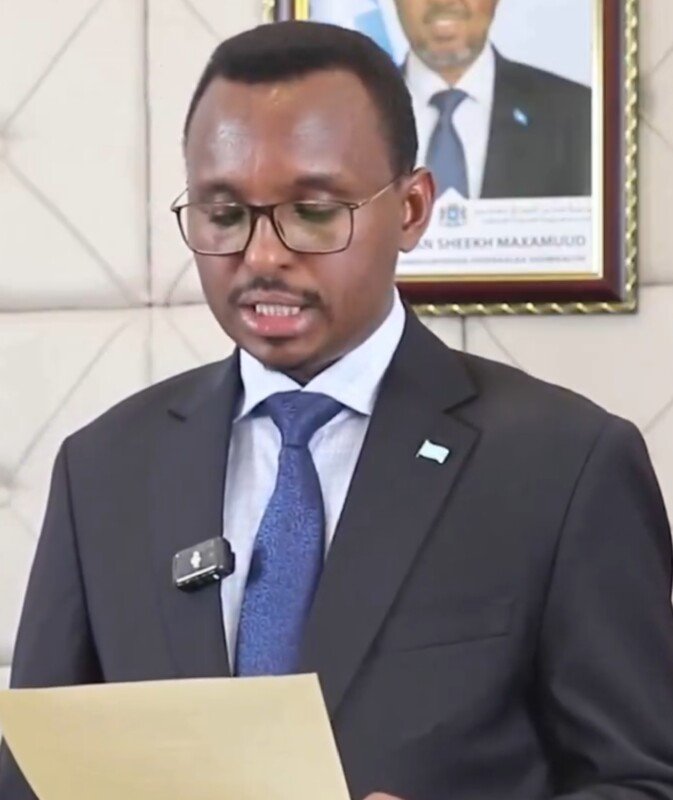
MOGADISHU — Somalia’s federal Office of the Auditor General has uncovered widespread weaknesses in governance, legal compliance, internal controls and the management of public assets, according to the 2025 Annual Compliance Audit Report released on June 30, 2026.
The report, presented by Auditor General Ahmed Isse Guutaale, revealed that 22 government agencies were audited for compliance with national laws, regulations, and procedures. Key findings included serious procurement irregularities, poor management of government assets, failure to implement internal audit systems, and non-compliance with human resource policies.
According to the report, 59 percent of audited government agencies failed to comply with legal procurement procedures, resulting in irregular expenditures totaling $18,554,459.67. The audit also found that 53 percent of agencies did not properly verify the qualifications and registration of service providers and consultants.
The Ministry of Foreign Affairs was cited for sending 14 diplomats abroad without fully meeting required conditions, while 19 employees were assigned to diplomatic missions without first completing mandatory diplomatic training.
The report also highlighted weaknesses in the management of government assets, including the absence of a proper vehicle registration system and failure to maintain accurate records of donated assets. The Ministry of Transport and Civil Aviation was found to have leased government properties to 10 private companies without following proper procurement procedures, and five of those companies had never paid taxes.
In addition, the audit found that 50 percent of government agencies had failed to implement internal audit systems, a significant weakness that the Auditor General described as requiring corrective action.
The OIOS audit of UNSOS highlighted deficiencies in records management, incomplete filing of procurement information, and a high vacancy rate in the Procurement Section, underscoring the broader challenges of oversight and accountability in Somalia’s public institutions.
Key Audit Findings
Among the most significant findings in the 2025 report:
- Procurement irregularities: 59% of agencies failed to comply with procurement laws, with irregular expenditures totaling over $18.5 million. 53% of agencies did not properly verify service provider qualifications.
- Asset mismanagement: The Ministry of Transport leased properties to 10 companies without following proper procedures; five companies had never paid taxes. The Ministry also failed to maintain a proper vehicle registration system.
- HR non-compliance: 14 diplomats were posted abroad without meeting required conditions; 19 employees were assigned without mandatory diplomatic training. 46% of agencies had not established required ethics and discipline committees.
- Weak internal controls: 50% of agencies had not implemented internal audit systems. The Ministry of Endowments had no policies for managing mosques and religious schools, and no Waqf committee had been established.
The Auditor General has previously highlighted Somalia’s progress in promoting openness in public financial management, including reforms aimed at improving digital systems for financial reporting and strengthening oversight institutions.
Follow-Up and Implementation
The Auditor General’s office also conducted a follow-up on previous audit recommendations. The 2025 follow-up found that 54% of recommendations had been fully implemented, 27% partially implemented, and 19% not yet implemented. This represents a significant improvement from 2019, when only 6% of recommendations were implemented, and 2020, when the rate stood at 24%.
The report noted that parliamentary committees have played an increasingly effective role in following up on audit findings, contributing to the steady rise in recommendation implementation rates. The Auditor General praised the Federal Parliament’s commitment to oversight, noting that this cooperation has been instrumental in advancing accountability.
The Auditor General has faced legal challenges, including a summons by the Benadir Regional Court in February 2025 on accusations of obstructing a court decision, which he denied, claiming the charges were politically motivated to disrupt his anti-corruption investigations.
Critical Note
While the 2025 Compliance Audit Report highlights significant governance weaknesses, the true test of accountability lies in the implementation of its recommendations. The report’s findings on procurement irregularities, asset mismanagement, and weak internal controls underscore the systemic challenges that continue to undermine public financial management in Somalia. The Auditor General’s office has previously flagged $21 million in missing government funds and uncovered embezzlement across multiple departments, highlighting the scale of the corruption challenge.
The improved follow-up rate of 54% is encouraging, but it also means that nearly half of all audit recommendations remain either partially or fully unimplemented. Without sustained political will, institutional capacity, and parliamentary oversight, these reports risk becoming an annual exercise in documentation rather than a catalyst for meaningful reform. The international community, which has invested heavily in Somalia’s state-building, must continue to press for accountability and transparency in the management of public resources.
Recommended Reading On ftlsomalia.com
- UNSOS Seeks Auctioneers for $30 Million Disposal of UN Equipment
- Somalia Showcases Anti-Corruption Reforms at Arab Transparency Forum
- Auditor General Summoned by Mogadishu Court
- Somalia’s Aid Dependency Crisis Deepens
- United States Halts Aid Programs to Somalia
- Somali MP Accuses President of Selling Citizenship