
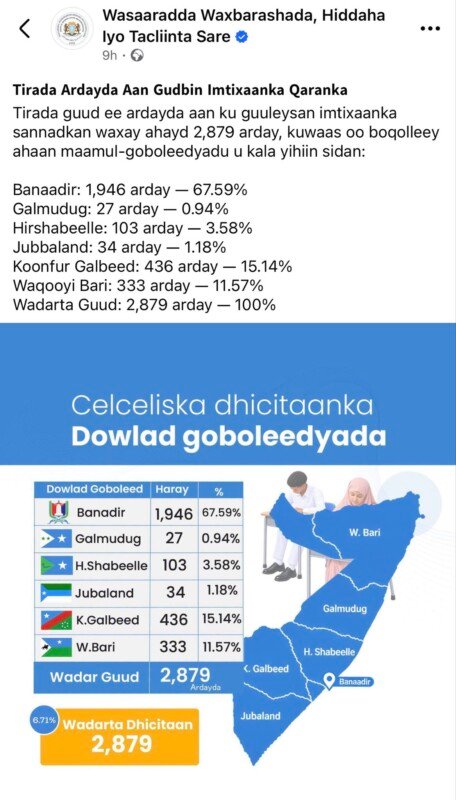
MOGADISHU — A map published by the Federal Ministry of Education depicting examination figures has sparked controversy after it appeared to exclude Puntland as a political entity, prompting a sharp response from political analyst and former presidential advisor Abdisaid Muse Ali.
In a post on X, Muse Ali warned that “maps are rarely neutral” in contested political orders and that political change is often normalised first through language, then administration, and eventually maps. He argued that Puntland has effectively “disappeared as a political entity” from the official map, a development he described as part of a broader pattern by the administration of President Hassan Sheikh Mohamud.
“Study this map carefully. The HSM’s ministry of education examination figures are almost secondary. Puntland has disappeared as a political entity,” Muse Ali wrote. “In contested political orders, maps are rarely neutral. Political change is often normalised first through language, then administration, & eventually maps.”
Muse Ali warned that Puntland must “define and defend its constitutional territory and political status,” otherwise others will increasingly define them on its behalf. He noted that the current administration is “unilaterally rewriting the constitutional settlement, redefining federal member states and redrawing Puntland on official FGS maps.”
A Warning to Puntland Leadership
Muse Ali directly challenged Puntland President Said Abdullahi Deni, questioning his judgment in having previously provided a political platform to President Mohamud in Garowe in December 2020. At that time, he said, Puntland was told that Mohamud had “changed.”
“Today Deni warns Puntland about the man he helped rehabilitate politically. Perhaps Puntland should accept the political reality HSM himself is creating,” Muse Ali wrote.
He suggested that Puntland should cease treating the current federal authorities in Mogadishu as a legitimate federal authority until a new constitutional settlement is negotiated. Puntland has previously expressed concern that Somalia is experiencing a constitutional vacuum, advocating for immediate consultations to avert potential instability. The regional administration has maintained that federal institutions have lost their constitutional legitimacy and does not recognize President Mohamud as a legitimate president .
“Puntland should govern its affairs, defend its constitutional territory & deal with HSM & Damuljadiid only as a group of the political disputes to that future political settlement,” Muse Ali stated.
The Politics of Maps and Federalism
The map controversy reflects deeper tensions over the nature of Somalia’s federal settlement. Puntland has warned that the nation was heading toward a perilous political and security collapse unless the political deadlock in Mogadishu is addressed. The regional administration has called for immediate consensus on long-overdue elections, warning that failure to address the political deadlock could lead to further deterioration of security and governance across the country .
Maps have historically been used to assert political claims and shape perceptions of territorial integrity. The exclusion of Puntland from an official government publication raises questions about whether the omission was intentional or an administrative oversight. For Puntland, which has consistently asserted its constitutional rights as a federal member state, the map represents another example of what it sees as efforts by the Federal Government to marginalise regional authorities.
Puntland has previously barred federal-linked troops from moving through its territory and accused Mogadishu of seeking to use federal forces to weaken security inside the region. President Deni has accused President Mohamud of breaking the country apart and warned that policies backed by allies of the president threaten to fracture Somalia regionally .
The Puntland Cabinet has announced that it will refer the names of politicians, military officers, and individuals accused of undermining the region’s security and stability to the judiciary for prosecution, following escalating tensions between Puntland and the Federal Government after a series of security operations in Gaalkacyo and Bosaso .
President Deni has initiated a series of broad political consultations in Garowe, aimed at marshalling a unified regional stance against what he describes as the “destabilizing” presence of federal troops in Puntland’s territory .
Puntland has also invoked constitutional authority to reject Turkish maritime operations off its coast, asserting its jurisdiction over the management and exploitation of resources within its territory and territorial waters. The regional government cited Articles 44, 51, 52, 53, 54 and 142 of Somalia’s Provisional Federal Constitution, as well as Articles 4 and 54 of the Puntland Constitution, to support its position that it retains exclusive authority over its marine resources until the federal constitutional order is fully established and harmonised .
Critical Note
The controversy over the exclusion of Puntland from a federal map is not merely a bureaucratic oversight; it is a reflection of the deepening constitutional crisis in Somalia. Whether intentional or not, the omission of a federal member state from an official government publication reinforces the perception that Mogadishu is pursuing a centralising agenda that undermines the federal framework.
The Federal Government must address this issue transparently, clarify the status of the map, and affirm its commitment to the constitutional settlement that provides for federal member states. Failure to do so will further erode trust between Mogadishu and Garowe and deepen the already significant political divisions that have paralysed progress on key national issues.
As Abdisaid Muse Ali noted, “maps are never neutral” in contested political orders. The Somali people deserve a federal government that respects the constitutional framework and works to strengthen, not undermine, the federal system. Without such a commitment, the current trajectory of confrontation and mistrust is likely to continue.
Recommended Reading On ftlsomalia.com
- Puntland Flags Somalia’s Constitutional Crisis, Calls for Emergency Dialogue
- Puntland Accuses Federal Government of Creating Constitutional Vacuum
- Puntland and Federal Government Near Armed Conflict
- Puntland Cabinet Vows to Prosecute Federal Officials Over Security ‘Destabilisation’
- Puntland Accuses Hassan Sheikh of Remaining in Office Illegally
- Deni Holds Security Talks in Garowe to Counter Federal Government’s Military Deployment