
MOGADISHU: A major diplomatic row has erupted following the publication of a damning security brief by the International Crisis Group (ICG), titled “New Chapter, Same Stalemate: Somalia’s War with Al-Shabaab“, which declares the four-year war against Al-Shabaab to be stuck in a permanent structural stalemate.
Somalia’s State Minister for Foreign Affairs, Ali Mohamed Omar (Ali Bal’ad), issued an immediate, sharp public pushback against the report’s conclusions, criticizing international policy circles for persistently viewing Somalia through an outdated lens of perpetual failure.
In an official statement published on X, Minister Bal’ad rejected the narrative that the central government is incapable of managing its own sovereign defense or governing effectively, calling the ICG’s assessment “incomplete and unfair.” He argued that external observers routinely fail to comprehend the sheer complexity of the state-building tasks currently being undertaken by the Mohamud administration.
Villa Somalia’s Three-Front Argument Under Fire
According to Minister Bal’ad, the Federal Government of Somalia (FGS) has spent the last four years attempting to execute three monumental structural transformations simultaneously: prosecuting an all-out war against an entrenched insurgent network, rebuilding a shattered national defense architecture from the ground up, and pushing through a comprehensive constitutional review process necessary for future democratic elections.
“No serious student of post-conflict reconstruction would describe even one of these tasks as easy,” Bal’ad stated, defending the executive branch’s performance. “Somalia has been attempting all three at once, under fire, and with shrinking resources.”
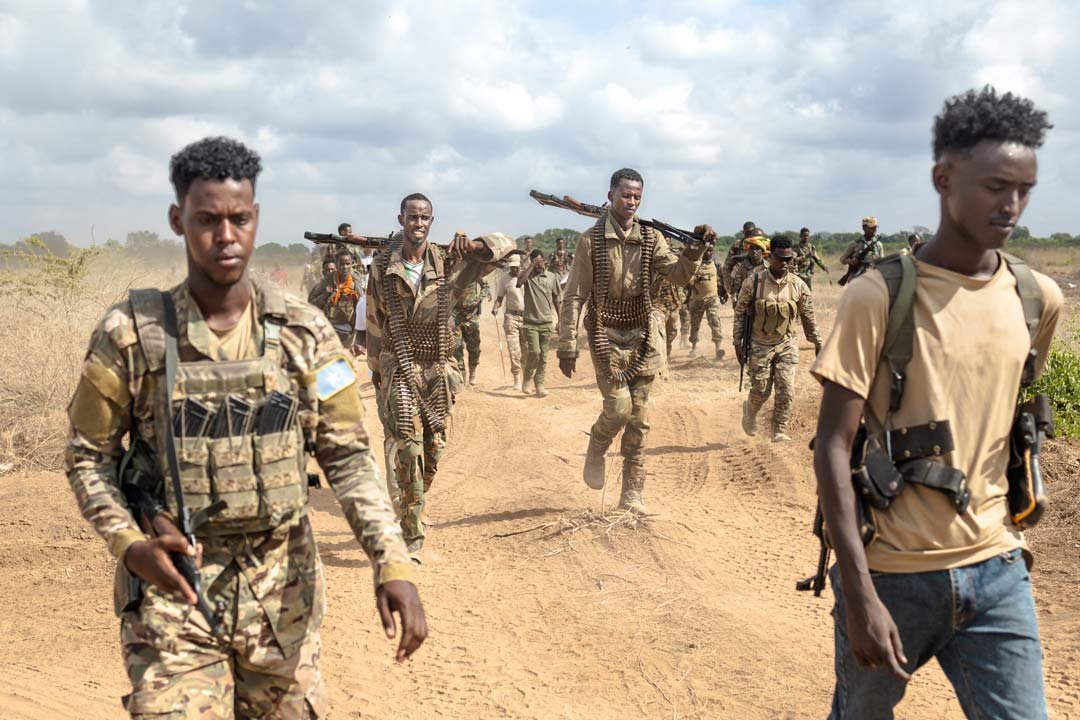
However, the ICG dossier, presents a far more severe, unvarnished picture of the front lines. The report details how Al-Shabaab effectively wiped out the central government’s 2022–2023 counteroffensive gains, systematically retaking large swathes of Hiraan and Middle Shabelle throughout 2025. While FGS forces, heavily supported by external allies, have managed to anchor a defensive perimeter around Mogadishu, the ICG maintains that the war has reverted to a strategic impasse where neither side can maintain a decisive upper hand.
The Insurgent Playbook vs. Federal Fracturing
The ICG brief highlights an alarming tactical evolution by Al-Shabaab, noting that the militant group has scaled back its use of pure coercion. By replacing aggressive external commanders with local clan figures, signing non-aggression pacts with exhausted Macawisley militias, and reducing predatory taxation rates, the group has successfully entrenched its administrative authority across rural central sectors.
Conversely, the central government remains severely hindered by internal political fractures and a collapsing military retention rate. The report indicates that out of 20,000 new troops trained via external pipelines in Uganda, Eritrea, Ethiopia, and Egypt, fewer than half remain in active service due to poor logistics, inadequate equipment, and widespread operational desertion. Furthermore, corruption continues to undermine the military high command, with vital supplies routinely siphoned off before reaching forward operating bases.
FTL Editorial Analysis: Pushing Back on the FGS and ICG Fallacies
The public friction between Minister Bal’ad and the Crisis Group exposes deep flaws in both the government’s defense of its record and the ICG’s proposed solutions.
First, Minister Bal’ad’s defense that the FGS is “attempting all three tasks at once” ignores the reality that these crises are largely self-inflicted by Mogadishu’s hyper-centralized political strategy. As highlighted in the report, the FGS has routinely undermined its own military front lines by redirecting its focus toward unilateral constitutional adjustments designed to benefit the current executive at the ballot box in 2026. This aggressive push to concentrate power in the capital has alienated traditional allies and sparked active political standoffs with Federal Member States like Puntland and Jubaland, causing regional forces to turn their focus away from Al-Shabaab.
Second, the ICG’s primary recommendation, urging Mogadishu to open a dialogue track and encourage humanitarian aid delivery in insurgent-held territory as a stepping stone to a “political solution”, is profoundly naive. Elevating an unrepentant Al-Qaeda affiliate to a legitimate political partner while it actively enforces a totalitarian social code and levies a 30% tax on humanitarian relief does not solve the impasse; it formalizes an insurgent state-within-a-state.
The military and political gridlock cannot be solved by capitulation disguised as diplomacy, nor can it be hidden behind defensive press releases from the Ministry of Foreign Affairs. True stabilization requires the FGS to abandon its centralist fixation, heal the fractures within the federal model, and genuinely finance state-level Darwish and police forces capable of holding recovered ground. Until an authentic national power-sharing agreement is realized, the front lines will remain at a costly, bloody standstill.
Related Posts On ftlsomalia.com: