
KISMAYO — Jubaland State President Ahmed Mohamed Islam (Ahmed Madobe) has extended his congratulations to all Somali students who successfully passed this year’s Grade 12 national secondary school examinations, with special recognition for students from Jubaland who achieved top rankings.
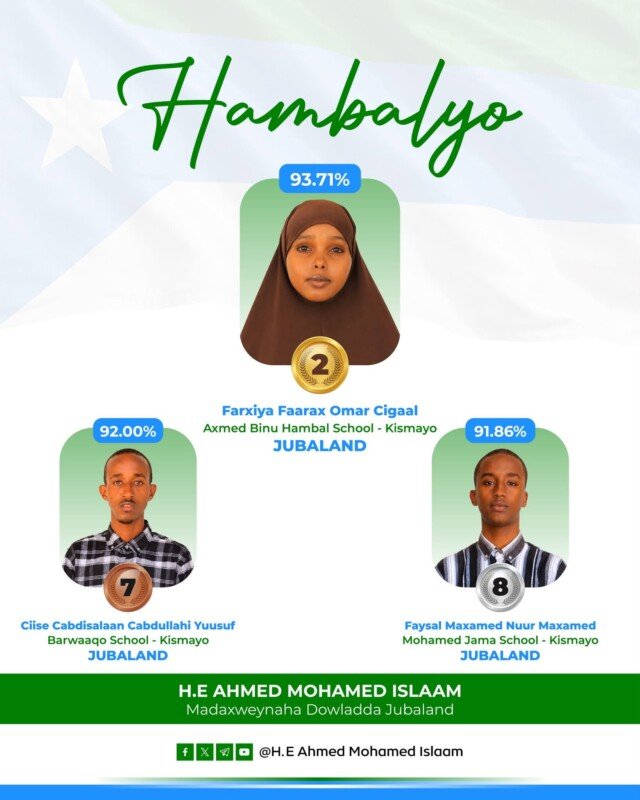
In a statement, the President specifically praised three Jubaland students who secured positions among the top performers nationally. Farxiya Faarax Omar Cigaal, a student at Axmed Binu Xambal School, secured 2nd place nationally. Ciise Cabdisalaan Cabdullahi Yuusuf from Barwaqo School achieved 7th place, while Faysal Maxamed Nuur Maxamed from Maxamed Jaamac School secured 8th place nationwide.
“This achievement reflects the effort, talent, and dedication these students have invested in their education,” President Madobe said. He also extended his congratulations to the parents, teachers, and the wider education community for their vital role in this success. He wished all Somali students a bright future and even greater accomplishments than those they have achieved today.
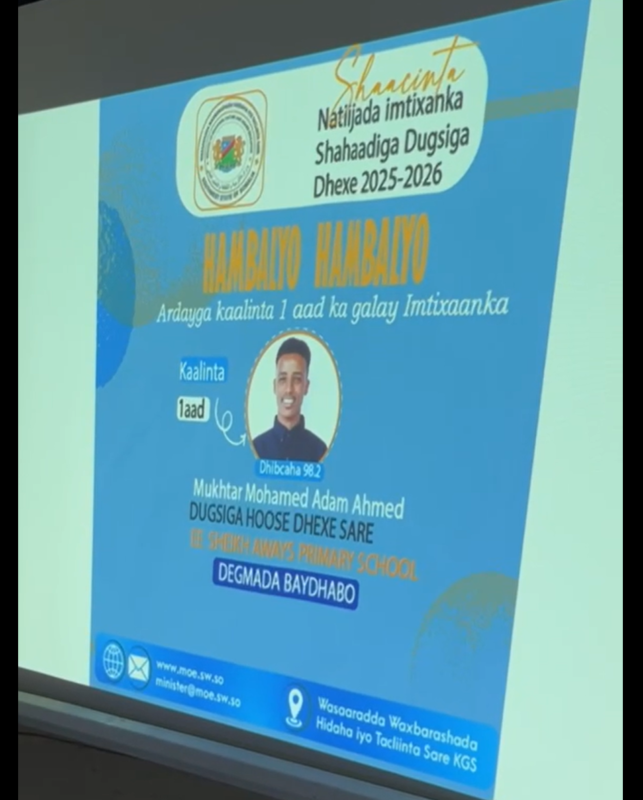
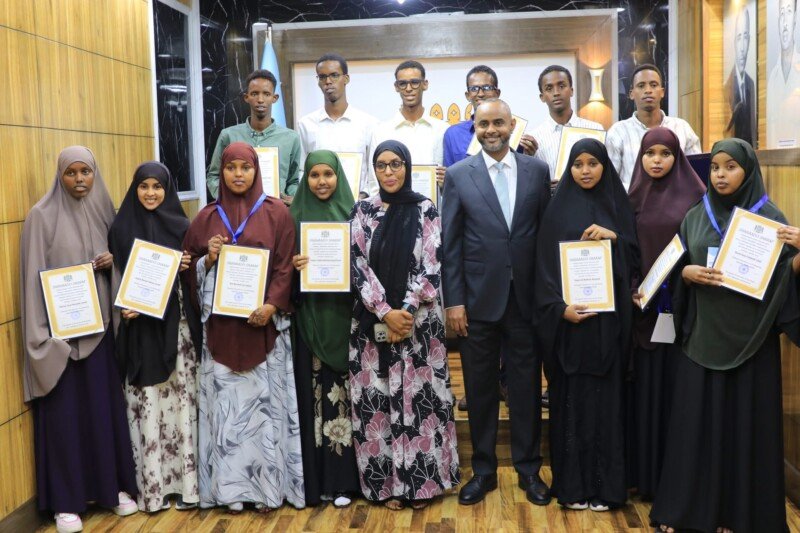
The announcement of the top students follows recognition by Prime Minister Hamza Abdi Barre and the Minister of Women and Human Rights Development, who honoured the top student in this year’s national exams, Maxamed Ciise Daahir, and his mother. The Prime Minister announced that the government would provide a job for the mother and a full scholarship for her son’s university education.
President Madobe has been actively engaged in diplomatic and regional affairs, previously hosting U.S. Ambassador Richard H. Riley in Kismayo to discuss the importance of national unity against terrorism. “Today in Kismayo, I met with the President of Jubbaland to discuss the importance of national unity to fight terrorism for the benefit of the people of Jubbaland and all of Somalia,” Riley stated .
The Federal Ministry of Education, Culture and Higher Education announced the Grade 12 national exam results on August 15, 2026, confirming that 40,037 students passed the examination while 2,879 did not meet the required standard. The top three students nationally are Maxamed Ciise Daahir Yuusuf, Farxiya Faarax Cumar Cigaal, and Amino Khaalid Cabdalla Ahmed .
Somaliland also announced its Grade 12 and Grade 8 examination results, with 16,051 out of 16,078 students passing the Grade 12 exams, a 99.8% pass rate. The high pass rates have raised questions about the rigour of the examination systems in different regions.
President Madobe’s recognition of the students’ achievements reflects the importance Jubaland State places on education as a foundation for development. The success of students from Jubaland in the national exams highlights the continued operation of the education system in the region and the dedication of students and educators despite the challenges facing the federal member state.
Across the country, education systems have been working to standardize curricula and examination processes, though significant challenges remain, including limited access, inadequate resources, and teacher shortages.
Critical Note
President Madobe’s recognition of the top-performing students from Jubaland is a welcome gesture that highlights the importance of education and academic excellence. However, the broader challenge facing Jubaland’s education system—and Somalia’s as a whole—remains the provision of quality education to all children, not just the top performers.
While students like Farxiya Faarax Omar Cigaal, Ciise Cabdisalaan Cabdullahi Yuusuf, and Faysal Maxamed Nuur Maxamed have achieved remarkable success, millions of children across the country remain out of school due to conflict, displacement, poverty, and lack of infrastructure. The government must prioritize investment in education and ensure that resources reach the most marginalized communities.
The recognition of individual success should be part of a broader strategy to improve education access and quality across the country. Without sustained investment in education infrastructure, teacher training, and curriculum development, the gap between the education system’s potential and its reality will continue to widen.