
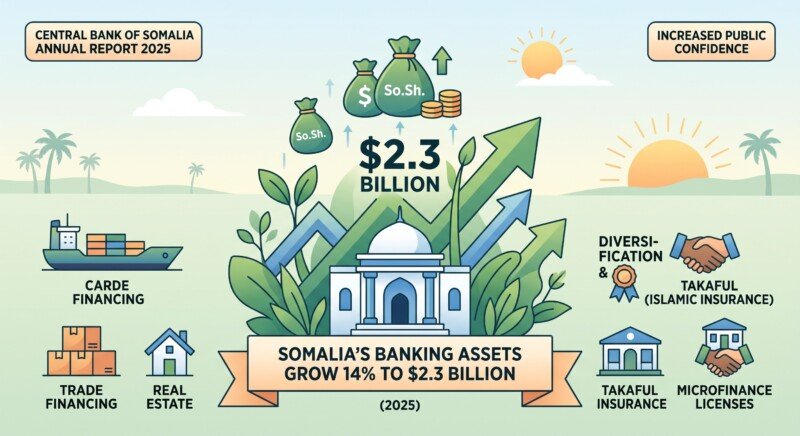
MOGADISHU — Somalia’s banking sector continued to demonstrate strong growth in 2025, with total banking assets increasing by 14 percent to $2.3 billion, equivalent to 20 percent of GDP, according to the Central Bank of Somalia’s Annual Report for 2025. The expansion reflects sustained confidence in the financial system, steady deposit mobilization, and increased engagement within the formal financial sector.
Financing assets rose by 14 percent to $540 million in 2025, up from $473 million in the previous year, reflecting continued private-sector credit demand. Within the financing portfolio, trade financing and real estate loans remained the largest components, increasing from $169 million in 2024 to $205 million in 2025 and from $111 million in 2024 to $139 million in 2025, respectively. This trend highlights sustained commercial activity alongside growing investment in property-related sectors.
Investment assets also recorded steady growth, rising to $359 million from $324 million in 2024, an 11 percent increase, as banks continued to strengthen and diversify their portfolios. Equity investment remained the largest component, rising from $184 million to $215 million, followed by property and real estate investment, which increased from $118 million to $128 million.
On the liabilities side, commercial banks’ total liabilities rose to $1,976 million in 2025, up from $1,716 million in 2024, representing a 15 percent increase. Customer deposits remained the primary source of funding, totaling $1,630 million, broadly stable compared with $1,652 million in 2024. Customer deposits accounted for approximately 82 percent of total liabilities, maintaining their position as the dominant funding base for commercial banks.
The banking sector’s expansion was supported by continued improvements in governance, transparency, and institutional capacity, reinforcing confidence in the financial system. A major legislative milestone was achieved in May 2025 with the enactment of the revised Financial Institutions Law, which established the legal and regulatory framework for microfinance institutions and strengthened the foundation for financial sector development.
As of December 2025, Somalia’s financial sector comprised 13 domestic commercial banks, 1 international bank branch, 14 money transfer businesses, and 6 mobile money operators, totaling 34 licensed core financial institutions. In addition, the sector included a growing number of microfinance institutions, with 7 non-deposit-taking microfinance institutions licensed in November 2025, marking an important step toward expanding financial inclusion and formal oversight.
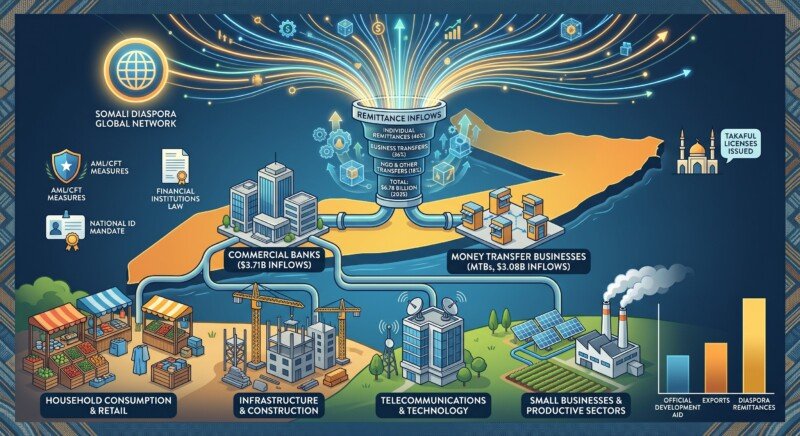
The growth in banking assets reflects the broader economic context. Real GDP growth is estimated at 3.1 percent in 2025, while inflation stood at 3.7 percent. Remittance inflows remained strong, reaching $6.78 billion, providing critical support to households, businesses, and the wider economy.
Financial Soundness and Stability
The banking sector remained financially sound during the review period. Capital adequacy and core capital ratios continued to exceed regulatory requirements, while liquidity levels remained strong across the banking system. The Capital Adequacy Ratio remained above the regulatory minimum requirement of 12 percent throughout the review period, reaching about 18 percent in the first half of the year and standing at around 15 percent by December 2025.
The Liquidity Asset Ratio remained well above the regulatory minimum requirement of 20 percent throughout the review period, indicating a strong liquidity position in the banking sector. The ratio fluctuated between approximately 47 percent and 54 percent over the period, reaching about 54 percent by December.
The Core Capital Ratio also remained consistently above the regulatory minimum requirement of 8 percent throughout the review period. Despite a gradual decline during the second half of 2025 to about 14 percent by December, the ratio remained comfortably above the required threshold, reflecting the continued strength of banks’ high-quality capital positions.
Critical Note
The growth of Somalia’s banking sector to $2.3 billion in assets reflects a strengthening of the financial system and growing public confidence in formal banking institutions. The expansion of financing to the private sector, particularly in trade and real estate, suggests that banks are increasingly playing a role in supporting economic activity. However, the concentration of financing in these sectors also raises concerns about the diversification of lending and the potential for asset bubbles.
While the regulatory reforms, including the enactment of the Financial Institutions Law and the licensing of microfinance institutions, are positive steps, the effectiveness of these reforms will depend on implementation and enforcement. The banking sector’s capital adequacy and liquidity ratios are healthy, but the decline in the Core Capital Ratio during the second half of 2025 bears watching.
The banking sector’s growth must be accompanied by continued regulatory oversight and efforts to expand financial inclusion, particularly for underserved populations. The licensing of microfinance institutions is a welcome step, but access to formal financial services remains limited for many Somalis, particularly in rural areas. Without sustained investment in financial infrastructure and inclusion, the risk is that the benefits of banking sector growth will not reach the broader population.