
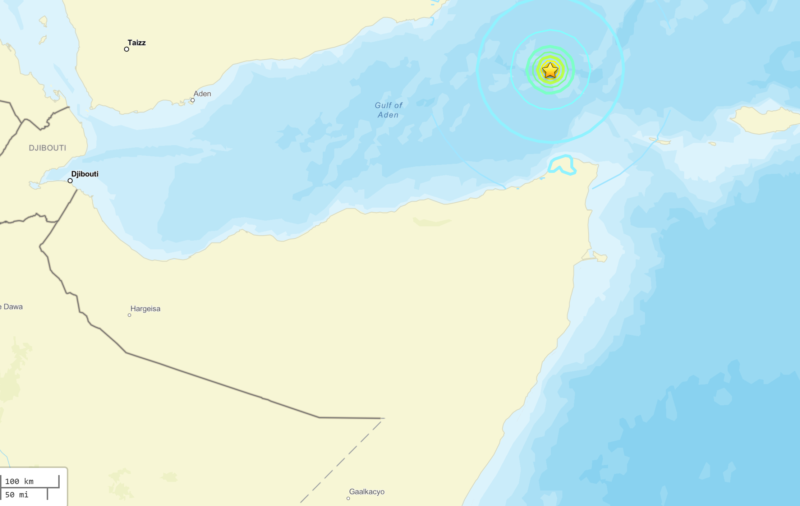
GULF OF ADEN — A magnitude 6.0 earthquake struck the Gulf of Aden early Friday, approximately 145 kilometers (90 miles) north of Caluula in the Bari region of Puntland, according to the U.S. Geological Survey (USGS).
The earthquake occurred at 21:07 UTC on August 27, 2026 (00:07 local time on August 28 in the region). It was centered at 13.265°N, 50.543°E at a shallow depth of 10 kilometers. The European-Mediterranean Seismological Centre recorded a similar magnitude of 6.0 with a slightly deeper estimate of around 18 kilometers. The German Research Centre for Geosciences (GFZ) also confirmed the event with a magnitude of 6.0.
The epicenter lay in the eastern Gulf of Aden, roughly 146 km north of Caluula (population about 6,100), 165 km north-northwest of Breda, Somalia, and about 209 km southeast of Mukalla, Yemen. No immediate reports of damage, injuries, or tsunami generation have emerged, with the USGS issuing a Green alert indicating a low likelihood of casualties or significant economic losses. Puntland authorities have not yet issued an official statement on the impact of the earthquake.
The region has experienced seismic activity before. In December 2023, several areas in northern Somalia experienced tremors as aftereffects of a magnitude 5.6 earthquake that hit the Gulf of Aden approximately 149 kilometers from Las Khorey . Fortunately, there were no reports of casualties, injuries, or damages arising from either the earthquake or the subsequent tremors .
The earthquake has caused fear and concern among residents of coastal areas, particularly communities dependent on maritime transport and fishing, although no significant impact has been confirmed. There have been no reports of damage to fishing boats or vessels operating between Somalia and Yemen.
Tectonic Context and Regional Seismicity
The Gulf of Aden is an active divergent plate boundary where the Arabian and Somali plates are pulling apart. Seafloor spreading along the Sheba Ridge and associated transform faults produces frequent moderate seismicity. The region forms part of the larger Afar–Red Sea–Gulf of Aden rift system that began developing tens of millions of years ago.
The Gulf of Aden regularly experiences magnitude 5–6 events and occasional stronger ones. Notable historical quakes include a magnitude 6.6 near Kilmia, Yemen, in December 2006, and another 6.6 near Al Ghaydah, Yemen, in July 1970. More recently, a magnitude 6.0 struck the Gulf of Aden in July 2018, and a 5.9 magnitude quake occurred near Las Khorey, Somalia, in June 2023. On January 3, 2026, a magnitude 5.1 earthquake was felt in Caluula, making today’s 6.0 event stronger than the previous one. Smaller events (magnitude 4–5) occur more frequently closer to the Somali coast, including near Caluula.
Somalia has previously demonstrated solidarity with countries affected by earthquakes, donating $4.8 million to help victims of the devastating earthquake in Turkey in February 2023, which recorded over 45,000 deaths .
The August 27 event ranks among the stronger recent quakes in the eastern Gulf of Aden but remains consistent with the area’s ongoing tectonic activity.
Impact and Preparedness
The USGS PAGER system issued a Green alert, indicating a low likelihood of casualties or significant economic losses. Maximum estimated shaking intensity reached Modified Mercalli Intensity IV (light shaking) in the nearest areas. Approximately 66,000 people are estimated to have experienced light shaking, while more than 1 million felt weak shaking. Structures in the broader region are generally vulnerable to shaking, with many low-rise nonductile concrete buildings common, though the offshore location limited the effects on land. Tsunami risk was assessed as low for an event of this magnitude and location.
Somalia has recently introduced a Multi-Hazard Early Warning System under the global Early Warnings for All framework, collaborating with the United Nations Development Programme and the Green Climate Fund . The initiative aims to reduce disaster-related deaths by 42 percent and extend early warning coverage from 20 percent to complete national coverage by 2030 .
The government has also been scaling up disaster preparedness efforts ahead of the anticipated Super El Niño rains expected between October and December 2026, with forecasts indicating a high probability of widespread flooding across the country . Building on lessons from 2023, when floods and drought displaced 2.3 million people and affected millions more, the government and humanitarian partners are supporting contingency planning and risk analysis .
SoDMA and the UN have been conducting regular humanitarian coordination meetings, examining current humanitarian conditions nationwide and exploring methods to enhance relief operations for at-risk populations . These meetings stress the importance of regular coordination in facilitating effective humanitarian aid delivery and addressing the requirements of populations facing drought, displacement, and other humanitarian issues .
Earthquake swarms are also common in the broader southern Red Sea, Afar, and Gulf of Aden region, sometimes linked to magmatic activity along the rift. Authorities and monitoring agencies continue to track aftershocks. No major secondary hazards have been reported at this time.
Critical Note
The magnitude 6.0 earthquake in the Gulf of Aden serves as a reminder of the region’s tectonic activity and the vulnerability of coastal communities. While the offshore location and low population density in the immediate area limited the impact, the event highlights the need for continued seismic monitoring and disaster preparedness, particularly along the Somali coast where infrastructure is often poorly equipped to withstand strong shaking.
The fear and concern among residents of Caluula and other coastal towns, as well as the lack of an official statement from Puntland authorities, underscore the importance of effective communication and preparedness measures. Communities dependent on maritime transport and fishing should be particularly aware of the risks associated with seismic activity.
Despite the USGS Green alert, the psychological and logistical effects of such an event should not be underestimated. Somalia faces escalating effects of climate change, including persistent severe droughts and recurrent floods that have detrimentally impacted local communities, disrupted economic activities, and suppressed agricultural output .
The UN humanitarian chief has warned that nearly 6.5 million people in Somalia are experiencing severe hunger, with rapidly deteriorating drought conditions, ongoing conflict, and massive reductions in global aid exacerbating the nation’s humanitarian crisis . The Somali government and international partners should ensure that monitoring systems remain operational and that communities are educated on earthquake safety and broader disaster preparedness.