
DHUSAMAREB – The Director of Somalia’s National Intelligence and Security Agency (NISA), Mahad Mohamed Salad, arrived in the central city of Dhuusamareeb on Thursday for high-level talks with Galmudug President Ahmed Abdi Kariye “Qoorqoor,” as a deepening political rift between the federal government and the regional administration threatens to destabilize one of the country’s most strategically important states.
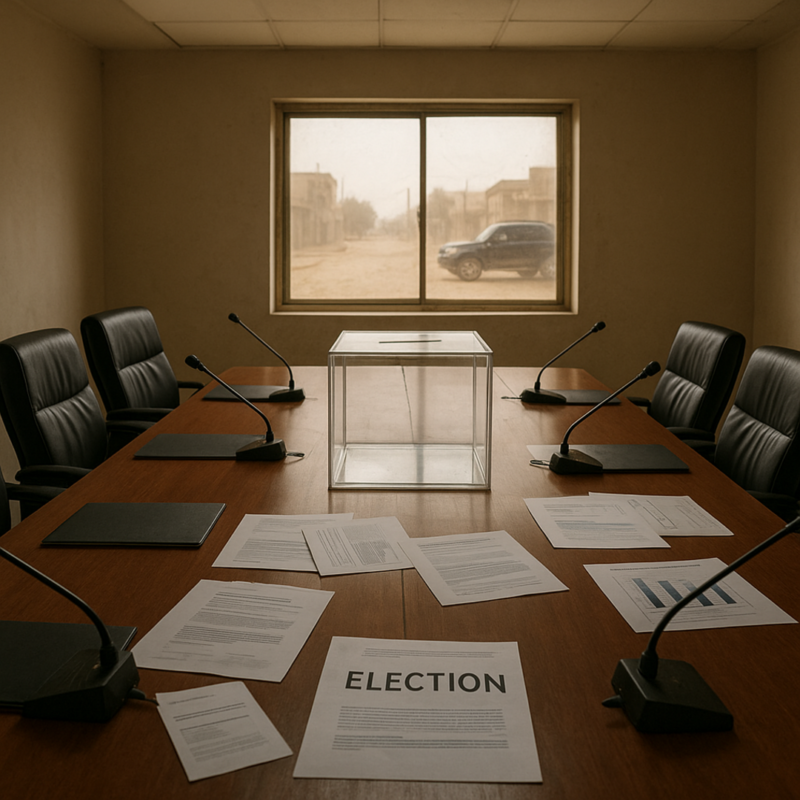
The intelligence chief’s visit is viewed as a precursor to an anticipated trip by Prime Minister Hamza Abdi Barre, who is reportedly preparing to travel to Dhuusamareeb to ease disputes over political arrangements and electoral processes in Galmudug. According to sources familiar with the talks, discussions are centered on differences over political participation and party alignment before upcoming regional elections, which have been scheduled for July.
President Qoorqoor is said to be insisting on his right to participate in the political process under the Justice and Solidarity Party (JSP), while also indicating he could join another party if his position is not accepted. The stance is seen in Mogadishu as a possible challenge to the federal government’s preferred electoral framework in Galmudug.
A Dangerous Rift at the Core of Government
The visit comes amid what analysts have described as a “dangerous political rift” at the core of Somalia’s federal government and security apparatus. The crisis stems from a bitter disagreement between President Hassan Sheikh Mohamud and his intelligence chief over who will lead Galmudug. Under a discreet power-sharing agreement, Mahad Salad was reportedly slated to move into regional politics and seek the Galmudug presidency, with former police chief Sadiq John positioned to take control of NISA.
However, the agreement began to collapse after President Mohamud changed direction and instead backed Libaan Ahmed Hassan, also known as Liban Shuluq, to run for the Galmudug presidency. This approach bypasses typical party competition and has set the stage for a critical confrontation in the central region.
Intelligence Chief Issues Demands
During tense late-night meetings at the presidential palace, President Mohamud reportedly gave an ultimatum to his intelligence chief, demanding unwavering support for the party’s chosen candidate. Salad responded with several conditions: he called for the political impasse in Galmudug to be resolved peacefully, demanded an open and competitive election involving all rival candidates, and argued that the regional leadership should ultimately go to whoever could secure broad support. Salad also warned he would not support any effort that could lead to bloodshed in Dhuusamareeb.
In recent days, Mahad Salad reportedly informed both President Mohamud and Prime Minister Barre directly that he plans to run for the Galmudug presidency himself. A move that is considered in political circles to be a notable blow to Villa Somalia.
Federal Intervention and Local Defiance
The dispute has escalated into a direct confrontation between Mogadishu and the incumbent Galmudug president. Ties between Mohamud and Qoorqoor have deteriorated substantially in recent weeks, fueled by competing efforts to control the regional election schedule and procedures. While Qoorqoor has been lobbying for JSP backing for a second term, federal officials worry the current leader might use his local influence to obstruct or postpone the regional elections.
The power conflict has also divided local security units. A high-stakes confrontation emerged following a controversial dual appointment for the position of Galmudug Police Chief. The federal authorities appointed Colonel Mohamed Dahir Abdulle, while a defiant Qoorqoor issued a state decree rejecting the move and reappointed Khaliif Abdulle Maalin (Ilkacase). The overlapping claims of authority could lead to a protracted legal and political battle.
Military Buildup and Security Concerns
The political tensions have been accompanied by a significant military buildup in central Somalia. The federal government has rapidly transported heavy military equipment to Dhuusamareb and airlifted additional troops to the nearby district of Guriel. The armaments, delivered under strict federal supervision, will reportedly equip approximately 1,000 newly trained soldiers stationed near the regional capital.
Business figures have also entered the political conversation, urging a negotiated settlement to the tensions surrounding Galmudug’s political future. They are reportedly pushing for a final agreement before the first week of June.
Way Forward
Talks in Dhuusamareeb are expected to continue, with officials describing them as sensitive and potentially decisive for future relations between Mogadishu and Dhuusamareeb. The dispute emerges as the federal government works to align electoral arrangements across federal member states, with Galmudug regarded as a crucial arena in the wider political transition. Whether dialogue can resolve the crisis remains to be seen, but the convergence of political rivalries, security disputes, and military deployments has made Galmudug one of the most volatile flashpoints in Somalia’s political landscape.