
MOGADISHU: A political standoff has emerged between the Federal Government of Somalia (FGS) and the Galmudug State administration following a controversial dual appointment for the position of Galmudug Police Chief. The dispute risks creating a leadership vacuum or internal friction within the regional security apparatus at a time when Galmudug is actively engaged in military operations against Al‑Shabaab insurgents and heading toward state elections.
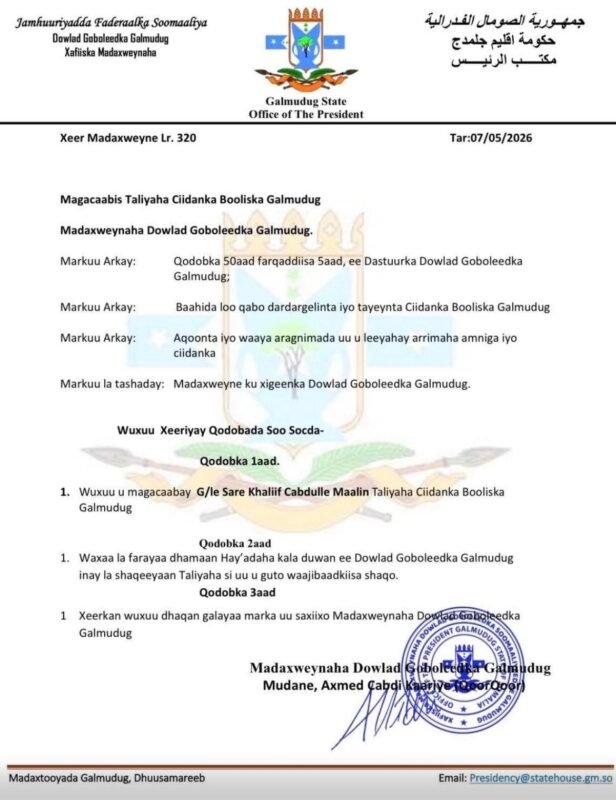
The confrontation began on Thursday, when the Federal Government announced the dismissal of the incumbent Galmudug Police Commander, Khaliif Abdulle Maalin, popularly known as “Ilkacase.” In his place, federal authorities appointed Colonel Mohamed Dahir Abdulle, a high-ranking officer previously attached to the Presidential Guard at Villa Somalia. In a swift and defiant response, Galmudug President Ahmed Abdi Kariye (Qoorqoor) issued a state decree rejecting the federal move and officially reappointed Khaliif Ilkacase to the same post, effectively reinstating the commander sacked by Mogadishu.
The conflicting decrees highlight deepening tensions over the constitutional jurisdiction of security appointments in Somalia’s federal member states. Under the country’s federal framework, the management of regional police forces has frequently been a flashpoint between the central government and regional leaders. Neither the Federal Ministry of Internal Security nor the Galmudug State House has issued further statements regarding how the two rival commanders will navigate their overlapping mandates.
Tit‑for‑Tat Appointments and Security Implications
The standoff reflects a broader trend of federal‑state tensions over security governance. Previous disagreements have involved the appointment of regional police chiefs and the division of authority between Mogadishu and federal member states. The dual appointment of competing commanders risks operational confusion and could exacerbate clan‑based divisions within Galmudug’s security forces. This comes as Galmudug forces remain on the front lines of the fight against Al‑Shabaab, and any disruption in the chain of command could undercut ongoing military campaigns.
In response to the unfolding crisis, the Federal Ministry of Internal Security has not yet commented on how it intends to enforce its directive. Meanwhile, President Qoorqoor has framed the state decree as an assertion of Galmudug’s constitutional autonomy, arguing that regional police chiefs fall under the purview of state authorities. The overlapping claims of authority could lead to a protracted legal and political battle reminiscent of earlier federal‑state disputes over security sector control.
Broader Federal‑State Tensions
The police chief standoff is the latest in a series of confrontations between the federal government and federal member states over the distribution of powers. The federal government previously rejected a South West State election as an “illegal pseudo‑election”, and similar disagreements have arisen over the command of regional police forces. These disputes have often been resolved through political mediation, but the current impasse appears more entrenched, with both sides refusing to back down.
Within Galmudug itself, there have been recent incidents underscoring internal security challenges. Clashes erupted in a central Somalia town over a police station dispute, highlighting how local security disagreements can quickly escalate into armed confrontations. Political leaders on both sides have called for restraint, urging dialogue to prevent the police chief dispute from spiraling into wider instability. However, with no immediate resolution in sight, the rivalry risks undermining public confidence in both federal and state institutions.
Local elders and civil society groups have expressed concern that the political feud could distract from the pressing security challenges facing Galmudug. The state remains a key battleground in the fight against Al‑Shabaab, and any fragmentation of its police command could weaken counter‑insurgency efforts. Moreover, with Galmudug preparing for state leadership elections, the political uncertainty may create an environment conducive to further polarization.
International partners, including the United Nations and the African Union, have traditionally played a mediation role in federal‑state disputes. However, as of Friday, no external mediation effort had been publicly announced. Observers warn that if the standoff continues unresolved, it could lead to parallel police structures, with rival commanders issuing conflicting orders to security personnel — a scenario that has in the past led to deadly clashes in other parts of the country.
Context: Federal Police Oversight and State Autonomy
The federal government has consistently asserted its authority over national security forces, including the power to appoint and dismiss regional police commanders. However, federal member states have often resisted what they view as overreach, arguing that the constitution grants them significant autonomy over their internal security apparatus. In past years, high‑level visits by the Somali Police Chief to Galmudug have sought to strengthen coordination between federal and state police forces, but the underlying tensions over command authority have never been fully resolved.
As the standoff continues, residents of Galmudug’s major towns, including Dhusamareb and Galkayo, are watching closely. Any overt clash between supporters of the two rival commanders could rapidly destabilize the region. For now, both the federal government and the Galmudug administration have refrained from escalating the confrontation beyond the exchange of decrees and statements. However, with the May 15 expiration of President Hassan Sheikh Mohamud’s term heightening political sensitivities nationwide, the outcome of this dispute will be closely watched.
Recommended Reading on ftlsomalia.com:
- Federal Government Rejects South West State Election as an ‘Illegal Pseudo‑Election’
- Clashes Erupt in a Central Somalia Town Over Police Station Dispute
- Somali Police Chief Inspects Galmudug Police Station and Security Checkpoints
- Evictions in Mogadishu Ignite Fierce Political Showdown
- Opposition: President’s Mandate Expires May 15 Without Elections