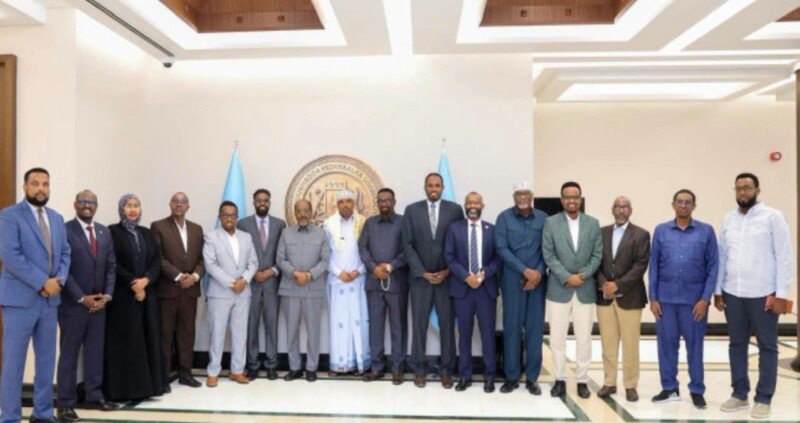


MOGADISHU – The Somali Future Council, a key opposition coalition, has endorsed a proposed “Transitional Direct Elections Model” as a compromise framework to break the country’s protracted political deadlock, while simultaneously urging that mediation efforts between the opposition and the federal government should not be handled by a single actor.
The statement from the council, issued on Saturday, signals support for a middle-ground approach that blends direct voting with the country’s traditional 4.5 clan power‑sharing system, but insists that any agreement must be based on broad political consensus and a process grounded in consultation, dialogue, and mutual agreement.
The council’s endorsement comes as Turkey pushes to play a leading role in mediation, with Ankara’s intelligence agency reportedly taking the lead in efforts to broker a political agreement between President Hassan Sheikh Mohamud’s administration and opposition groups. Turkish intelligence representatives have visited Mogadishu to hold separate discussions with both opposition figures and President Mohamud, as part of significant diplomatic efforts to resolve the political impasse over delayed elections[reference:0].
Future Council Backs Transitional Model, Insists on Consensus
In its statement, the Future Council said Somalia is entering a delicate political phase that calls for an electoral system suited to present realities while maintaining the country’s existing power‑sharing arrangements. The council said its backing for the proposed model depends on wide political consensus among major stakeholders and on a process grounded in consultation, dialogue, and mutual agreement.
According to the statement, the council believes the transitional model could create a route toward inclusive elections while protecting stability during a sensitive stage in Somalia’s political development. The group also rejected any postponement of elections or political arrangements that could create a governance gap or fuel instability. It urged political leaders and stakeholders to continue dialogue and compromise to reach a durable agreement that can prevent division and uncertainty.
The council also said it plans to formally submit detailed proposals on the transitional election model, including its guiding principles, implementation steps, and mechanisms for ensuring wide participation by political actors and society. The opposition‑aligned Future Council had previously unveiled a fresh electoral roadmap that offered an alternative to the Federal Government’s push for a one‑person‑one‑vote system, describing an “Expanded Indirect Election” model that blends direct voting by citizens with the 4.5 clan power‑sharing system[reference:1][reference:2].
Opposition Calls for Wider International Mediation
The call for broader international participation comes as the Future Council seeks to ensure that mediation is not dominated by a single actor. Sources familiar with the discussions said representatives of the international community recently met members of the Future Council, where the opposition presented its final proposals on the electoral process. The bloc advocated a framework different from the one supported by Villa Somalia and warned that the window for reaching a deal is narrowing.
The sources said Turkish officials believe they can convince President Hassan Sheikh to accept a consensus‑based electoral model and have started discussing a roadmap intended to build trust among opposition leaders. However, Turkey’s attempts to mediate have faced setbacks, with disputes over which political actors should be officially recognised as part of the opposition complicating preparations for the next round of talks[reference:3]. The opposition has maintained that mediation should include the broader international community to guarantee neutrality and help secure a durable agreement.
A Compromise Approach Amid Deep Divisions
The Future Council’s support for the Transitional Direct Elections Model is politically significant because it signals backing for a compromise approach at a time when Somalia remains divided over how future elections should be held. By supporting a transitional framework while insisting on political consensus and preservation of the 4.5 power‑sharing formula, the council appears to place itself between those calling for immediate universal suffrage and those who prefer the current indirect electoral system.
The council’s focus on dialogue and consultation suggests recognition that no electoral model is likely to succeed without broad agreement among the Federal Government, opposition groups, and regional stakeholders. Its rejection of election delays and political deadlock also reflects growing concern among political actors about the risk of institutional uncertainty if consensus is not reached in time.
The opposition has previously discussed a proposed indirect voting system, signaling a shift away from both the 2022 electoral arrangement and the “one person, one vote” model advocated by President Hassan Sheikh Mohamud[reference:4]. The proposed model reflected growing concern among opposition figures over the feasibility of holding universal suffrage elections in the near term[reference:5].
International Pressure and Government Position
The proposal could offer a basis for further negotiations by presenting a middle‑ground option that combines gradual electoral reform with political stability. However, its final impact will depend on whether other major political stakeholders are willing to support the framework once its details are formally presented.
Separately, the federal government recently informed international partners that it remains committed to pursuing an electoral model similar to those used in recent regional polls in Banadir and South West State, according to diplomatic sources. Critics have said those elections lacked broad political consensus and offered limited competition.
High‑level negotiations between the government and the opposition have collapsed without a resolution, revealing deep, ongoing disagreements regarding the nation’s electoral trajectory[reference:6]. The primary source of conflict centers on the proposed electoral models, with the federal administration maintaining support for a nationwide “one‑person, one‑vote” system while the Future Council endorses an alternative, indirect electoral approach[reference:7].
Way Forward
As debates over elections and constitutional arrangements continue, the Future Council’s position adds another voice to the search for a consensus‑based path forward for Somalia’s political transition. The disagreement over the electoral framework has intensified tensions between the government and opposition groups, raising concerns among international partners about the chances of a negotiated settlement before upcoming polls.
The United Nations Transition Mission in Somalia has called on the federal government and opposition leaders to continue political dialogue and establish consensus on an inclusive electoral model, expressing disappointment that recent talks ended without a breakthrough[reference:8]. The European Union has likewise urged Somalia’s political actors to immediately resume talks[reference:9].