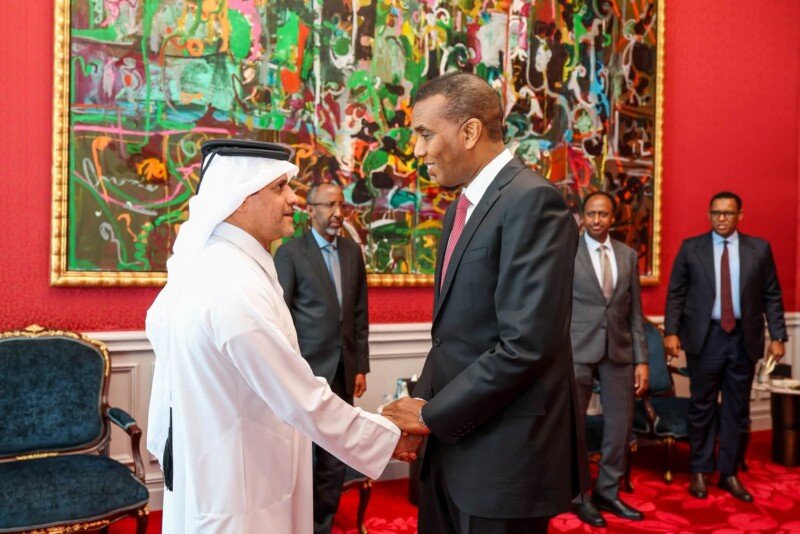

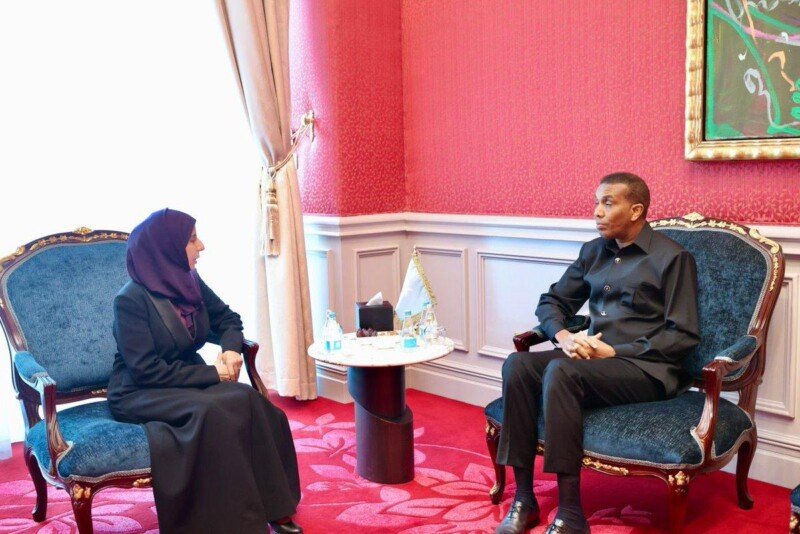
DOHA — Prime Minister Hamza Abdi Barre has met with Yemen’s Minister of Foreign Affairs and Expatriates, Dr. Afrah Al-Zouba, in Doha, where the two leaders discussed strengthening bilateral relations and regional security issues.
The meeting focused on enhancing cooperation between Somalia and Yemen, with particular emphasis on security coordination in the Red Sea, the Gulf of Aden, and the Horn of Africa. According to Yemen’s Ministry of Foreign Affairs, the two sides also discussed the importance of Red Sea and Gulf of Aden littoral states strengthening cooperation and security coordination to protect maritime navigation and counter threats including terrorism, human trafficking, and piracy.
The Amir of Qatar, Sheikh Tamim bin Hamad Al-Thani, has received a written message from Somali President Hassan Sheikh Mohamud concerning bilateral relations and ways to further deepen and expand cooperation between the two countries. The message was delivered by Prime Minister Hamza during his meeting with Qatar’s Prime Minister and Minister of Foreign Affairs, Sheikh Mohammed bin Abdulrahman bin Jassim Al-Thani, in Doha on Sunday. The Qatari Amir reaffirmed his country’s commitment to supporting Somalia’s security, stability, and development.
The National Academy discussions are part of Prime Minister Hamza Abdi Barre’s wider working visit to Qatar, which is focused on strengthening bilateral relations and reviewing progress on previously signed agreements between the two countries. Foreign Minister Abdisalam Abdi Ali (Dhaye) held a meeting at the Qatar Leadership Centre in Doha with officials from the centre, focusing on Qatar’s potential involvement in implementing the academy.
The Prime Minister’s personal connection to Yemen adds a meaningful dimension to the bilateral relationship. Hamza Abdi Barre studied at Yemen’s University of Science and Technology in Sana’a, where he earned his bachelor’s degree in 2001 before pursuing his master’s at the International Islamic University of Malaysia. His time in Yemen has given him a deep understanding of the country’s people, culture, and challenges, a connection he has previously referenced in diplomatic engagements.
Deepening Bilateral Relations
Prime Minister Hamza previously received Yemen’s Ambassador to Somalia, Fadl Ali Ahmed Al-Hanak, in Mogadishu in May 2026, where they discussed strengthening the longstanding bilateral relationship with special focus on joint efforts against human trafficking and the management of migration challenges. The Somali Prime Minister highlighted the deep historical, cultural, and economic connections that have long linked the two countries and called for expanding collaboration across several sectors.
Ambassador Al-Hanak commended Somalia’s progress in development, security and democracy, expressing Yemen’s appreciation for Somalia’s ongoing recovery and stabilization efforts.
Yemen and Somalia have agreed to deepen collaboration in maritime and air transport, commerce, and regional security, marking a significant step toward strengthening ties between the two neighboring nations. The understanding was reached during a meeting in Aden between Yemeni Minister of Transport Dr. Abdisalam Hamid and Somali Ambassador to Yemen Abdulhakim Mohamed.
Yemen’s Defense Minister has hosted Somalia’s Ambassador in Aden, signaling a renewed push for closer security collaboration between the two conflict-affected nations, focusing on combating illegal migration routes and coordinated efforts against terrorism.
Houthi Threats and Red Sea Security
Houthi rebels in Yemen have attacked and sunk a United Nations-flagged aid vessel carrying humanitarian supplies from Somalia, killing four crew members and detaining ten others. The incident occurred in the Red Sea, drawing international condemnation and raising fresh concerns about the safety of humanitarian missions in the region.
The Houthi leadership has previously threatened to treat any Israeli installation in Somaliland as a legitimate military target, raising the spectre of regional conflict spilling directly onto Somali soil. Yemen’s Houthi movement has already closed the Red Sea to Israeli ships and has threatened to close the strait entirely amid regional tensions.
The United Nations Security Council has extended monthly reporting on Houthi attacks in the Red Sea, with Somalia’s representative emphasising that instability in the Red Sea extends beyond regional boundaries and is closely connected to global peace and prosperity.
The African members of the UN Security Council, including Somalia, have issued a strong joint statement reaffirming their commitment to Yemen’s sovereignty and warning against external interference, as tensions in the country escalate following unauthorised Iranian flights and Houthi attacks.
Somalia’s Minister of Defense has held a strategic phone conversation with his Yemeni counterpart on enhancing bilateral military cooperation, with a particular point of concern being the potential for emerging links between Somalia’s Al-Shabaab militants and Yemen’s Houthi movement.
Critical Note
Prime Minister Hamza’s meeting with Yemen’s Foreign Minister reflects Somalia’s ongoing efforts to strengthen regional cooperation and address shared security challenges. The Prime Minister’s personal ties to Yemen, where he studied for his bachelor’s degree, offer a unique foundation for strengthening bilateral relations and demonstrate his understanding of the country’s complex political and social dynamics.
The discussion on Red Sea and Gulf of Aden security is particularly timely, given the resurgence of piracy off the Somali coast and the ongoing Houthi threats to maritime navigation. The potential links between Al-Shabaab and the Houthis represent a significant concern for regional stability, as noted by the UK Secretary of State for Foreign, Commonwealth and Development Affairs, who expressed deep concern over the escalating activities of Al-Shabaab and its increasing connections with Yemen’s Houthi rebels. Somalia’s position at the UN Security Council advocating for Yemen’s sovereignty and condemning external interference reflects its commitment to stability in the region.
However, the effectiveness of such meetings will depend on tangible outcomes. Both Somalia and Yemen face significant internal challenges that limit their capacity to cooperate on security issues. The Somali government must ensure that its diplomatic engagements translate into concrete action, including strengthened coordination on maritime security and counter-terrorism, while also addressing the humanitarian and security implications of the ongoing Houthi threat to the region.