
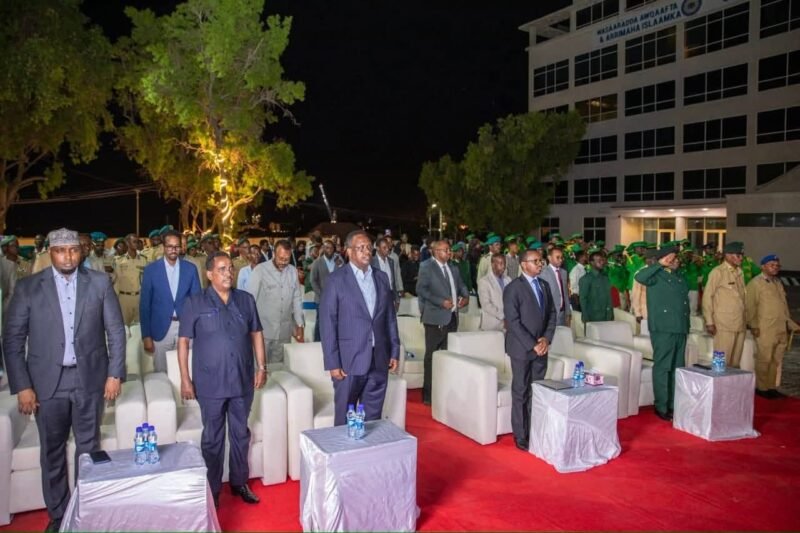
MOGADISHU: High-ranking officials from the Federal Government, including cabinet ministers, members of both houses of the Federal Parliament, and the Commander of the Custodial Corps, convened in the capital on Thursday evening for an executive symposium dedicated to the national justice sector. The formal event was designed to highlight recent structural advancements and to solidify operational cooperation across all branches of the judicial framework.
The occasion placed a spotlight on the comprehensive reform initiative led by the Minister of Justice and Constitutional Affairs, Hassan Moalin. The minister has invested significant resources in coordinating diverse judicial entities to create a cohesive and modernised legal structure. His primary objective has been to establish a robust legal system capable of implementing government directives, regularising judicial processes, and safeguarding citizens’ rights.
As part of the evening’s proceedings, the Ministry premiered a documentary illustrating the specific operational enhancements achieved by the justice sector. The presentation offered domestic and international observers a transparent view of the government’s growing ability to maintain legal order, manage correctional institutions, and implement legal procedures efficiently. The coordination of these institutions is considered a fundamental prerequisite for creating a stable atmosphere essential for the nation’s long-term peace and prosperity.
The event builds on a series of recent justice-sector milestones. Earlier this week, Minister Moallin met with the National Independent Human Rights Commission to address prison conditions, detainee rights, and judicial reforms for vulnerable populations. Both parties committed to improving prison oversight and developing a justice framework consistent with international human rights standards. The United Nations has highlighted the need for such coordination, citing concerns about outdated and overcrowded facilities.
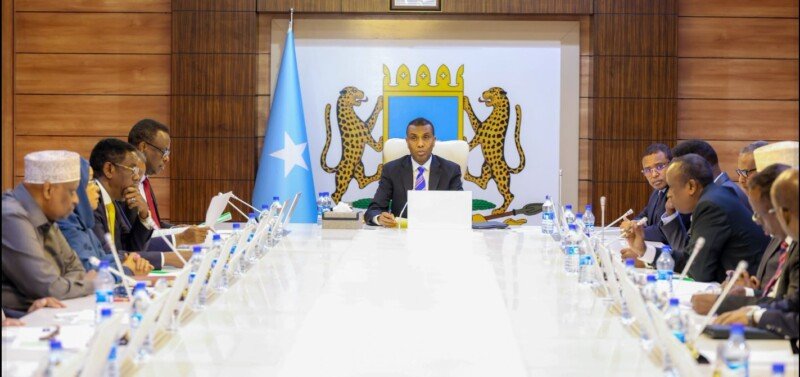
In April, the ministry convened a senior leadership meeting to evaluate progress on priority projects, including ongoing constitutional review processes and judicial reforms. The ministry has been working to modernise Somalia’s legal framework, including the introduction of a new Criminal Code to replace the outdated 1962 legislation. Minister Moallin has described the goal as establishing “a just, efficient, and updated judicial system that serves the Somali population.”
Thursday’s symposium also aligns with the government’s flagship Joint Justice and Corrections Programme (JJCP), a UN-partnered initiative focused on legal aid, court infrastructure, judicial training, and prison management reforms. The programme has also worked to align customary justice practices with formal rule-of-law institutions. In May 2025, the ministry hosted a town hall in Mogadishu where officials, legal experts, and community leaders discussed how traditional dispute resolution systems could be better integrated with formal judicial institutions. “Equitable access to justice for all Somalis must be at the heart of any legal reform,” the ministry’s permanent secretary said at that forum.
The symposium took place against the backdrop of broader constitutional developments. In March 2026, the Federal Parliament approved comprehensive amendments to the national constitution, formally ending the country’s 14-year provisional era. The Ministry of Justice described the ratification as the foundation for a new phase of state-building, with officials emphasising that the updated framework clearly outlines the allocation of federal powers. However, the vote was highly polarised, with the Somali Future Council condemning the process and vowing to continue recognising only the 2012 Provisional Constitution.
Minister Moallin has played a key role in national reconciliation and political dialogue. He chairs a ministerial committee overseeing the organisation of national consultative forums, and has urged opposition groups to bring their concerns to the negotiating table rather than issuing ultimatums. “If they have genuine grievances, they should present them through dialogue. Preconditions only obstruct the path to national unity,” he has said.
On the international front, Minister Moallin has expanded judicial partnerships, signing a cooperation agreement with Algeria to enhance collaboration on legal frameworks, judicial independence, human rights, and the rule of law. The agreement was described by both sides as a significant step toward strengthening institutional capabilities within the judicial domain.
The 8th Annual Judicial Conference, held in February 2026, further underscored the government’s focus on improving collaboration between judicial bodies and law enforcement departments. Participants, including the Chairman of the Armed Forces Court, the National Attorney General, and the Benadir Regional Police Chief, explored methods to streamline processes from investigation to trial, with the objective of reducing delays and ensuring consistent legal application.
Thursday’s executive symposium was designed to present these various efforts under a single umbrella, reinforcing the message that a coordinated, modernised justice sector is central to the country’s broader agenda of national stability, democratic consolidation, and post-conflict recovery. Officials described the alignment of the country’s judicial institutions as an essential requirement for establishing a secure and regulated environment conducive to long-term prosperity.
Recommended Reading on ftlsomalia.com:
- Justice Minister and Human Rights Commission Discuss Prison Reforms
- Justice Ministry Assesses Key Projects, Advances Post‑Constitutional Reform Agenda
- High‑Level Meeting Held in Somalia to Review JJCP Progress
- A Fractured Milestone: Somalia Adopts Constitutional Amendments as Regional Leaders Reject Vote
- Somalia, Algeria Establish Judicial Cooperation Agreement
- Somalia Holds National Discussion on Aligning Customary Justice with Rule of Law