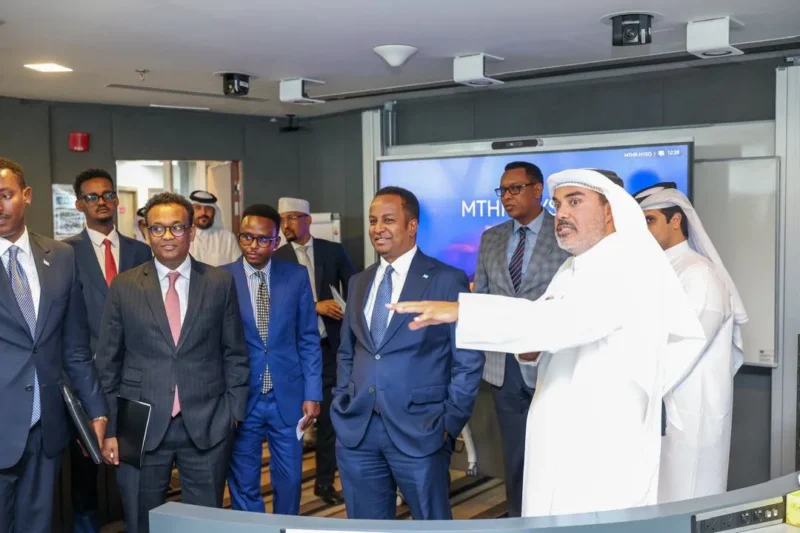

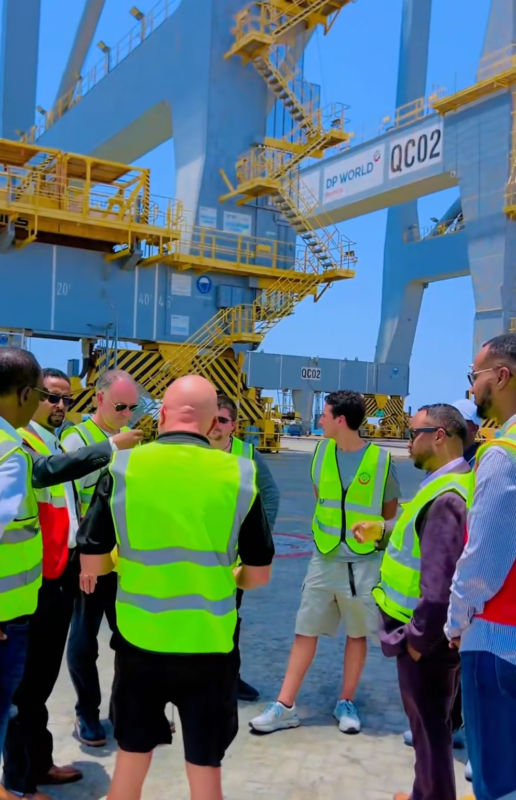
BERBERA — The Somaliland Ports Authority has welcomed delegations from the Ukraine-based RIDNE Food Consortium and the Tony Blair Institute to Berbera Port, where discussions explored the port’s potential as a hub for importing, storing, and distributing humanitarian food supplies to the Horn of Africa, Sudan, and Yemen.
Ports Authority Manager Ali Diriye Ahmed hosted the delegations, with talks focusing on Berbera’s strategic position on the Gulf of Aden and its capacity to serve as a logistical gateway for humanitarian aid in the region. The discussions also covered wider cooperation opportunities in Somaliland, including the port’s potential to support food security initiatives across the Horn of Africa.
The meeting comes as Berbera Port has undergone significant transformation over the past decade. DP World has unveiled a new maritime corridor connecting the UAE’s Jebel Ali Port with Berbera, operating every nine days to improve cargo flow and cut delivery times between the Middle East and the Horn of Africa. The port’s expanded container terminal, modernized equipment and upgraded transport links to Ethiopia have made it an increasingly attractive alternative to traditional regional ports like Djibouti.
Port traffic at Berbera was up 30 percent from 2023 to 2025, and a deal under negotiation with Ethiopia could see traffic rise by another 80 percent. The port is positioned as a key maritime gateway for Red Sea and Gulf shipping routes, approximately 250 km east of Djibouti. The UK has also invested in the region, with Ambassador Mike Nithavrianakis visiting Berbera Port in January 2025 to inspect investments, including the rehabilitation of the Berbera-Burao road, which has reduced travel times by 40 percent and created 1,300 jobs in the port and Special Economic Zone.
The UAE’s investment in Berbera has transformed the port, creating jobs, building infrastructure, and boosting economic growth for the region. Somaliland officials and local business owners view the new link as a lifeline for economic growth, with livestock exporters, agricultural producers and manufacturers now seeing a faster route to Gulf markets.
UK investments have also contributed to the establishment of a market for over 60 women fish traders, demonstrating a focus on inclusive growth and empowerment, particularly for women in the region.
Berbera’s Strategic Importance and Israel’s Growing Interest
Berbera’s strategic location has also drawn significant international attention, particularly from Israel. The deepening relationship between Somaliland and Israel has been extensively covered by international media, with President Abdirahman Mohamed Abdullahi (Irro) making an official visit to Israel in June 2026 that included the opening of Somaliland’s embassy in Jerusalem. The visit marked the territory’s first diplomatic mission abroad and the eighth foreign mission to be opened in the city.
Israel’s Defense Minister Israel Katz has confirmed that his country has worked with Somaliland discreetly for years, stating that “Israel and Somaliland share a longstanding friendship rooted in common interests, democratic values, and a commitment to security and stability. For many years, we have cooperated quietly in a number of activities that will remain confidential.” Katz said the two sides are now determined to raise security cooperation to new levels.
Investigative reporting has indicated that Israel has established an intelligence presence at Berbera International Airport and is holding ongoing discussions about the possible creation of an Israeli military base. According to Drop Site News, multiple current and former officials confirmed that Israel already has an intelligence footprint at Berbera Airport, with a unit of Somaliland’s presidential guard having returned from training in Israel.
The base under discussion would give Israel a military foothold on a crucial waterway near the Bab al-Mandab Strait, a maritime chokepoint comparable in importance to the Strait of Hormuz. Yemen’s Houthi movement has already closed the Red Sea to Israeli ships and has threatened to close the strait entirely amid regional tensions.
Somaliland President Irro has rejected claims that Israel is establishing military bases or intelligence facilities in the breakaway region, even as he confirmed that security cooperation between the two sides is expanding. “At the moment, Israel has no troops in Somaliland, but I cannot say what may happen in the future,” Irro said. Defense Minister Mohamed Yusuf Ali also told Reuters that Israel has no military presence in Somaliland at present.
The deepening ties have drawn sharp criticism from regional actors opposed to closer ties with Israel. The African Union, IGAD, Qatar, Saudi Arabia, Jordan, Iraq, China and others have all rejected the move. Even the United States, while not formally condemning the recognition, has reaffirmed its “One Somalia” policy and declined to follow Israel’s lead.
Israeli Foreign Minister Gideon Sa’ar has stated that agreements with Somaliland do not include any provision for relocating people from Gaza to Somaliland. “There is no agreement between Israel and Somaliland concerning the transfer of Gazans to Somaliland,” Sa’ar said, addressing allegations from several Arab nations and the Somali government that Israel had ulterior motives in recognizing Somaliland.
President Irro’s visit to Israel included a formal reception at the Knesset, where he met with Knesset Speaker Amir Ohana to discuss closer ties between the two legislative bodies. The visit to the Knesset added a symbolic and political dimension to the trip, with Somaliland officials describing it as one of the most important moments of the visit.
Critical Note
The engagement of the RIDNE Food Consortium and the Tony Blair Institute with Berbera Port reflects the growing international interest in Somaliland’s strategic maritime assets and the region’s potential as a humanitarian logistics hub. However, the involvement of these actors raises significant concerns given their controversial reputations and documented ties to broader geopolitical agendas.
The Tony Blair Institute has been linked to plans for post-war Gaza, including proposals to “temporarily relocate” Palestinians from Gaza to Somaliland, which have been condemned as a form of displacement. The institute’s funding from Larry Ellison, a major donor to the Israeli military, and its lobbying on behalf of the Trump administration’s Gaza plans, suggest that its engagement in Somaliland may be driven by broader strategic interests rather than purely humanitarian considerations.
Berbera’s strategic location near the Bab al-Mandab Strait has also drawn significant interest from Israel, with reports of an intelligence presence and discussions about a potential military base. The deepening security ties between Israel and Somaliland have drawn sharp criticism from Somalia’s federal government, the African Union, and several Muslim-majority countries. The Djibouti President has described the UAE as “Israel’s vanguard” and warned that an Israeli base in Berbera would directly threaten stability throughout the Horn of Africa.
The Somaliland government must ensure that any agreements or partnerships resulting from these discussions are transparent and serve the interests of the local population. The international community must recognise that the port’s humanitarian potential cannot be fully realised without addressing the underlying political and legal uncertainties surrounding Somaliland’s status and its growing ties with actors whose agendas extend far beyond humanitarian assistance.
Recommended Reading On ftlsomalia.com
- Somaliland’s Berbera Port Linked to UAE in New Jebel Ali Shipping Route
- Israel Opens Somaliland Intelligence Base
- Israel Says It Secretly Worked With Somaliland for Years
- UK Ambassador Visits Somaliland’s Berbera Port
- Somaliland-Israel Ties Draw Global Attention
- President Cirro: No Israeli Troops in Somaliland for Now
- Israel Denies Plans to Resettle Gazans in Somaliland
- Somaliland President Welcomed at Israel’s Knesset