
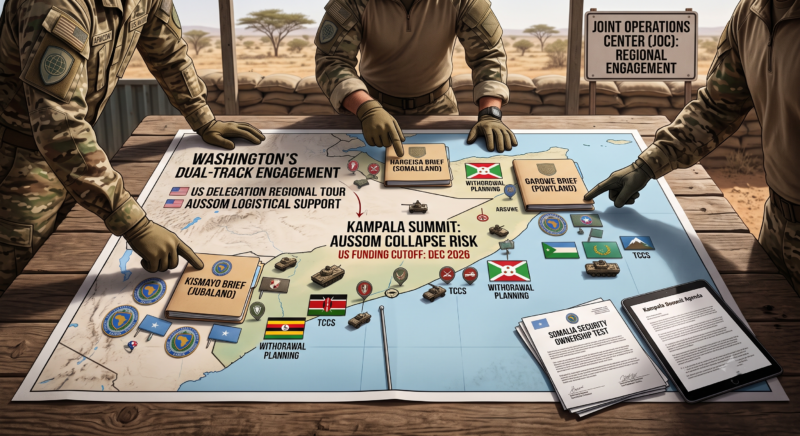
MOGADISHU – Member of U.S. delegation comprising congressional staff and officers from Africa Command (AFRICOM) is expected to begin a tour of Jubaland, Puntland and Somaliland on, in a visit that underscores Washington’s dual-track approach of deepening engagement with regional administrations while publicly demanding that Somalia assume greater responsibility for its own security.
The delegation will start in Kismayo before moving to Garowe and Hargeisa for consultations with regional leaders, according to sources familiar with the trip. The visit is framed as an information-gathering mission on Somalia’s security situation and a platform to convey Washington’s new policy direction ahead of the Kampala summit on the future of the African Union Support and Stabilization Mission in Somalia (AUSSOM). The Kampala meeting, scheduled for July 31, will bring together troop-contributing countries (TCCs), defence ministers and military chiefs to decide the fate of a mission that has become the cornerstone of Somalia’s counter-terrorism efforts but is now teetering on the edge of collapse due to a US funding cutoff.
A Mission on the Brink
The Kampala summit comes at a critical juncture. The United States has notified the African Union that it will no longer finance the UN Support Office in Somalia (UNSOS) beyond December 2026, a decision that threatens to pull the logistical rug from under AUSSOM’s 12,000-strong force. Washington has contributed nearly $2 billion to the UN support mission but has grown increasingly frustrated with what it views as insufficient progress by Somali leaders in assuming responsibility for their own security. The UNSOS budget for the 2026–2027 financial year stands at $481 million, with the US providing approximately 26 percent of that through assessed contributions. Without UNSOS, AUSSOM would lose critical logistical support, including food, water, fuel, transportation, medical services and casualty evacuation.
The timing of the delegation’s visit is therefore no coincidence. By travelling to Kismayo, Garowe and Hargeisa before the Kampala summit, Washington is signalling that it is looking beyond Mogadishu for partners in the region, a move that risks further fragmenting an already fractured federal system. AFRICOM has previously engaged with Puntland and Somaliland as “administrations within Somalia,” a formulation that allows military-to-military engagement outside formal State Department channels. AFRICOM Commander General Dagvin Anderson completed an unprecedented high-level visit to Somaliland and Puntland, labeling them “administrations within Somalia” and offering them military diplomatic engagement unavailable via formal U.S. State Department routes. This latest visit builds on that precedent, offering regional leaders a direct line to Washington at a moment when the federal government is struggling to present a credible plan for the security transition.
Engagement Without Accountability
The delegation’s itinerary also reflects the US approach to Somalia’s political crisis. While Washington has publicly supported the federal government’s counter-terrorism efforts, it has simultaneously pursued parallel tracks with Puntland, Jubaland and Somaliland, a strategy that has fuelled mistrust and accusations of divide-and-rule. The visit comes as the US and Britain are planning a renewed diplomatic push to bring together Somalia’s feuding political leaders for what sources describe as a final attempt to break the electoral deadlock. But expectations for a breakthrough remain low, with continued political divisions threatening to undermine governance reforms and international support.
The delegation’s tour also raises questions about the transparency and accountability of US engagement. While officials have framed the visit as routine diplomacy, the timing and composition of the delegation, combining congressional staff and AFRICOM officers, suggest a more urgent objective: to assess whether regional administrations can be relied upon to fill the security vacuum that would follow a US withdrawal. For the Somali government, this is a humiliating reality. President Hassan Sheikh Mohamud has held meetings with senior security officials to assess readiness, but Somali officials have not yet presented a comprehensive transition roadmap. Uganda has already declared its intention to withdraw its troops after nearly two decades, and Burundian forces are also set to pull out, triggering fears of a broader exodus of troop-contributing countries.
The Kampala Summit: A Test of Somali Ownership
The Kampala summit is expected to focus on operational timelines, funding, and enhanced coordination between Somali security forces and international partners. But the gap between diplomatic rhetoric and financial reality remains wide. The African Union has projected a need for approximately $190 million in 2025 to facilitate the shift from ATMIS to AUSSOM, while civil society monitors note that short-term needs already surpass $90 million. The EU has reaffirmed its support for AUSSOM, but even that is not enough to close the gap.
The European Union and United States have together funneled more than $7 billion into Somalia’s security sector since 2007, yet nearly two decades later, Somalia remains reliant on international forces, with donor nations increasingly questioning the long-term results of their investment. The US delegation’s tour of regional administrations is a reminder that the international community is losing patience with Mogadishu’s failure to present a credible plan. By engaging directly with Puntland, Jubaland and Somaliland, Washington is effectively hedging its bets, preparing for a scenario in which the federal government is unable to assume full security responsibility. For the Somali people, the stakes could not be higher. A sudden withdrawal of AUSSOM without adequate preparation could create a security vacuum that Al-Shabaab would be quick to exploit.
Way Forward
The US delegation’s visit to Jubaland, Puntland and Somaliland is a stark reminder of the fragility of Somalia’s security transition. The Kampala summit may secure a temporary reprieve, but it will not resolve the underlying problem: Somalia is not yet ready to stand alone, and its international partners are no longer willing to carry the burden indefinitely. Horn of Africa leaders have united in Addis Ababa to boost funding for AUSSOM, but the hybrid funding model being considered is a recognition that no single actor can carry the burden alone. The federal government must present a credible plan for the security transition, address the corruption and governance failures that have undermined donor confidence, and engage with regional administrations in a spirit of genuine partnership rather than confrontation. Without these steps, the US delegation’s tour will be remembered not as a moment of diplomatic engagement, but as the beginning of the end of international support for Somalia’s security.
Recommended Reading On ftlsomalia.com
- Somalia Faces Critical Security Test as AUSSOM Mission Nears Collapse Without UN Support
- Western Powers Renew Diplomatic Push as Somali Leaders Remain Deadlocked
- US Faces Critical Choice on Somalia Security Assistance as AUSSOM Mandate Nears Expiry
- AU, US Officials Discuss Boosting Security Cooperation in Somalia
- Donor Fatigue Grows as $7B Security Investment in Somalia Faces Scrutiny
- Horn of Africa Leaders Unite in Addis Ababa to Boost Funding for AUSSOM