
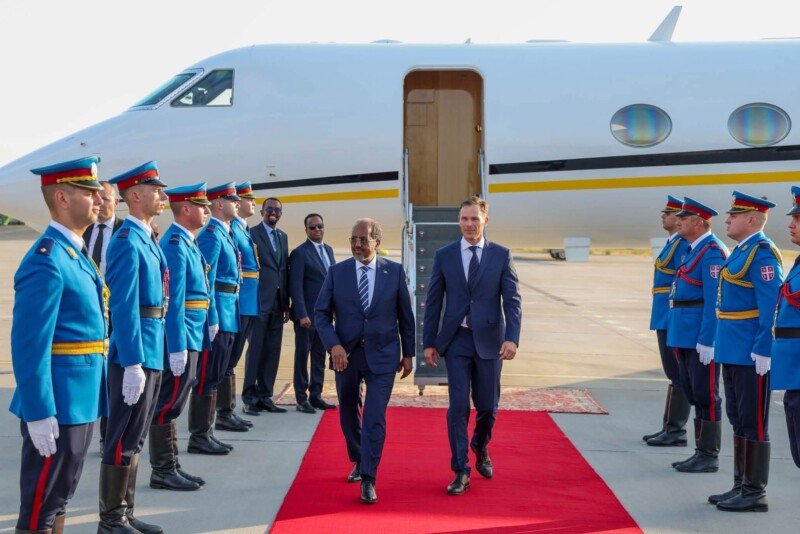
BELGRADE — President Hassan Sheikh Mohamud and his delegation have arrived in Belgrade, Serbia, where they were warmly received by senior officials of the Serbian government. The President is expected to hold talks with his Serbian counterpart, Aleksandar Vučić, on strengthening bilateral relations and cooperation in political and mutual interests.
President Mohamud is also participating in the high-level summit commemorating the 65th anniversary of the First Conference of the Non-Aligned Movement, which was held in Belgrade in 1961. The summit comes as Somalia and Serbia have been deepening their bilateral relationship, with both nations committed to expanding collaboration beyond traditional diplomacy into trade, agriculture, construction, and education .
Somalia and Serbia have recently signed several agreements to strengthen their partnership. In September 2025, the two countries signed a landmark agreement to train Somali diplomats, equipping them with advanced skills to navigate complex global challenges and strengthen Somalia’s representation abroad. Foreign Minister Abdisalam Ali described the signing as a “strategic milestone” that enhances Somalia’s ability to build a modern and professional foreign service .
Deputy Foreign Minister Isaak Mursal met with his Serbian counterpart Damjan Jović in Belgrade to explore fresh opportunities for joint collaboration, with discussions highlighting technology, economic growth, education, and security as priority areas . Both nations recognized the value of harmonizing their foreign policy approaches to promote common interests globally .
Prime Minister Hamza Abdi Barre also visited Belgrade in September 2025, leading a high-level delegation to deepen Somalia-Serbia relations. The visit focused on trade and economic cooperation, security collaboration, and cultural and educational exchanges .
Defense cooperation has also been a key pillar of the relationship, with Minister of Defence Ahmed Moallim Fiqi holding high-level discussions with his Serbian counterpart Bratislav Gašić to advance practical areas of collaboration, including specialized skills training for Somali forces, technology exchange, and joint defense initiatives .
Somali Ambassador to Serbia, Mohamed Abdullahi Ahmed, has overseen the training of elite Presidential Guard officers at the Marshal Tito Training Centre in Belgrade, thanking the Serbian Government for their commitment to strengthening Somalia’s security capabilities. “You are here to learn skills crucial for our country. I ask you to complete this demanding training with honor so you can return prepared to serve Somalia at the highest capacity,” Amb. Ahmed told the officers .
In September 2025, Somalia and Serbia signed a healthcare cooperation agreement, allowing Somali citizens to access medical treatment in Serbia while also promoting training opportunities and knowledge exchange between the two nations .
However, the President’s visit has been overshadowed by a diplomatic controversy at Somalia’s Embassy in Serbia. Leaked audio recordings have surfaced showing a confrontation between two individuals over who has the legal authority to use the embassy building and represent Somalia diplomatically in Belgrade .
The recording center on questions of official appointment, diplomatic authority, and control of the Somali Embassy in Belgrade . The two parties in the leaked audio file, are H.E. Mohamed Abdullahi Ahmed as Somalia’s Ambassador, and ‘Galad’, the new consular, appointed by the Ministry of Foreign Affairs.
Another major point of contention concerns the embassy building itself, with both men disputing who leased the property and who has control over the facility .
Critical Note
The leaked audio scandal at Somalia’s Embassy in Serbia raises serious questions about the management of Somalia’s diplomatic missions abroad. The dispute over who has the legal authority to represent Somalia in Belgrade suggests a breakdown in communication and coordination within the Ministry of Foreign Affairs. The government must provide clarity on the situation and address any administrative or diplomatic disagreements to prevent further damage to Somalia’s international reputation.
The timing of the scandal, during a high-level summit attended by the President, is particularly damaging. It suggests that the Ministry of Foreign Affairs has lost control over its own diplomatic appointments and embassy administration. Without a swift and transparent response, the incident could undermine Somalia’s credibility in its international engagements.
The international community should encourage Somalia to address these administrative issues promptly and to ensure that its diplomatic missions are managed professionally and in accordance with international norms.