
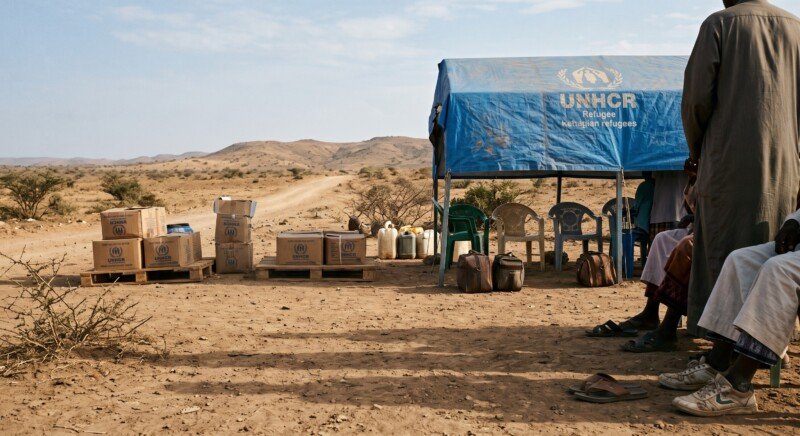
GENEVA — More than 23,000 Ethiopian refugees and asylum-seekers are currently residing in Somalia, according to new data released by the UN Refugee Agency (UNHCR), as displacement across the Horn of Africa continues to grow.
According to a UNHCR report published on August 28, 2026, data collected up to the end of July 2026 shows that a total of 155,000 Ethiopians are living as refugees or asylum-seekers across six neighboring countries. Somalia hosts 23,645 Ethiopian refugees, making it the third-largest host country after Sudan (63,954) and Kenya (43,348). Djibouti hosts 15,310, South Sudan hosts 8,484, and Eritrea has registered 15 Ethiopian refugees.
Conflict, insecurity, and natural disasters remain the primary drivers of displacement across the region. The data reflects the broader humanitarian crisis in the Horn of Africa, where more than 506,600 outward movements were recorded along the Eastern Route toward Yemen and the Gulf during the latest reporting period, representing an 18% increase from the previous year.
According to UNHCR’s Regional Bureau for Eastern and Southern Africa, migration along the Eastern Route is rarely a straightforward journey, with many migrants and refugees spending months or even years in Somalia and Djibouti before attempting to cross the Red Sea. The report states that “journeys are rarely linear: people pause, change course, or remain in Djibouti and Somalia for months or years, depending on their access to protection, legal status and resources.”
The displacement of Ethiopians is part of a broader pattern of conflict and political exclusion in the region. The Ogaden National Liberation Front (ONLF) has highlighted the enduring grievances of the Somali population in Ethiopia’s Somali Region, where decades of political exclusion, militarization, and economic hardship have contributed to instability and displacement [citation:1].
Within Ethiopia itself, UNHCR reports that approximately 1.1 million refugees and asylum-seekers are currently residing, with the majority coming from South Sudan (483,769), Somalia (362,091), Eritrea (171,362), and Sudan (97,985). Ethiopia also hosts 5,674 Kenyan refugees and 2,507 Yemeni refugees.
Beyond refugees, Ethiopia has nearly 1.9 million internally displaced persons, with approximately 1.7 million displaced by conflict and insecurity and nearly 173,000 by natural disasters. UNHCR has also registered 996 Ethiopian refugees who returned to their country in 2026.
Conflict and insecurity in Ethiopia, particularly in the Oromia, Amhara, and Tigray regions, combined with limited documentation and economic opportunities, continue to push people to leave the country. Trafficking networks operating along the Eritrea–Tigray–Addis Ababa–Afar–Djibouti corridor expose migrants, particularly young adults, to extortion and abuse.
The UNHCR data also reveals that refugees in Eastern and Southern Africa remain in exile for a median period of almost 16 years, underscoring the urgent need to expand solutions. Children and young adults are among the most affected, with refugees registered before the age of five remaining in asylum for a median of over 18 years.
Ethiopia itself is also facing a mounting humanitarian crisis due to renewed conflict, climate shocks, and cross-border displacement, with more than 150,000 people displaced during the first three months of 2026 alone. The UN Population Fund reported that the convergence of crises is placing severe strain on already stretched health services, with women and girls among the most affected.
Critical Note
The UNHCR data highlights the significant and often overlooked role Somalia plays as a host country for refugees from neighboring Ethiopia. While Somalia is frequently portrayed solely as a source of displacement, the country has become a destination for thousands of Ethiopians fleeing conflict and instability. This reality challenges the simplistic narrative of Somalia as merely a country of origin for refugees and underscores the complex dynamics of displacement in the Horn of Africa.
However, Somalia’s capacity to host refugees is severely constrained by its own humanitarian and security challenges. With millions of Somalis themselves displaced and facing acute food insecurity, the presence of over 23,000 Ethiopian refugees adds additional strain to already overstretched resources. The international community must recognize Somalia’s role as a host country and provide adequate support to both refugees and host communities.
The broader regional context, with over 155,000 Ethiopian refugees across six countries, underscores the need for a coordinated regional response to displacement. The long duration of exile, with refugees remaining in asylum for a median of 16 years, highlights the failure of the international community to find durable solutions. Without sustained investment in protection, livelihoods, and solutions, the cycle of displacement and dependency is likely to continue.