
JERUSALEM – Somaliland President Abdirahman Mohamed Abdullahi (Irro) paid respects at two of Israel’s major historical sites on the first day of his inaugural state visit to the territory, as both sides highlight a growing diplomatic relationship that has drawn strong criticism from Somalia and numerous Muslim countries.
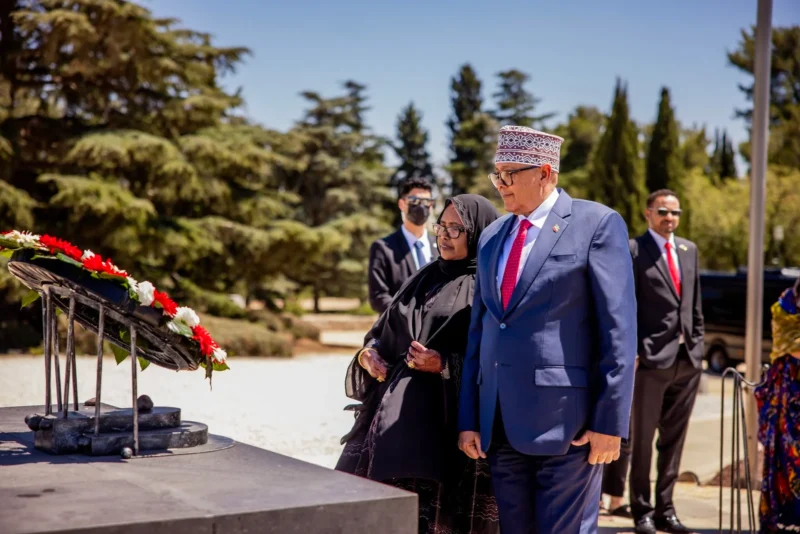
On Sunday, Irro placed a wreath at the tomb of Theodor Herzl, the founder of modern political Zionism, on Mount Herzl before visiting Yad Vashem, Israel’s Holocaust memorial, according to a statement from his office. At Yad Vashem, officials presented Irro with accounts of the Holocaust, guiding him through the history of the atrocity and the events that shaped it. The Somaliland leader also went to the Grove of Nations, where he planted a tree that his office described as a symbol of friendship, cooperation and enduring relations between Somaliland and Israel. The statement said the tree represents a living bond meant to outlast the visit and mark a historic friendship that strengthens ties between the two sides.
Landmark Visit Shadowed by Legal Doubt
Irro arrived in Jerusalem for his first state visit to Israel, where he held a joint press conference with Israeli President Isaac Herzog. “We are deeply appreciative that the State of Israel has chosen to receive us with such an honour on this historic occasion. Through this gesture, Israel has joined a moment that will be remembered in the diplomatic history of our nation, and we do not take it lightly,” he said.
“For the past 35 years, Somaliland has been speaking with and reaching out to world leaders. They asked only one question: to see us. Only one country wished to see us and recognise Somaliland, and that is the government of Israel and its people,” Irro added.
Herzog, addressing the same press conference, spoke at length about the relationship between the two nations. “The sight of people in Somaliland waving Israeli flags in celebration of this new relationship warmed all of our hearts, Mr President. Today, we are equally delighted to see the flags of Somaliland flying here at the President’s Residence and throughout Jerusalem,” he said. Herzog described the visit as a sign of the “great potential of this wonderful new partnership,” citing shared concerns over “radical extremism” and the need for “security and stability in the region and in the Horn of Africa.” He described Somaliland’s separate administration from the rest of Somalia as “a reality on the ground for several decades,” wording that aligns with Israel’s formal recognition of the territory in December 2025.
However, the diplomatic breakthrough remains on shaky legal ground. Former Somali intelligence chief Fahad Yasin has argued that the recognition has no legal weight, noting that it was not passed by the Israeli executive or the Knesset and that it has no basis in Israel’s own charters or laws. “If Netanyahu leaves office or any new developments occur in the region, a new decree could be issued to reverse it, or it could simply be ignored,” Yasin wrote.
‘A Trap, Not a Diplomatic Breakthrough’
The visit came just days after Somalia’s President Hassan Sheikh Mohamud strongly criticised Israel’s recognition of Somaliland, calling it not recognition but a “trap” designed to advance Israel’s security interests against Iran-aligned Houthi forces and pull Somalia into a war that is not its own. He has previously described Israel’s recognition as “one of the darkest days in Somalia’s history” and said Mogadishu had considered using force but ultimately chose dialogue and persuasion. He warned of a looming threat to the country from the move, saying its early signs were already visible.
President Mohamud has repeatedly cautioned that Israel’s engagement with Somaliland risks importing the Middle East’s conflicts into the Horn of Africa. In an interview with TRT World, he said Somalia has never attacked Israel and does not want Israeli‑related conflicts brought to Somali soil, calling the situation deeply regrettable. He further vowed that Somalia would “confront any Israeli forces coming in” if Tel Aviv attempted to establish a military base in the breakaway region.
Controversial Embassy Opening and International Condemnation
Irro is also scheduled to open an embassy that Somaliland has established in Jerusalem, making it the second Muslim-majority territory to do so, a move condemned by 19 Muslim-majority countries. Somaliland will become only the second Muslim‑majority entity to open an embassy in Jerusalem after Kosovo, a choice that has been widely criticised as an unacceptable provocation. The decision has drawn a furious response from 16 Arab and Islamic nations, which issued a joint statement condemning the move as “illegal, unacceptable, and a flagrant violation of international law and United Nations resolutions.”
The Organisation of Islamic Cooperation has denounced the action as a “clear defiance of the international community’s will” and a “serious breach of the United Nations Charter and relevant resolutions.” The African Union has also strongly condemned Israel’s unilateral recognition of Somaliland and called for its immediate revocation, reaffirming that Somaliland remains an integral part of Somalia.
Strategic Calculations and Security Concerns
For Somaliland, the visit is a calculated gamble. President Irro has indicated that Somaliland is prepared to offer Israel rights to valuable mineral deposits in exchange for technology and investment, and the delegation is arranging meetings with Israeli business leaders to attract foreign investment to the territory.
Israel, for its part, sees Somaliland as a strategic partner near the Bab al‑Mandeb Strait. The growing relationship has also been marked by reports of secret military cooperation. A CNN investigation revealed that Somaliland provided Israel with a covert military position during the recent war with Iran, allowing Israeli aircraft a potential stopping point on long‑range missions. Investigative outlet Drop Site News has further reported that Israel has established an intelligence presence at Berbera International Airport and is holding ongoing discussions about the possible creation of an Israeli military base.
The visit underscores how a decades‑old separatist dispute is now intersecting with the volatile geopolitics of the Middle East. For Mogadishu, the embassy opening and the deepening security ties represent the realisation of its worst fears: that Israel is using Somaliland’s quest for recognition to insert itself into the Horn of Africa, bringing with it the conflicts of the Middle East and exposing Somali territory to retaliation by the Houthis and Iran.
Recommended Reading On ftlsomalia.com:
- Somaliland President Opens Embassy in Israel
- Somalia President Calls Israel’s Recognition of Somaliland a ‘Dark Day’
- Mogadishu Cautions Israel Over Somaliland Engagement
- President Mohamud Threatens to ‘Confront’ Any Israeli Military Presence in Somaliland
- The Somaliland Recognition Crisis: Israel Stands Alone Amid Global Condemnation
- Somaliland to Open Jerusalem Embassy as Second Muslim Nation in Israel Deal