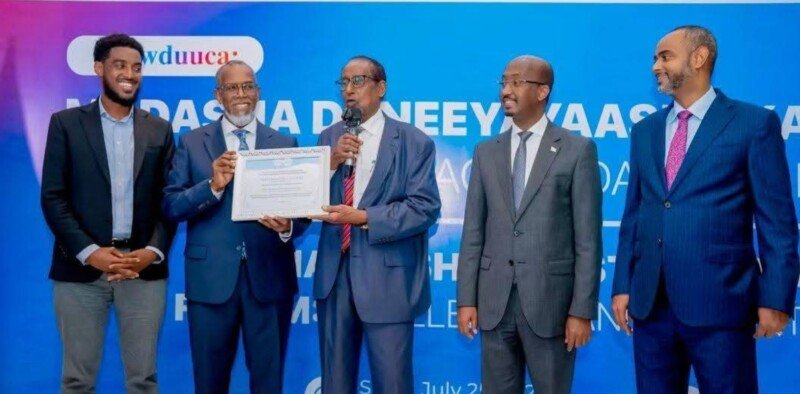

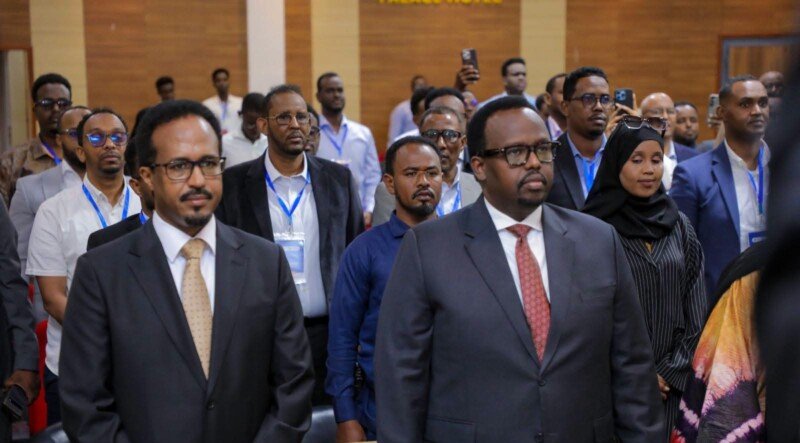
MOGADISHU – Deputy Prime Minister Salah Ahmed Jama has officially opened the National Trade Facilitation Committee (NTFC) capacity-building and operational planning workshop in Mogadishu, reaffirming the government’s commitment to removing trade barriers and accelerating economic growth as part of the National Transformation Plan (NTP) 2025–2029.
The workshop, which brought together representatives from the East African Community (EAC) and other stakeholders, focuses on harmonising trade regulations, strengthening quality standards and infrastructure, and eliminating barriers that hinder trade and increase costs. The Deputy Prime Minister emphasised that trade facilitation is a critical pillar for implementing the NTP and plays a key role in boosting the economy, encouraging investment, and enhancing the country’s trade competitiveness.
A Strategic Priority for Economic Transformation
The National Transformation Plan (NTP 2025–2029) is a comprehensive five-year strategy designed to accelerate Somalia’s progress toward economic growth, good governance, social development, and environmental resilience. The plan focuses on transformational governance, sustainable economic transformation, social and human capital development, and environmental and climate resilience. Trade facilitation is central to the sustainable economic transformation pillar, aiming to create a competitive economy built on domestic production.
The plan was officially launched in March 2025 and represents a strategic shift from traditional development to large-scale national transformation. The Deputy Prime Minister’s remarks underscored the importance of aligning trade policies with the NTP’s broader objectives.
Deepening Regional Integration
Somalia formally became the eighth member of the East African Community in March 2024, marking a significant step in its diplomatic and economic trajectory. Since then, the government has prioritised harmonising policies with the bloc to open new opportunities for investment, trade, and regional partnerships. The Deputy Prime Minister noted that intra-African trade remains below target and called on Somalia to prioritise strengthening trade with its neighbours and investing in sectors where it holds a competitive advantage, particularly fisheries.
Somalia and Kenya are currently engaged in discussions to establish a trade facilitation agreement aimed at addressing and eliminating irregular non-tariff barriers that have been impacting their trade relations. President Hassan Sheikh Mohamud has previously reaffirmed Somalia’s commitment to regional unity, noting that accession to the EAC marked a transformative step toward rebuilding its economic influence.
The Private Sector and Sustainable Growth
The Deputy Prime Minister stressed that sustainable economic growth depends on strengthening the role of the private sector, aligning trade and industrial policies, increasing value addition to domestic production, and building a competitive economy based on domestic production. The World Bank-funded SPRING project, valued at $105 million, focuses on advancing the nation’s economic development via private-sector-led expansion and more job opportunities. The Commerce Minister has previously met with business leaders to promote industrial development, with a special emphasis on improving import-export logistics.
The NTFC workshop is a critical step in Somalia’s efforts to align with international best practices on trade facilitation. The committee has previously examined strategies for simplifying licensing processes, reducing clearance times at ports and borders, and fostering closer collaboration between public agencies and the private sector. The National Trade Facilitation Committee has also been central to Somalia’s bid for accession to the World Trade Organization (WTO), with discussions focusing on necessary reforms to align Somalia’s trade policies with WTO standards.
Way Forward
The NTFC workshop marks an important step in Somalia’s efforts to streamline trade, attract investment, and integrate more deeply into regional and global markets. The Deputy Prime Minister’s call for harmonised regulations, improved quality infrastructure, and the removal of trade barriers reflects the government’s recognition that trade facilitation is not merely a technical exercise but a strategic imperative for economic transformation. However, Somalia’s trade infrastructure is still underdeveloped, and the private sector faces significant challenges, including weak institutions, limited access to finance, and persistent insecurity. The success of the NTFC’s work will depend on the government’s ability to translate its commitments into tangible reforms that benefit Somali businesses and consumers.
Recommended Reading On ftlsomalia.com
- A Trade Facilitation Agreement between Somalia and Kenya is in the Offing
- Arusha Summit Concludes with Key Infrastructure Projects Approved for East African Community
- Egeh Unveils Somalia’s SPRING Project to Push Economic Growth
- Somalia Announces Plans to Advance Trade Reforms at Key Technical Meeting
- Somalia’s Second Deputy PM Chairs Discussions on WTO Bid