
MOGADISHU – Somalia’s fisheries sector is at a critical juncture. The Somali Marine Science and Research Organisation (HCBS), in partnership with Magan Forum, convened a high-level stakeholder forum in Mogadishu to assess the challenges and opportunities facing the industry. The forum comes as the government deepens its strategic partnership with Turkey in the blue economy, raising questions about sovereignty, transparency, and the balance between foreign investment and local benefit.
The forum brought together senior federal officials, including Ports and Maritime Transport Minister Abdulkadir Mohamed Nur, Fisheries and Blue Economy Minister Ahmed Hassan Adan, and Mogadishu Port Director General Mohamed Ali Nur (Ameriko). Experts, researchers, businesspeople, fishermen, and other stakeholders also participated. The discussions focused on strengthening stakeholder cooperation, improving fish production, protecting marine resources, and advancing the blue economy as a pillar of national development.
A Sector Under Pressure
During the forum, HCBS presented research on the state of Somalia’s marine resources, highlighting the growing threats to the marine environment. The importance of protecting marine biodiversity and implementing sustainable management practices to safeguard resources for present and future generations was strongly emphasized.
Somalia has Africa’s longest coastline, stretching over 3,300 kilometers, and its waters are among the richest fishing grounds in the region. Yet the sector remains underdeveloped. The sector contributes an estimated 2-3 percent of GDP, a fraction of its potential. Illegal, unreported, and unregulated (IUU) fishing by foreign vessels continues to deplete stocks, while local fishermen lack access to markets, finance, and modern equipment. President Hassan Sheikh Mohamud has stated that more than a thousand vessels are currently fishing illegally in Somali waters.
The government has made some progress. The Fisheries Management and Development Law of 2023 provides a legal framework for sustainable management. A strategic cooperation agreement signed in December 2025 between Somalia’s Fisheries Ministry and Turkey’s OYAK Group established SOMTURK as a joint venture with exclusive authority over fisheries licensing in Somalia’s Exclusive Economic Zone. The launch event in Mogadishu saw participation from Second Deputy Prime Minister Jibril Abdirashid Haji, who characterized the project as a pivotal advancement for economic growth and the responsible exploitation of Somalia’s oceanic assets.
The Promise and the Peril
Officials have framed the partnership as transformative. The government projects the sector could generate significant revenue and create thousands of jobs. The agreement aims to increase fish production, establish domestic processing facilities, enhance the technical capacity of Somali fishermen, and create thousands of jobs, particularly for youth and populations in coastal regions. It is also expected to strengthen Somalia’s maritime surveillance and enforcement capacity.
Yet the deal has drawn sharp criticism. In July 2026, Puntland issued a formal statement rejecting any Turkish maritime operations off its coastline, specifically barring the Turkish company SOMTURK from conducting any fishing activities within Puntland’s territorial waters without prior approval. The administration argued that the Federal Government lacks the legal authority to grant concessions covering Puntland’s seas and land territory. Puntland has previously expressed strong criticism of Turkey’s role in Somalia, with State Minister for Information Mohamud Aided Dirir characterising Turkey’s engagement as motivated by self-interest.
The concerns are not limited to federal-state tensions. Somalia’s fisheries sector has long been plagued by weak institutions, limited enforcement capacity, and pervasive corruption. Somalia has been urged to implement measures to combat corruption and ensure that revenues from the fisheries sector are used for public benefit. The risk that SOMTURK could become another vehicle for elite capture rather than genuine development is real.
A Partnership of Convenience
Turkey’s expanding role in Somalia has been a cornerstone of Ankara’s Africa strategy since President Erdogan’s landmark visit in 2011. Turkish firms already manage Mogadishu Port and Aden Adde International Airport, and Turkey has invested over $1 billion in Somalia through aid, development projects, and economic partnerships. A Turkish delegation recently visited Mogadishu to discuss investments in the fisheries sector, and high-level meetings have been held to advance bilateral cooperation in sustainable fisheries and aquaculture.
Turkish naval vessels are currently escorting and protecting a drilling fleet operating off the Somali coast, including the Cagri Bey ultra-deep-sea drillship, which began its inaugural international deep-water energy operation in early 2026. Turkish warships have been providing security for the vessel and its crew. The Turkish parliament has approved a two-year extension of Turkey’s military mission in Somalia, authorizing Turkish forces to continue providing training and advisory support, including operations against illegal fishing.
But the relationship is not one of equals. Turkey’s access to Somali waters, considered among the world’s most abundant fish reserves, is matched by a concentration of control that raises questions about sovereignty and long-term benefit. The exclusive licensing authority granted to SOMTURK means that a Turkish military-affiliated entity now holds the keys to Somalia’s maritime wealth. The revenue model is designed to support OYAK’s pension fund objectives, not necessarily Somalia’s long-term development.
Way Forward
The stakeholder forum in Mogadishu and the deepening partnership with Turkey reflect both the potential and the peril of Somalia’s blue economy ambitions. The government has an opportunity to transform a sector that has long been neglected, but it must do so with transparency, accountability, and a genuine commitment to local benefit.
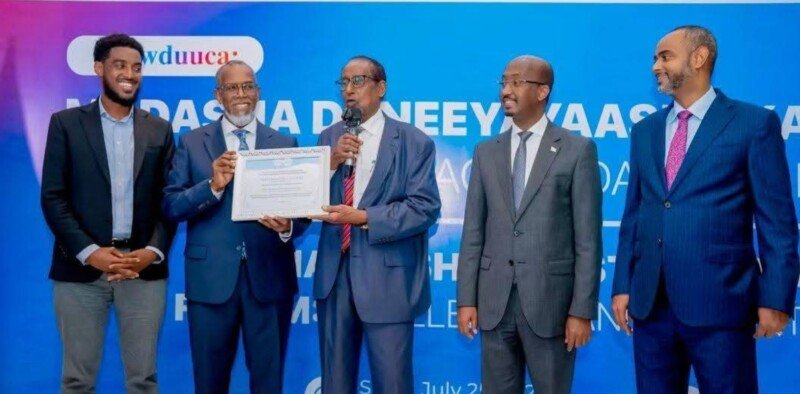
In closing the forum, HCBS Chairman Professor Farah Ahmed Omar presented honorary certificates to Minister Abdulkadir Mohamed Nur, Minister Ahmed Hassan Adan, and Mogadishu Port Director General Mohamed Ali Nur, commending their roles in advancing fisheries, the blue economy, port development, and the strengthening of Somalia’s maritime laws and governance. The recognition is a reminder that progress is possible, but it will require more than certificates and ceremonies.
For the partnership to deliver on its promises, the Somali government must ensure transparency in revenue management, address the corruption that has historically plagued the sector, and engage with federal member states like Puntland rather than imposing agreements from Mogadishu. Without these safeguards, the blue economy risks becoming another source of contention rather than a foundation for recovery.
Recommended Reading On ftlsomalia.com
- Somalia Partners with Turkey’s OYAK to Advance the Blue Economy
- Turkish Delegation Arrive in Somalia for Talks on Investments in Fisheries Sector
- Somalia and Türkiye Strengthen Ties in Marine Sector Development
- Somalia, Türkiye Ink Deal to Boost Fishing Sector
- Turkish Parliament Approves Two-Year Extension of Military Mission in Somalia
- Puntland Invokes Constitutional Authority to Reject Turkish Maritime Operations