
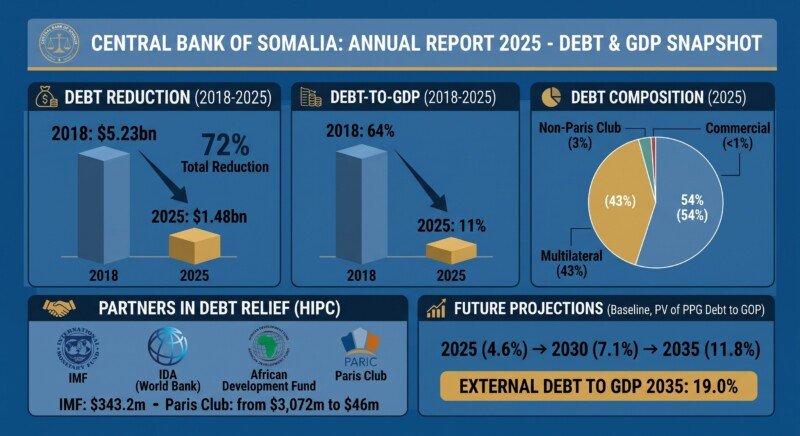
MOGADISHU — Somalia’s external public debt has undergone a historic transformation, declining from $5.23 billion in 2018 to $1.48 billion in 2025, while the external debt-to-GDP ratio fell from 64 percent to 11 percent over the same period .
The dramatic reduction follows Somalia’s attainment of the Completion Point under the Enhanced Heavily Indebted Poor Countries (HIPC) Initiative on December 13, 2023. The milestone marked the culmination of more than a decade of reforms aimed at strengthening macroeconomic management, public financial governance, fiscal transparency, and institutional capacity .
Total debt service savings for the country amounted to $4.5 billion, with debt relief provided by the IMF ($343.2 million), IDA ($448.5 million), African Development Fund ($131.0 million), other multilateral creditors ($573.1 million), as well as bilateral and commercial creditors ($3.0 billion). Bilateral creditors include members of the Paris Club, creditors from the Arab Coordination Group, and other official bilateral creditors .
According to the Central Bank of Somalia’s Annual Report for 2025, total external debt declined from $5,311 million in 2019 to $1,482 million in 2025, representing a cumulative reduction of approximately 72 percent. The composition of the debt portfolio changed significantly during the review period. Paris Club debt declined sharply from $3,072 million in 2019 to just $46 million in 2025, reflecting the successful implementation of debt relief agreements. Multilateral debt also fell from $1,530 million to $634 million during the same period.
By 2025, non-Paris Club creditors accounted for 54 percent of total debt, multilateral institutions for 43 percent, Paris Club creditors for 3 percent, and commercial creditors for less than 1 percent. The remaining debt stock is increasingly concentrated among non-Paris Club and multilateral creditors, with the non-Paris Club debt reflecting ongoing bilateral negotiations, as these creditors are not part of the coordinated Paris Club debt relief framework.
At the end of the third quarter of 2025, the total debt portfolio amounted to $1.4 billion, with multilateral creditors accounting for 42 percent ($604.14 million) and bilateral creditors for $838.88 million. The main non-Paris Club creditors include Arab creditors such as the Abu Dhabi Fund, the Government of Iraq, the Kuwait Fund, and the Saudi Fund .
Debt relief under the HIPC Initiative has provided Somalia with access to critical additional financial resources to strengthen the economy, reduce poverty, and promote job creation. The external debt-to-GDP ratio fell from 64 percent in 2018 to less than 6 percent by the end of 2023, and stood at approximately 11 percent in 2025 .
The Somalia authorities have remained firmly committed to sustaining the reform momentum post-HIPC to build resilience, promote inclusive growth, and reduce poverty. The IMF and World Bank continue to work together to provide the technical assistance and policy guidance the authorities need to achieve these goals. The IMF will continue its engagement with Somalia in the context of the new three-year IMF financial arrangement .
Somalia’s successful debt relief process has been “nearly a decade of cross-governmental efforts spanning three political administrations,” according to President Hassan Sheikh Mohamud. “This is a testament to our national commitment and prioritization of this crucial and enabling agenda.”
However, the World Bank and IMF have warned that Somalia’s capacity to absorb shocks remains “weak.” The reliance on external financing remains significant, covering nearly 65 percent of the budget, and external grants proved volatile in early 2025, declining by 51 percent from $166 million in 2024Q2 to just $82 million in 2025Q2 .
Somalia’s fiscal position remains fragile. Domestic revenue currently stands at a meager 2.6 percent of GDP, contrasting sharply with the African average of 15 percent, while security expenditures consume approximately 64 percent of this revenue. The ongoing concentration of tax collection authority solely within the Benadir Regional Administration, excluding full fiscal federalization with Federal Member States, poses a critical threat to the Federal Government’s stability and legitimacy .
In the baseline, external debt is projected to rise gradually, reaching 11.3 percent of GDP by 2030 and 19.0 percent by 2035, driven largely by a shift from grants to concessional loans. The PV of PPG external debt to GDP is forecast to rise from 4.6 percent of GDP in 2025 to 7.1 percent in 2030 and 11.8 percent in 2035—well below the indicative threshold of 30 percent .
Critical Note
The reduction of Somalia’s external debt from $5.23 billion to $1.48 billion represents a historic achievement that restores debt sustainability and offers access to new external financing to support inclusive growth and poverty reduction. The debt relief process, spanning three political administrations, demonstrates the potential for sustained reform when there is political commitment and international support.
However, the fragility of Somalia’s fiscal position remains a significant concern. Domestic revenue currently stands at a meager 2.6 percent of GDP, contrasting sharply with the African average of 15 percent, while security expenditures consume approximately 64 percent of this revenue. The reliance on external financing, covering nearly 65 percent of the budget, proved catastrophically volatile in early 2025, with external grants declining by 51 percent .
The IMF projects that external debt will rise gradually, reaching 19.0 percent of GDP by 2035, driven largely by a shift from grants to concessional loans. The government must ensure that new borrowing is undertaken prudently and transparently, and that the resources are used effectively to build resilience, promote inclusive growth, and reduce poverty. Without sustained commitment to institutional reforms and fiscal discipline, the risk remains that Somalia could once again fall into a debt trap.