
DOHA — Somalia and Qatar have signed a landmark cooperation agreement to establish the Somali University of Technology (TUS University), a significant step toward expanding and modernizing Somalia’s higher education sector.
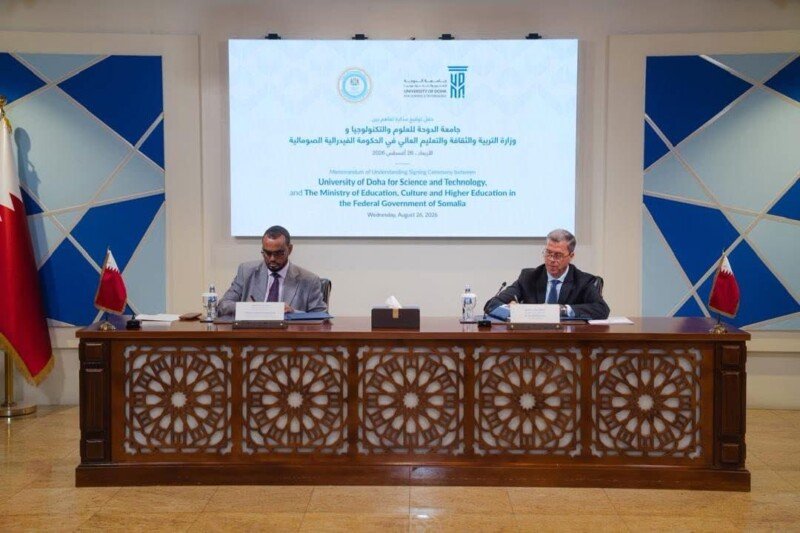
The agreement was signed between Somalia’s Ministry of Education, Culture and Higher Education and the Doha University of Science and Technology (UDST) in Doha. Under the agreement, UDST will support curriculum development, faculty training, quality assurance and accreditation for the new university.
The university’s first phase will focus on technology, marine sciences, aviation, petroleum, engineering, energy and healthcare management, creating new opportunities for Somali youth and building skills needed for the country’s economic and technological growth. A key focus will be developing Somali academics and future university leaders, strengthening local teaching, research and administrative capacity.
The project is aligned with the National Transformation Plan 2025–2029 and represents a major investment in Somalia’s knowledge economy, human capital and future workforce. The agreement was signed by Mohamed Abdullahi Mahmoud, Director General of Higher Education, and Prof. Rashid Benlamri, UDST Vice President for Academic Affairs.
The agreement comes as Prime Minister Hamza Abdi Barre continues his official visit to Qatar, where he has been discussing broader bilateral cooperation, including investment in education and human capital development. The Qatari Emir has reaffirmed his country’s commitment to supporting Somalia’s security, stability, and development.
The university agreement follows a recent MoU between Somalia and Qatar to establish the National Academy of Somalia, a planned centre for developing leadership and improving the quality of civil service. Foreign Minister Abdisalam Abdi Ali held a meeting at the Qatar Leadership Centre in Doha with officials from the centre, focusing on Qatar’s potential involvement in implementing the academy.
The bilateral relationship between Somalia and Qatar has deepened significantly in recent years. In January 2026, Somalia and Qatar signed a Defence Cooperation Agreement in Doha, aimed at strengthening military ties and security collaboration between the two countries. The agreement, described as “historic” by Defence Minister Ahmed Moallim Fiqi, focuses on military training, the exchange of expertise, the development of defence capabilities, and enhanced security cooperation.
The two countries have established a joint committee and finalised strategic agreements, with the inaugural session jointly led by Somalia’s Foreign Minister Abdisalam Abdi Ali and Qatar’s Minister of State for Foreign Affairs, Soltan bin Saad Al-Muraikhi. The high-level discussions concluded with the signing of four comprehensive agreements targeting development in cultural, financial, youth, and agricultural sectors.
President Hassan Sheikh Mohamud visited Doha in February 2026 for high-level talks focused on strengthening bilateral relations in security, economic development, and political stability. The visit formed part of a wider diplomatic initiative to expand international partnerships following Somalia’s termination of agreements with the UAE.
President Mohamud has also engaged in high-level telephone discussions with Qatar’s Emir, with the Emir reaffirming Qatar’s full support for Somalia’s legitimate institutions and its commitment to enhancing the country’s security and stability. Doha has emerged as one of Mogadishu’s most critical partners since diplomatic relations between Somalia and the UAE deteriorated.
The establishment of the Somali University of Technology is expected to create significant opportunities for Somali youth in science, technology, innovation, and research, contributing to the country’s long-term development and economic growth.
Critical Note
The agreement to establish the Somali University of Technology with Qatar’s support represents a significant investment in Somalia’s higher education sector and human capital development. The focus on technology, marine sciences, aviation, petroleum, engineering, energy and healthcare management aligns with the country’s emerging economic needs, including the growing energy sector and the planned spaceport project.
However, the effectiveness of this initiative will depend on implementation. Somalia has signed numerous agreements with international partners, but the translation of these commitments into tangible improvements in education and service delivery has often been slow. The government must ensure that the university is established with clear objectives, adequate resources, and strong institutional backing to avoid becoming another symbolic project that fails to deliver meaningful change.
The partnership with Qatar reflects Somalia’s broader strategy of diversifying its international partnerships, but this must be balanced with a commitment to building on existing successes and ensuring that the university serves the long-term interests of the Somali people, rather than becoming a tool for political or diplomatic purposes.