
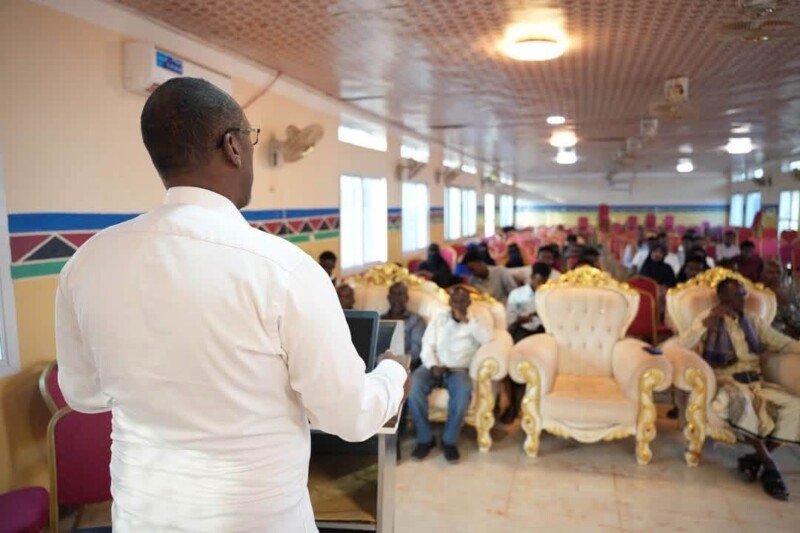
BALANBALLE – The National Independent Electoral and Boundaries Commission (NIEBC) has launched a training programme for election day workers in the Balanballe district of the Galgaduud region, as Galmudug State prepares for its first-ever one-person, one-vote elections. The training, which was officially opened by NIEBC Commissioner Mohamed Omar Sanatar, is part of ongoing efforts to prepare polling staff across Galmudug’s 11 districts.
Sanatar, who opened the training, urged participants to take full advantage of the programme, which focuses on electoral procedures, polling station management, and the integrity of the voting process. The training comes as Galmudug is set to hold local council and parliamentary elections on July 25, 2026, with 215,860 individuals enrolled and issued voting cards across the Galgaduud and Mudug regions. The elections mark a historic shift from the clan-based power-sharing system that has long characterised Somali politics.
A Training Programme with High Stakes
The Balanballe training is one of several initiatives the NIEBC has rolled out across Galmudug to ensure that election day staff are adequately prepared. The commission has previously launched specialised training workshops for journalists and other stakeholders ahead of elections. In April 2026, the NIEBC began training poll workers in key regions, focusing on voter registration procedures, polling station management, vote counting, and ensuring transparency throughout the electoral process.
The Balanballe training is particularly significant given the district’s history. Balanballe has been a flashpoint for clan conflicts and Al-Shabaab activity, and the successful conduct of elections there will be a test of the government’s ability to extend its authority to remote areas.
Political Context and Concerns
The training comes amid a backdrop of political tension and controversy surrounding the Galmudug elections. The NIEBC has rejected calls from political parties to delay the vote, citing the need to adhere to the electoral calendar. However, the decision has raised concerns about the credibility of the process, with critics arguing that the compressed timeline disadvantages candidates who lack resources and federal backing.
The federal government has also come under scrutiny for its role in the electoral process. Galmudug President Ahmed Abdi Kariye (Qoor-Qoor) withdrew from the presidential race following talks with federal officials, clearing the way for the federal government’s preferred candidate. President Hassan Sheikh Mohamud has designated Liban Ahmed Hassan as the sole candidate for the ruling Justice and Solidarity Party (JSP), bypassing internal party competition and raising concerns about the independence of the electoral process.
A Commission That Follows Orders, Not Principles
The NIEBC’s insistence on adhering to the July 25 date, despite requests for a delay, raises fundamental questions about its independence and commitment to a level playing field. In a region where many voters lack access to information and candidates struggle to reach remote communities, the decision to rush the process serves the interests of well-funded candidates with federal backing, not the voters who deserve meaningful engagement.
The training in Balanballe, while a necessary step, cannot compensate for the broader shortcomings of the electoral process. The NIEBC has been accused of being a rubber stamp for the federal government’s preferences rather than an independent arbiter of a free and fair contest. The refusal to grant additional campaign time, while technically within the commission’s authority, risks alienating political parties and undermining the very democratic principles the election is meant to advance.
Way Forward
The training of election workers in Balanballe is a welcome step toward ensuring that Galmudug’s first one-person, one-vote elections are conducted professionally. However, the credibility of the vote will ultimately depend on the NIEBC’s ability to ensure a level playing field for all candidates and to maintain public confidence in the integrity of the process. Without these safeguards, the training risks being an exercise in box-ticking rather than a genuine contribution to democratic governance.
Recommended Reading On ftlsomalia.com
- Galmudug Electoral Commission Rejects Calls to Delay July 25 Polls
- NIEC Releases Official Timeline for Galmudug State Elections
- Minister of Information and NIEBC Chairman Discuss Galmudug Election Awareness Campaign
- Galmudug President Qoor-Qoor Withdraws from Presidential Race
- President Backs Single Candidate for Galmudug Leadership
- NISA Director Mahad Salad Lays Foundation for New Security Base in Balanballe